
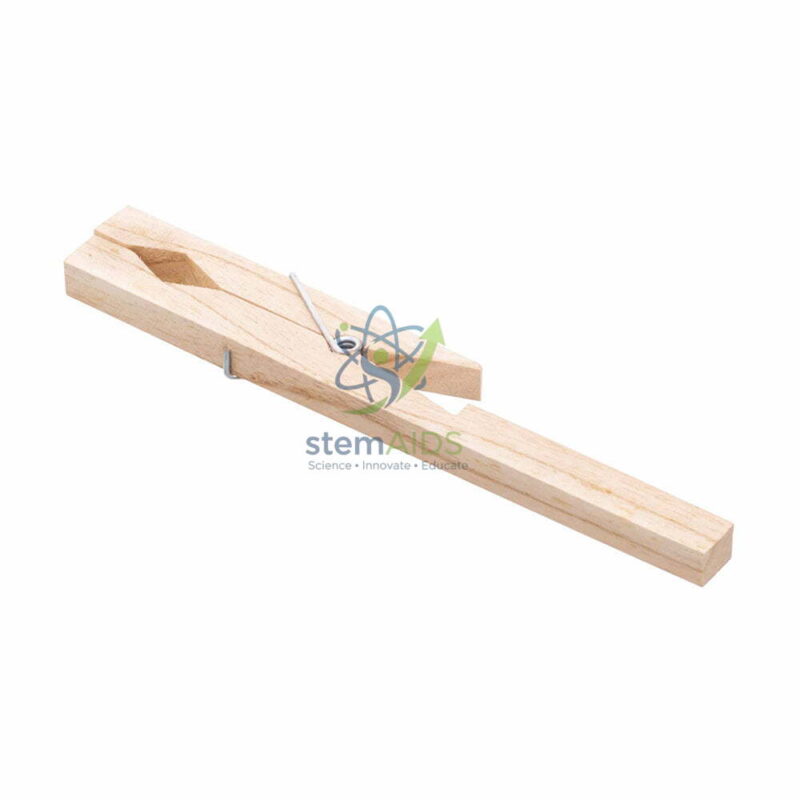
Quick Answer: The Test Tube Holder, Wooden is a wooden test tube holder made of two long wooden arms joined by a spring, like a large clothes peg, as the listing photograph shows. Pressing the handle ends opens the jaws; releasing them grips a test tube near its mouth for heating or carrying.
Why Wood Is Still Used
Wood is a poor conductor of heat, so a wooden holder stays comfortable in the hand while the tube it holds is warmed, and the wide arms are easy for small hands to squeeze. The wooden jaws are also softer than glass and unlikely to scratch or chip a tube, which makes the design popular for younger students.
The spring between the arms supplies the grip. Unlike a scissor-type holder, the jaws close by themselves when released, so a student cannot accidentally loosen them while watching the flame. The photograph shows a V-shaped cut-out in the jaws that cradles the round tube.
Wood has one clear limit: it chars. Keep the jaws near the top of the tube and out of the flame, and choose a wire test tube holder where the tube must be held right over a strong flame. Test the grip with the largest boiling tubes you plan to use, since peg holders have a limited opening.
Care & Handling
- Keep the wooden test tube holder out of the flame; scorched wood weakens and can smoulder.
- Do not soak the holder; wipe it clean and let it dry at room temperature.
- Check the spring each term and replace holders whose spring has rusted or lost tension.
Specifications
| Type | Spring-peg test tube holder |
| Arms | Wood (as titled), V-shaped cut-out at the jaws (as pictured) |
| Spring | Metal spring joining the arms |
| Action | Press the handle ends to open; release to grip |
| Jaw opening | Confirm at enquiry |
Applications
- Warming a small amount of liquid or solid in a test tube in school practicals
- Holding a test tube during the heating stage of food tests in a water bath
- Carrying warm tubes from a water bath to a rack
- Classes of younger students, who find a peg action easier than squeezing wire
Why Choose LabEquip
Primary and middle schools often choose wooden holders because students find them comfortable and intuitive. LabEquip stocks them alongside wire and strip holders in General Lab Products; class quantities can be requested on the contact page.
Frequently Asked Questions
Why use a wooden test tube holder rather than a metal one?
Wood stays cool in the hand and is gentle on glass. It suits younger students and practicals where tubes are warmed rather than heated strongly.
Can the wooden holder go into the flame?
No. Wood chars and can smoulder. Grip the tube near its mouth so the holder stays well above the flame.
How do I open it?
Press the two handle ends together, as with a clothes peg. The jaws open; place the tube between them and release.
Why does the spring rust?
The spring is usually steel, and repeated washing or storage in a damp room makes it rust. Wipe holders dry and store them in a dry drawer.
Can it hold a boiling tube?
Only if the jaws open wide enough for the wider tube. Test one boiling tube in the holder before a practical and use a larger holder if it is tight.
How long does a wooden holder last?
With the jaws kept out of the flame and the holder kept dry, it lasts many terms. Replace it when the jaws are charred or cracked, or the spring no longer grips firmly.
Last Updated: September 2026




Reviews
There are no reviews yet.