
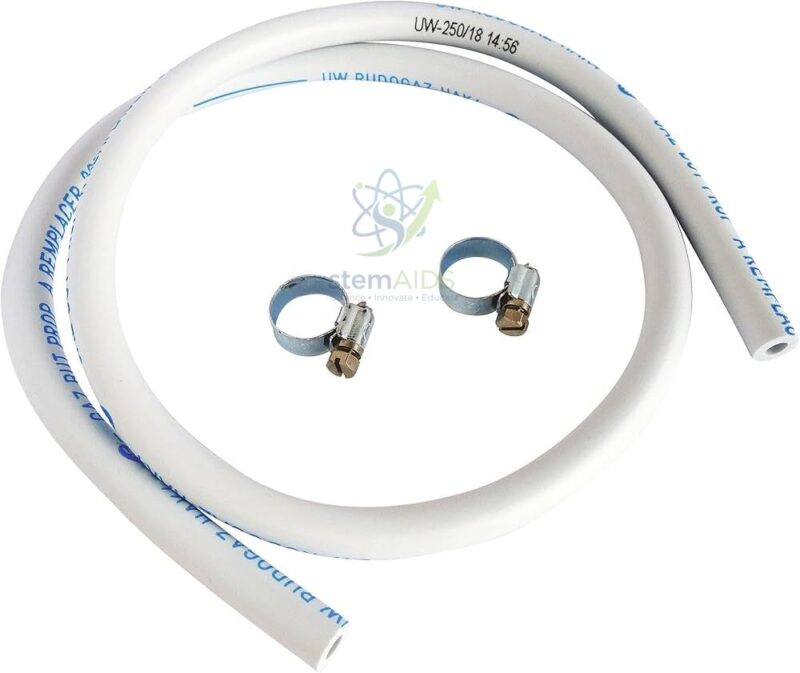
Quick Answer: The standardized gas pipe is a flexible gas hose, shown in white with printed markings and two clamps, that connects a laboratory burner to a gas tap or regulator. Its title lists it for butane, propane or natural gas.
What the Gas Pipe Connects and Why the Hose Matters
Every Bunsen, Meker or Teclu burner on a laboratory bench needs a flexible link between its inlet and the fixed gas supply. This hose is that link. It slides over the ribbed nozzle at each end and is held with a clamp, and its flexibility lets the burner be moved a short distance across the bench without strain on the tap.
The title describes the pipe as ‘standardized’. In gas fitting, the word is used for hose made to a published gas-hose specification, which is normally identified in the printing along the hose, as visible in the photo. This page does not name a specification, so ask LabEquip for the marking details if your local rules require a particular one. On many gas hoses that printing also includes a replacement date, the simplest guide for planning renewals.
Butane and propane come from cylinders or cartridges through a pressure regulator, while natural gas usually arrives from a building supply at low pressure. The burner must suit the gas: a jet sized for natural gas, as on the Bunsen burner for natural gas, will not run correctly on propane, and the reverse. The hose only carries the gas, so check the burner’s gas type whenever the supply changes.
Applications
- Linking a bench gas tap to a Bunsen or Meker burner in chemistry and biology labs
- Connecting a portable burner to a butane or propane cylinder regulator in rooms without piped gas
- Replacing hardened or cracked burner tubing during routine maintenance
- Microbiology benches where a burner is used to flame loops beside the work area
Specifications
| Product | Flexible gas pipe (hose) for laboratory burners |
| Gases named in title | Butane, propane or natural gas |
| As pictured | White hose with printed markings, shown with two band clamps |
| Connects | Gas tap or regulator outlet to the burner inlet nozzle |
| Length and bore | Confirm at enquiry |
Inspection & Safe Use
- Inspect the full length before each session: bend the hose gently and look for surface cracks, especially near the ends
- Route it behind the burner and away from the flame and hot tripods, never across the bench edge
- Turn the gas off at the tap, not only at the burner, at the end of every session
- Replace it by its printed date, or sooner if it has hardened, kinked or been scorched
Why Choose LabEquip
Technicians replacing burner tubing across a teaching lab need hose and fittings that match their nozzles and gas type. LabEquip supplies the standardized gas pipe with gas pipe clamps and burners from its general lab products range, and the contact page takes requests for lengths and quantities.
Frequently Asked Questions
Can one gas pipe serve both LPG and natural gas?
The title lists this pipe for butane, propane or natural gas, so the hose itself can carry either. The burner and any regulator must still match the gas in use, because jets and pressures differ between LPG and natural gas.
How often should laboratory gas hose be replaced?
Follow the replacement date printed on the hose where one is given, and replace it sooner if it hardens, cracks, kinks or shows scorch marks. Rubber ages even when unused, so check stored spare lengths too.
Is a clamp needed at each end?
Clamping both ends is good practice, especially at the gas tap or regulator, where an accidental pull would release gas. The photo shows the pipe with two clamps for this purpose.
What length of hose is sensible on a bench?
Keep it as short as practical while letting the burner stand safely away from the tap and any flammable materials. Long loops can be caught by elbows and dragged towards the flame.
Can ordinary rubber laboratory tubing be used instead?
General-purpose rubber or silicone tubing is not designed for gas and may soften or let gas pass through its wall over time. Use hose intended for the gas, as this pipe is, and keep general tubing for water and vacuum work.
What should I do if I smell gas near the hose?
Turn off the gas at the tap or cylinder valve, put out any flames and ventilate the room. Then check the joints with soapy water and replace the hose or refit the clamp before relighting.
Last Updated: October 2026




Reviews
There are no reviews yet.