
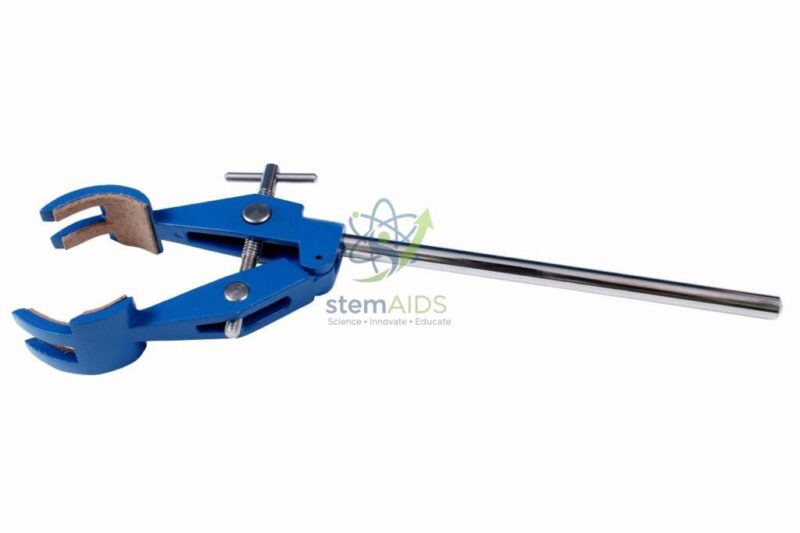
Quick Answer: The Standard Clamp Retort, Four Pronged, Pressure Die Cast, Aluminium is a four prong clamp: two jaws, each ending in a pair of fingers, close on a round vessel when the screw is turned. It holds flasks, bottles and cylinders on a retort stand; the listing photograph shows a blue body with a thumbscrew and a straight rod.
Four Points of Contact
Each jaw of a four-pronged clamp ends in two fingers, so a round object is touched at four points spaced around it. As the screw closes the jaws, the object is pushed into the middle of both pairs and centred automatically. That self-centring grip suits wide vessels that a two-prong clamp would hold along only two lines: conical flasks, reagent bottles, measuring cylinders and large boiling tubes.
Compared with a three-finger clamp such as the three pronged rubber lined clamp, four prongs spread the pressure over more contact points, which helps with heavier or wider items. Three-finger clamps remain the usual choice for narrow flask necks and condensers.
The body is pressure die cast aluminium, which keeps the clamp light at the end of its rod, so it adds little leverage on the stand. The same four-prong layout in zinc die casting is heavier for the same shape.
Applications
- Holding a conical flask during gas generation, leaving both hands free
- Clamping a measuring cylinder or reagent bottle upright at a filling station
- Supporting a wide boiling tube or a small beaker above a burner
- Holding a large test tube for collecting gas by downward delivery
Specifications
| Type | Four prong retort clamp |
| Body | Pressure die cast aluminium (as titled) |
| Finish | Blue, as shown in the listing photograph |
| Closure | Thumbscrew (as pictured) |
| Mounting | Straight rod into a boss head |
| Maximum opening | Confirm at enquiry |
Care & Handling
- Close the four prong clamp until the vessel cannot turn, then stop; glass cracks when squeezed hard at four points.
- Keep the aluminium body away from flames and clamp above the heat zone.
- Rinse off alkali splashes, which attack aluminium.
Why Choose LabEquip
Chemistry and biology labs that handle flasks and bottles of many sizes like a clamp that centres whatever it holds. LabEquip lists the aluminium and zinc versions together in General Lab Products, so buyers can choose by weight.
Frequently Asked Questions
What is the advantage of four prongs?
The vessel is held at four points spaced around it and is pushed into the centre as the clamp closes. Wide, round items sit more securely than in a two-prong clamp.
Can it hold a round-bottom flask?
It can grip the neck of a larger flask, but a three-finger clamp is the usual choice for narrow necks. Always clamp flasks at the neck, never around the bulb.
Why is die cast aluminium used?
It is light, so the clamp adds little weight at the end of its rod, and die casting gives each body the same shape, so the jaws close evenly.
How tight should the screw be?
Just tight enough that the vessel cannot rotate or slide when nudged. Overtightening concentrates force at the finger tips and can crack glass.
Can the clamp be used near a burner?
Keep it above the hot zone. Aluminium conducts heat quickly and loses strength when very hot, and coatings can scorch.
How is it different from the zinc version?
The layout is the same, but zinc alloy is more than twice as dense as aluminium, so the zinc clamp is noticeably heavier. The aluminium version puts less load on the stand.
Last Updated: September 2026




Reviews
There are no reviews yet.