
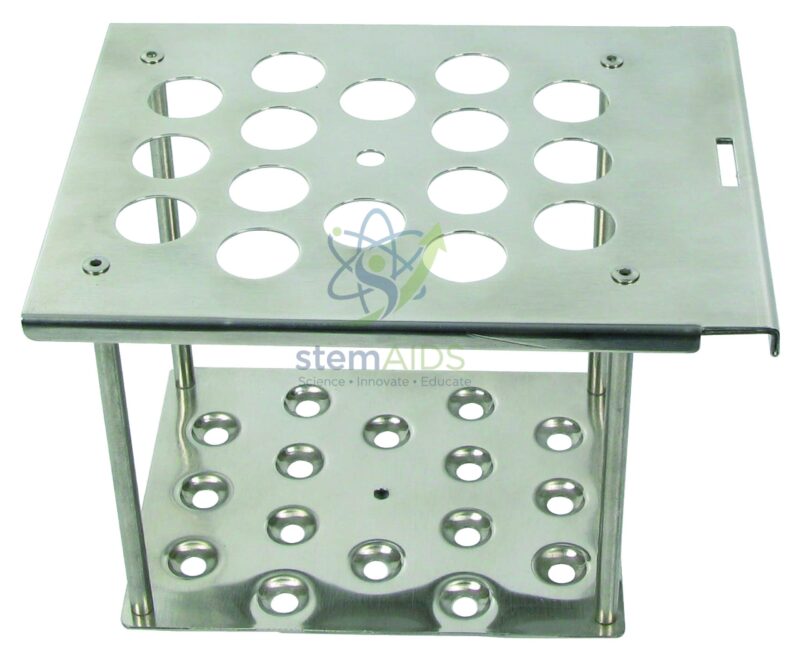
Quick Answer: The Stainless Steel Rack 16 Tubes is a two-tier tube rack made from stainless steel plate, pictured with 16 round holes in the top plate and matching dimpled seats in the bottom plate, joined by four posts, so tubes stand upright in a water bath or on the bench.
Plate Construction and Why It Matters
Unlike a wire rack, this stainless steel rack for 16 tubes is built from two flat plates. Tubes pass through the holes in the upper plate and rest in shallow dimples in the lower plate, which stops them sliding sideways and keeps the tube bottoms off the bath floor. Four posts join the plates, and the top plate has a folded edge with a slot along one side that serves as a grip for lifting.
Stainless steel suits a rack that spends its life in warm water: it does not float, does not soften with heat and resists the corrosion that affects painted or plated racks in baths. The same rack can go from the bath to the sink, and stainless steel racks can generally be autoclaved with the tubes.
Sixteen positions make a small, manageable set, such as one practical group’s samples, a standard series with unknowns, or a run of timed incubations. For microtubes that need to float instead, the mini floating foam racks are the alternative.
Specifications
| Material | Stainless steel plate |
| Positions | 16, as titled |
| Construction | Two plates joined by four posts, as pictured |
| Lower plate | Dimpled seats that locate the tube bottoms |
| Handling | Folded edge with a lifting slot on the top plate |
| Hole diameter and height | Confirm at enquiry |
Uses for a 16-Tube Steel Rack
- Holding test tubes in a water bath for enzyme, starch and reducing-sugar tests
- Standing tubes in a boiling water bath during Benedict’s tests in school biology
- Draining and drying washed tubes
- Carrying one group’s tubes between bench, bath and sink as a single unit
Care & Handling
- Wash with detergent and rinse well; rinse off saline, bleach and other chloride-rich liquids promptly, as chlorides can pit even stainless steel.
- Dry the rack before storage so deposits do not build up in the dimples.
- Put liquid in the tubes before the rack goes into water, since empty tubes can lift out of their seats.
Why Choose LabEquip
School biology departments and teaching labs buy the 16-tube rack for small-group practicals in water baths. LabEquip lists it in General Lab Products alongside glass test tubes; send the tube diameter you use through the contact page.
Frequently Asked Questions
Why does the rack have two plates instead of one?
The top plate keeps tubes upright and the dimpled lower plate stops them sliding and lifts them off the bath floor. Together they hold tubes steady even when the water is moving.
Can the rack stand in a boiling water bath?
Yes. Stainless steel is unaffected by boiling water. Check that the tubes themselves suit the temperature, and lift the rack out with heat-resistant gloves.
Will the rack rust?
Stainless steel resists rust in water, but long contact with salt solutions, bleach or acids can mark or pit it. Rinse the rack after use and dry it before storage.
Can it be autoclaved?
Stainless steel racks are generally autoclavable. Place the rack with its tubes on a tray in the autoclave and let it cool before handling.
How does a plate rack compare with a wire rack?
A plate rack gives firmer location and flat surfaces that are easy to wipe, while a wire rack is lighter and lets water flow more freely around the tubes. Both suit water baths.
What tube size fits?
The hole size sets the largest tube diameter. Tubes much narrower than the holes will lean, so choose holes that match your tubes closely.
Last Updated: October 2026






Reviews
There are no reviews yet.