
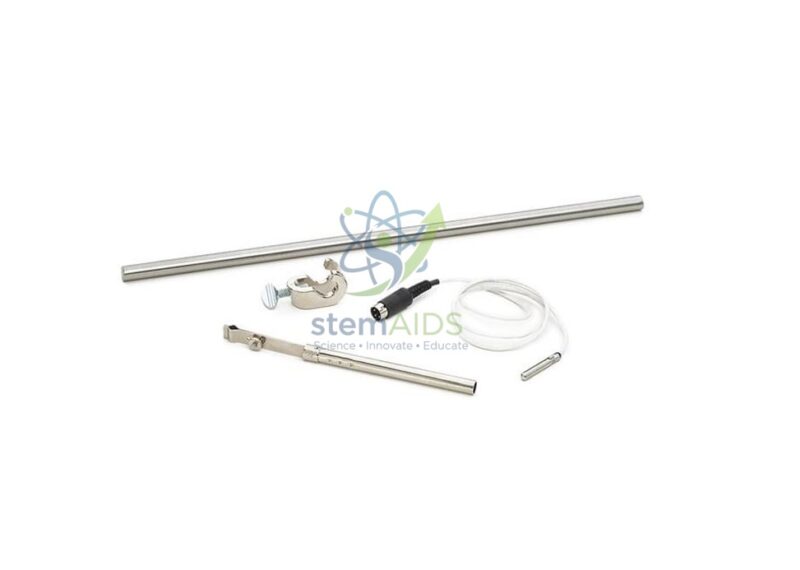
Quick Answer: The Stainless Steel Probe Kit is pictured as a stainless steel probe with its lead, a support rod and a rod clamp: the parts used to put an external temperature probe into a liquid and hold it there, typically so a hotplate stirrer can control to the sample’s own temperature.
Controlling the Sample, Not the Plate
A hotplate stirrer on its own controls the temperature of its top plate. The liquid in the beaker is always cooler, and by how much depends on the vessel, the volume and the stirring. An external probe changes that: dipped into the liquid and connected to a stirrer that accepts one, it lets the instrument regulate the liquid itself.
The photo shows the parts such a set-up needs: a slim stainless steel probe with a fitting at its top and a lead, a long support rod, a clamp to fix the probe to the rod and a small pin. Stainless steel suits immersion in water-based solutions and wipes clean easily; strong acids or halide solutions may call for a coated probe instead.
The title does not say which instruments the probe connects to or what sensor it carries. Probes are not interchangeable between makes, so the stirrer model must be matched before ordering.
Specifications
| Type | Probe kit with support parts |
| Probe | Stainless steel sheath with lead, as pictured |
| Support | Long rod and rod clamp, as pictured |
| Typical role | External liquid temperature sensing |
| Sensor type and instrument fit | Confirm at enquiry |
Applications
- Holding a stirred beaker at a set liquid temperature on a compatible hotplate stirrer
- Preparing media or solutions that must not overshoot their target temperature
- Monitoring a reaction mixture during slow heating
- Teaching demonstrations comparing plate temperature with liquid temperature
Care & Handling
- Clean the stainless steel probe kit’s sheath after each use and dry it before storage.
- Do not bend the probe or kink the lead; damage to either can give false readings.
- Keep the probe tip clear of the stir bar and the vessel base.
- Avoid long contact with concentrated acids and chloride-rich solutions, which can corrode stainless steel.
Why Choose LabEquip
Chemistry and biology labs add an external probe when the liquid temperature, not the plate setting, decides the result. LabEquip lists coated alternatives such as the PTFE SCT1/2 temperature probe in General Lab Products; send your stirrer model through the contact page to match the kit.
Frequently Asked Questions
Why is the liquid cooler than the hotplate setting?
Heat is lost through the vessel walls and the liquid surface, so the liquid settles below the plate temperature. An external probe measures the liquid directly.
Will this probe work with any hotplate stirrer?
No. Connectors and sensor types differ from one instrument make to another, so the kit has to be matched to your stirrer model.
When should a PTFE-coated probe be used instead?
Choose a coated probe for strong acids, halide solutions or other media that attack stainless steel. Stainless steel is fine for most water-based solutions.
How far into the liquid should the probe go?
Immerse the tip well below the surface, away from the stir bar and the vessel wall, so it reads the bulk of the liquid.
What happens if the probe is lifted out during heating?
The probe then reads room air, and the stirrer may keep heating to reach the set point. Fix the probe on its rod before starting and check that it stays submerged.
How should the probe be cleaned?
Wipe or rinse the sheath with water and mild detergent, then dry it. Do not immerse the connector or the plug of the lead.
Last Updated: October 2026





Reviews
There are no reviews yet.