







In Stock
Soil Thermometer
Thermomètre pour le sol Features a corrosion-resistant, high-thermal-conductivity pointed stem designed for seamless insertion into various soil horizons while maintaining structural integrity in compacted substrates.
Calibrated High-Contrast Interface Incorporates an analog or digital display with a wide thermal range, providing real-time measurements with a precision-rated accuracy of ±1.0°C across extreme environmental gradients.
$3.84
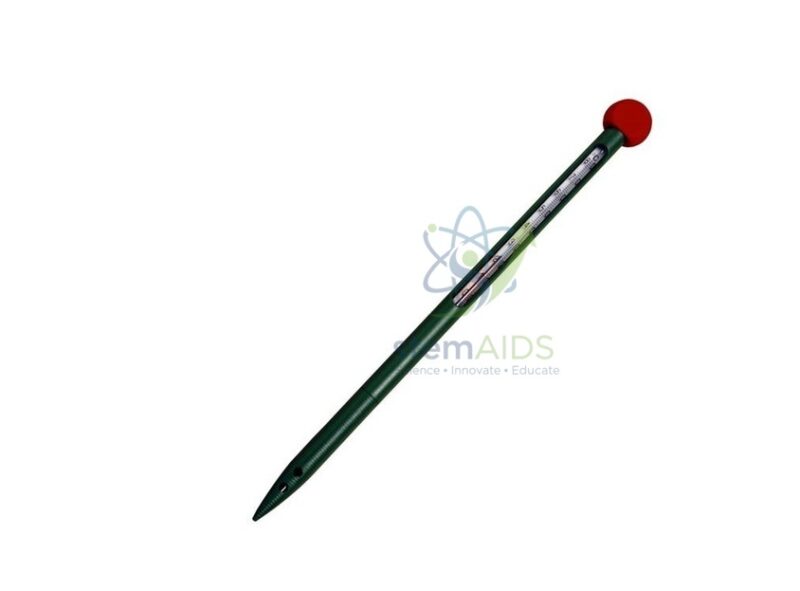
Quick Answer: This Soil Thermometer is a soil thermometer with pointed stem: the listing photograph shows a long, slender green stem narrowing to a point, topped by a red knob handle. It is pushed into soil, compost or growing media to read the temperature at depth, where seeds germinate and roots grow.
Reading Temperature Below the Surface
Soil warms and cools more slowly than air, and its temperature a few centimetres down governs when seeds germinate, how fast roots grow and how active soil organisms are. A thermometer with a long stem places its sensing end at the depth being studied while the reading end stays above ground, and the pointed tip helps it enter prepared soil.
The form in the photograph, a long stem with a knob to grip, is meant to be pushed in by hand. Even so, it should go into a pilot hole made with a rod or dibber, so the stem is not bent by stones or compacted layers. Allow several minutes for the reading to settle, and read at the same times of day when making comparisons.
LabEquip also lists a separate Soil Thermometer and a brass cone soil thermometer. This listing does not state the stem length, range, or whether the scale is read on a dial, a glass column or a digital display, and those details decide how deep it can read, so compare the three before choosing.
Investigations and Uses
- Germination experiments linking soil warmth to the day seedlings emerge.
- Tracking the heating of compost heaps as microbes break down waste.
- Comparing mulched and bare soil, or sunny and shaded beds, in school gardens.
- Agriculture practicals timing sowing and transplanting.
Taking Good Readings
- Make a pilot hole first and push the thermometer in straight, never twisting or levering it.
- Wipe the stem clean after use; dried soil on the tip slows the response next time.
- Store the thermometer in its case or hung by the knob, not loose in a toolbox.
- Check it now and then against a laboratory thermometer in a water bath at room temperature.
Specifications
| Type | Soil thermometer |
| Form in photograph | Long green pointed stem with red knob top |
| Use | Inserted into soil, compost or growing media |
| Reading position | Above the soil surface |
| Stem length, range and display | Confirm at enquiry |
Why Choose LabEquip
School garden clubs, agriculture colleges and biology departments buy soil thermometers for field plots and compost studies. LabEquip lists this model in General Lab Products, and stem length and range details can be requested through the contact page.
Frequently Asked Questions
How deep should a soil thermometer go?
That depends on the question. For seed germination, read at sowing depth, usually a few centimetres. Root-zone and seasonal studies use deeper readings, and meteorological stations record several fixed depths.
Why does soil temperature differ from air temperature?
Soil stores heat and passes it on slowly, so it warms later in the day and cools more slowly at night than the air. Deeper layers change even less, which is why readings at different depths tell different stories.
How long should I wait before reading?
Several minutes, until the reading stops changing. The stem has to reach soil temperature, and reading too soon gives a value somewhere between air and soil temperature.
Can it be used in a compost heap?
Yes, if the stem is long enough to reach the centre, where temperatures run highest. Readings over several days show the heap heating up as microbes break down the material and cooling as it matures.
How is this different from the other soil thermometers listed?
This listing’s photograph shows a long pointed stem with a red knob handle. The brass cone model has a metal cone at the tip for better heat contact, and the other soil thermometer listing does not show its form. Compare stem length and range when choosing.
How can I check its accuracy?
Stand the stem beside a reliable laboratory thermometer in a stirred beaker of water at room temperature and compare the readings once both settle. A difference that stays constant can be noted and corrected for.
Last Updated: September 2026
You must be logged in to post a review.
Bestsellers




Reviews
There are no reviews yet.