



In Stock
Soil Meter 4 in 1
₹850.00
Quick Answer: The 4 in 1 soil meter is a handheld digital tester with a single metal probe and an LCD screen, giving quick field readings of several growing conditions from one instrument. Meters of this design usually report soil moisture, soil pH, temperature and sunlight intensity, for school gardens, pot experiments and ecology surveys.
Four Readings from One Handheld Meter
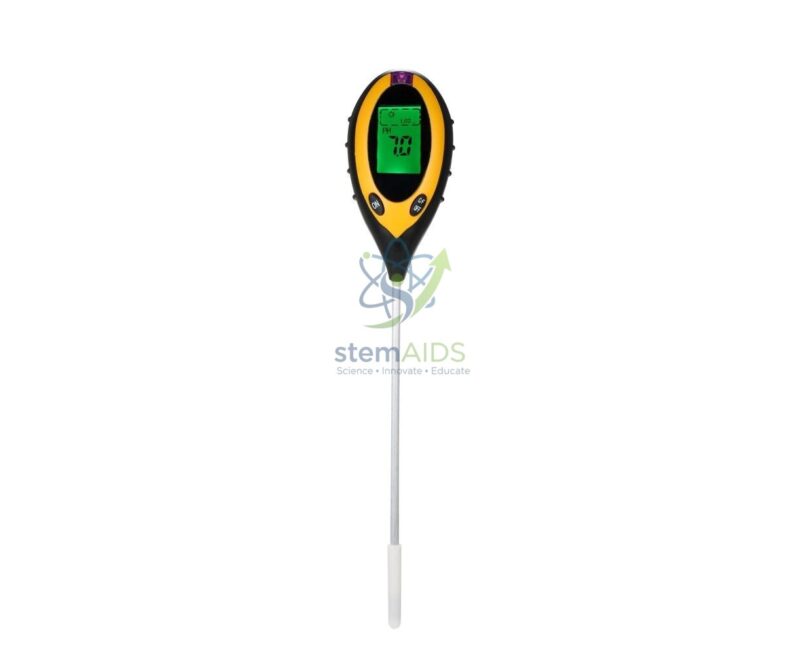
The listing image shows a yellow and black handheld unit with a backlit display at the top and a long probe below, and the image file name refers to moisture, pH and sunlight intensity. On meters of this style the fourth reading is normally temperature, with a button switching between modes; the exact parameter set and display ranges should be confirmed when ordering. One instrument covering four readings means a group records every value at the same spot at the same moment, which makes comparisons between sites cleaner than juggling separate gadgets.
The readings come from different sensors. Moisture and pH are sensed through the probe where it touches damp soil, while light is measured by a small sensor on the body, so the unit must face the sky and not sit in the student’s shadow.
Taking Reliable Readings on a School Plot
Push the probe straight down into the soil to the depth given in the instructions, steering clear of stones that scratch or bend the tip. In a dry bed, water a small patch, wait a few minutes and then test, because pH cannot be sensed through dry soil. Wipe the probe between sites so soil from one spot is not carried to the next, and take three readings a short step apart and average them rather than trusting a single push.
Treat the figures as indications for comparing sites and tracking change over a term, not as laboratory results. The light value, for example, ranks sunny and shaded spots rather than measuring in absolute units the light plants use for photosynthesis.
Specifications
| Item | Soil meter, 4 in 1, handheld digital |
| Display | Backlit LCD (as pictured) |
| Probe | Single metal probe pushed into moist soil |
| Readings named in listing image | Moisture, pH and sunlight intensity |
| Fourth reading and display ranges | Usually temperature; confirm at enquiry |
Applications
- Comparing moisture, pH and light under trees, beside walls and in open beds during a school-grounds ecology survey
- Tracking soil moisture in pot trials that test different watering schedules for seedlings
- Recording whether lime or compost shifted the pH reading of a garden bed over a term
- Relating the plants found in quadrats to the light and moisture measured at each site
Care & Handling
- Wipe the probe with a damp cloth and dry it after each session; never leave it standing in wet soil.
- Do not force the probe into hard, stony or baked ground or use it as a lever, since a bent probe gives false readings.
- Keep the display unit out of rain and sprinkler water, and take the battery out before storing it over a long holiday.
- Use the probe in moist soil only, not in fertiliser solutions or other liquids.
Why Choose LabEquip
The 4 in 1 soil meter suits schools running garden clubs, ecology fieldwork and agriculture practicals, where one tester per group covers several variables. Where only acidity and moisture are needed, compare the Soil pH-Digital Moisture Meter, and for true soil temperature at depth add a Soil Thermometer. Other field instruments are in General Lab Products, and group quantities can be sent through our contact page.
Frequently Asked Questions
How is a 4 in 1 meter different from a 2 in 1 pH and moisture meter?
A 2 in 1 meter reads only soil pH and moisture. A four-reading meter adds light intensity and a fourth value, usually temperature, so a group can record the main growing conditions at one spot with one instrument.
Why does the pH reading change when the soil is dry?
The probe senses pH through the film of water in contact with it. In dry soil that contact is poor and the reading drifts or stays fixed. Moisten the test spot with a little clean water, wait a few minutes and then read.
How accurate is a probe pH reading?
It is an indication, suitable for comparing beds or seeing a change over time, not a laboratory value. For an exact pH, soil is mixed with water and measured with a calibrated glass-electrode pH meter.
How should the light reading be taken?
Hold the meter at the same height at each site with the light sensor facing the sky, and keep your shadow off it. Take readings at a similar time of day, since light changes with cloud and the position of the sun.
Does the temperature reading show soil temperature?
On many compact meters the temperature sensor sits in the display unit, so it reflects the surrounding air rather than soil at root depth. For soil temperature at a set depth, a dedicated soil thermometer is more reliable.
Can the soil meter be left in the ground?
No. Leaving the probe in wet soil corrodes the metal and shortens its life. Take the reading, pull the probe out, wipe it clean and dry, and store the meter indoors.
Last Updated: September 2026
You must be logged in to post a review.
Bestsellers




Reviews
There are no reviews yet.