










In Stock
Slide Tray, Stainless Steel
High-Grade Stainless Steel: Manufactured from non-corrosive steel that resists rust, even when exposed to staining reagents, moisture, and high-humidity environments.
Precision Slotting: Features accurately spaced grooves or dividers that hold slides upright or at a slight angle, preventing contact between slides and protecting delicate specimens.
$3.61
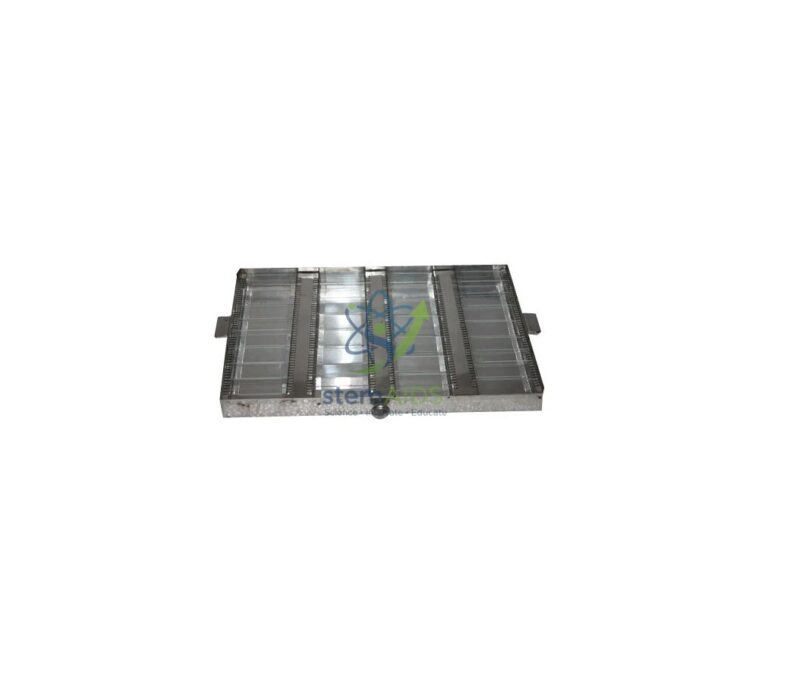
Quick Answer: The Slide Tray, Stainless Steel is a stainless steel slide tray: a rectangular metal frame divided by parallel rails into rows of slide positions, with a small tab at each end, as the listing photograph shows. It holds microscope slides for drying, staining work and carrying between benches.
Why Make a Slide Tray in Steel
Slide trays are made in card, plastic and metal, and the material decides how the tray can be cleaned. Card is for storage only. Plastic trays tolerate water and detergent but can warp with heat or craze with solvents. A stainless steel tray can be washed, soaked in disinfectant, wiped with alcohol and, being metal, put through dry heat or an autoclave cycle, which is why metal trays are chosen where contaminated slides are handled.
The rows between the rails keep each slide in its own position, so a set stays in order from the staining sink to the microscope, and slides do not slide into one another when the tray is carried. The open construction lets air circulate around the slides, which helps blood films and bacterial smears air-dry before fixing.
For flat storage of finished mounts, compare the microscope slide tray in the microscope range. The number of slides this metal tray holds is not stated in the title, so count the positions you need per practical group when ordering.
Applications
- Air-drying blood films and bacterial smears before heat or methanol fixing
- Carrying a practical group’s slides from the staining sink to the microscopes in order
- Holding plain glass microscope slides while wet mounts or smears are prepared
- Keeping used slides together for disinfection before washing or disposal
Specifications
| Type | Microscope slide tray |
| Material | Stainless steel (as titled) |
| Layout | Rows of slide positions separated by rails (as pictured) |
| Handling | Small tab at each end of the frame |
| Suits | Standard glass microscope slides |
| Slide capacity | Confirm at enquiry |
Care & Handling
- Rinse stain off the stainless steel slide tray promptly; dried crystal violet and similar dyes are easier to remove while wet.
- Soak in disinfectant, then wash in detergent and rinse; do not leave chlorine bleach standing on the metal.
- Dry thoroughly after washing, or dry it in an oven, to prevent water spots.
- Handle slides by their edges when loading so fingerprints do not land on the smear area.
Why Choose LabEquip
Pathology teaching labs, microbiology practicals and college histology rooms buy metal trays because they can be decontaminated repeatedly. LabEquip lists this tray in General Lab Products, alongside the plastic and card options in its microscope range.
Frequently Asked Questions
Why choose a stainless steel slide tray over a plastic one?
Stainless steel withstands heat, disinfectants and alcohol without warping or crazing, so the tray can be decontaminated many times. Plastic trays are lighter but less tolerant of heat and solvents.
Can the tray be sterilised?
Stainless steel generally tolerates dry-heat ovens and autoclave cycles. Remove all slides and any paper labels first, and let the tray cool before handling.
How should smears be dried on the tray?
Let them air-dry at room temperature, smear side up, away from draughts and dust, before fixing. Forced heating before fixing can distort cells, especially in blood films.
Does stain damage stainless steel?
Common biological stains do not attack stainless steel, but they can leave coloured films if allowed to dry. Rinse the tray with water straight after use and wash it with detergent.
Which slides fit the tray?
Trays of this kind are laid out for standard glass microscope slides. Measure your slides if you use unusual sizes, such as larger petrographic or double-width slides.
How should contaminated slides be handled on the tray?
Keep the tray on a disinfected surface and wear gloves. After the session, soak slides and tray together in a suitable disinfectant before washing or disposal.
Last Updated: September 2026
You must be logged in to post a review.
Bestsellers






Reviews
There are no reviews yet.