









In Stock
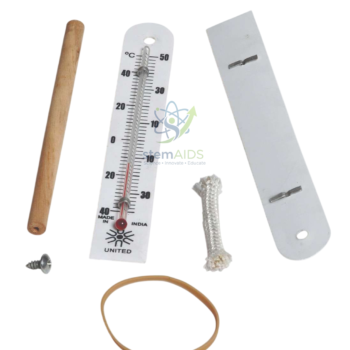
Rubber Belt
High-Elasticity Material: Fabricated from a specialized vulcanized rubber compound that maintains a 3:1 stretch ratio without permanent deformation, ensuring consistent tension across various pulley diameters.
Optimal Friction Profile: Features a non-porous, high-grip surface texture designed to eliminate mechanical slippage, facilitating precise rotational speed maintenance in both manual and motor-driven laboratory configurations.
$5.30
Quick Answer: The Rubber Belt is a flexible loop of rubber used to transmit rotation from one pulley or wheel to another. In school physics and technology labs, a rubber belt links a motor or hand crank to a driven pulley in demonstrations of belt drives and speed ratios.
How a Belt Drive Works
Friction between the belt and the rim of each pulley carries motion across. If the belt does not slip, its surface speed is the same at both pulleys, so a small driving pulley turning a large driven one produces lower speed and greater turning effect, while the reverse gives higher speed. The speed ratio is the inverse of the ratio of pulley diameters, a relationship students can check by counting turns or timing them with a stopwatch.
Twisting the belt into a figure of eight between the pulleys makes a crossed belt, which reverses the direction of the driven pulley. Tension matters too: a slack belt slips and loses motion, while an over-tight one loads the bearings. Rubber’s elasticity keeps the belt snug around the pulleys and absorbs small shocks, which is why it suits light classroom machines. The mechanical pulley working model is one example of apparatus built around belt and pulley ideas.
Belt length, cross-section (flat, round or V) and width decide which pulleys it fits, and these are not stated in the listing.
Applications
- Demonstrating speed ratios between pulleys of different diameters
- Showing direction reversal with a crossed belt
- Driving model machines, generators and fans from a small motor
- Replacing worn belts on existing classroom apparatus
Specifications
| Type | Endless rubber drive belt |
| Function | Transmits rotation between pulleys by friction |
| Material | Rubber; compound not specified |
| Arrangements | Open (same direction) or crossed (reversed direction) |
| Length, section and width | Confirm at enquiry |
Care & Handling
- Keep the belt and pulley rims free of oil and grease, which cause slipping.
- Set the tension so the belt does not slip under load but can still be deflected slightly by a finger.
- Take belts off apparatus that goes into long storage, so they do not take a permanent set.
- Replace belts that have cracked, stretched or glazed on the running surface.
Why Choose LabEquip
Physics and technology departments order belts both for new demonstrations and as spares for existing pulley apparatus. LabEquip lists them in General Lab Products; send the pulley sizes or details of the belt you are replacing via the contact page.
Frequently Asked Questions
How do I work out the speed ratio of a belt drive?
Divide the diameter of the driving pulley by the diameter of the driven pulley, assuming no slip. If the driver is 2 cm across and the driven pulley 6 cm, the driven pulley turns at one third of the driver’s speed.
How do I make the driven pulley turn the other way?
Cross the belt so it forms a figure of eight between the two pulleys. Crossed belts wear a little faster where the two runs rub, so keep the speed modest.
Why does the belt keep slipping?
It may be too slack, stretched with age, or contaminated with oil. Increase the pulley spacing or fit a shorter belt, and clean the belt and rims with detergent and water.
How do I measure the belt size I need?
Wrap a piece of string around the pulleys in their working positions, mark where it meets, and measure the length. Note also the groove shape and width so the new belt sits correctly.
Can a rubber belt be used with a high-speed motor?
Light classroom belts are intended for modest speeds and loads. High speeds or heavy loads need a belt rated for them, and all moving belts should be guarded or kept away from fingers, hair and loose clothing.
Why does a rubber belt crack over time?
Ozone, sunlight, heat and repeated flexing age rubber. Cracks appear first on the outer surface. Store belts in a cool, dark place, off the pulleys, to extend their life.
Last Updated: September 2026
You must be logged in to post a review.
Bestsellers




Reviews
There are no reviews yet.