
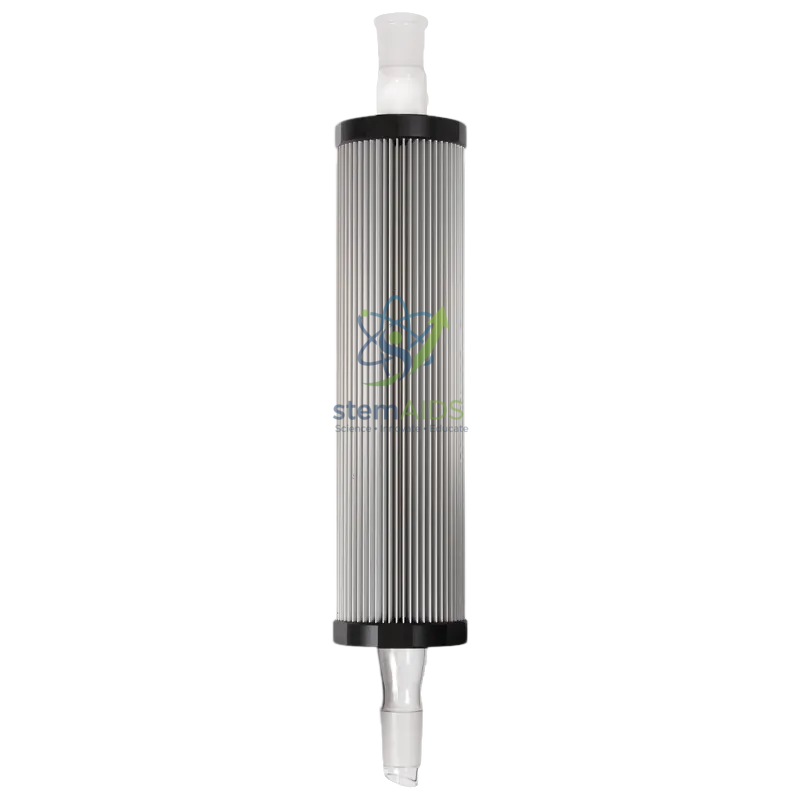
The StemAids Reflux Condenser is a laboratory glassware component designed for controlled reflux, vapour condensation and liquid return during heating experiments. It is suitable for chemistry laboratories, organic synthesis work, pharmaceutical laboratories, research centres, quality control departments, school laboratories, college laboratories and university practical setups.
A reflux condenser helps cool vapours produced during heating and converts them back into liquid form. The condensed liquid flows back into the reaction flask, allowing the reaction mixture to be heated for longer periods without significant solvent loss. This makes the reflux condenser an essential apparatus for organic chemistry experiments, extraction work, reaction heating, synthesis procedures and educational demonstrations.
Supplied under the StemAids brand, this reflux condenser is designed for institutional laboratory use where durability, clarity, chemical resistance and reliable cooling performance are required.
Key Features
- Laboratory reflux condenser for vapour cooling and liquid return
- Suitable for organic chemistry, synthesis and reaction heating applications
- Made from borosilicate glass depending on supplied configuration
- Available in common types such as Allihn, Liebig, Graham or coil condenser designs
- Compatible with standard ground glass joint systems depending on selected size
- Water inlet and outlet side arms for continuous cooling
- Helps reduce solvent loss during reflux experiments
- Suitable for schools, colleges, universities, QC labs and research facilities
- Useful with round-bottom flasks, heating mantles, oil baths and hotplate stirrer setups
- StemAids brand support for laboratory procurement and educational institutions
Product Specifications
| Specification | Details |
|---|---|
| Product Name | Reflux Condenser |
| Brand | StemAids |
| Product Type | Laboratory glass reflux condenser |
| Primary Function | Condenses vapours and returns liquid back to the reaction flask during reflux |
| Material | Borosilicate glass / borosilicate 3.3 glass depending on supplied model |
| Condenser Type | Allihn, Liebig, Graham, Dimroth or coil type depending on selected model |
| Cooling Method | Water-cooled jacket with inlet and outlet hose connectors |
| Common Length Options | 200 mm, 250 mm, 300 mm, 400 mm, 500 mm or 600 mm depending on model |
| Common Joint Sizes | 14/23, 19/26, 24/29, 24/40, 29/32 or 29/42 depending on requirement |
| Joint Type | Standard ground glass joint / interchangeable taper joint depending on configuration |
| Hose Connection | Two side hose nozzles for cooling water inlet and outlet |
| Recommended Cooling Flow | Water inlet from lower side arm and outlet from upper side arm |
| Compatible Apparatus | Round-bottom flask, heating mantle, oil bath, water bath, hotplate stirrer, clamps and laboratory stand |
| Recommended Use | Reflux reactions, solvent condensation, organic synthesis, extraction, distillation support and chemistry practicals |
| Cleaning Method | Clean with compatible laboratory detergent or solvent according to chemical residue and lab SOP |
| Important Note | Exact condenser type, length, joint size, hose connector style and glass grade should be confirmed from the final supplied model datasheet. |
Detailed Product Description
The StemAids Reflux Condenser is used when a chemical reaction needs to be heated for an extended time without losing solvent vapours. During reflux, the liquid in the reaction flask is heated until vapours rise into the condenser. The cooling jacket removes heat from the vapours, causing them to condense and return to the flask.
This process allows the reaction mixture to remain at a stable boiling condition while reducing solvent evaporation loss. Reflux condensers are widely used in organic synthesis, esterification, extraction, pharmaceutical research, sample preparation and teaching laboratories.
The condenser is typically made from borosilicate glass, which provides good thermal resistance, chemical resistance and clear visibility of vapour condensation. Depending on the design selected, the condenser may be a straight Liebig type, bulb Allihn type, coil Graham type or other reflux-compatible design.
The StemAids Reflux Condenser is suitable for laboratory setups using round-bottom flasks, heating mantles, hotplate magnetic stirrers, oil baths and stand-clamp systems. Correct cooling water connection and stable clamping are important for safe operation.
Applications
- Organic chemistry reflux reactions
- Solvent condensation and recovery
- Reaction heating with reduced solvent loss
- Esterification and synthesis procedures
- Extraction and sample preparation
- Distillation support depending on setup
- Pharmaceutical and QC laboratory workflows
- College and university chemistry practicals
- Research and development experiments
- Demonstration of condensation and reflux principles
How to Use StemAids Reflux Condenser
- Select the correct condenser: Choose the condenser type, length and joint size according to the flask, solvent and experiment requirement.
- Prepare the reaction flask: Add the reaction mixture, boiling chips or magnetic stir bar as required by the procedure.
- Connect the condenser: Attach the reflux condenser vertically to the round-bottom flask using the matching ground glass joint.
- Clamp the apparatus: Secure the condenser and flask with a laboratory stand, clamp and boss head to prevent movement.
- Connect cooling water: Attach water tubing to the lower side arm as the inlet and connect the upper side arm as the outlet to the sink.
- Check water flow: Start a gentle and steady cooling water flow before heating begins.
- Start heating: Heat the flask using a heating mantle, oil bath, water bath or hotplate stirrer as per the experiment requirement.
- Monitor reflux: Observe vapours rising and condensing inside the condenser. Condensed liquid should return to the flask.
- Avoid excessive boiling: Adjust the heat so vapours do not escape from the top of the condenser.
- Stop after completion: Turn off heating first and allow the setup to cool while cooling water continues briefly.
- Disconnect carefully: After cooling, stop water flow, remove tubing and dismantle glassware carefully.
- Clean and store: Wash the condenser according to lab procedure, dry it properly and store it safely in a glassware rack.
Safety Instructions
- Always clamp the condenser securely before heating.
- Use matching ground glass joints to avoid unstable connections.
- Connect cooling water from bottom inlet to top outlet.
- Check tubing connections to prevent leaks or flooding.
- Do not seal the top of a reflux condenser unless the procedure specifically requires a pressure-safe setup.
- Do not heat flammable solvents near open flames.
- Use a fume hood for volatile, toxic or flammable vapours.
- Do not expose hot glassware to sudden cold shock.
- Wear laboratory PPE such as safety goggles, gloves and lab coat.
- Allow the condenser and reaction flask to cool before dismantling.
Why Choose StemAids Reflux Condenser?
| Reason | Benefit for Laboratory Users |
|---|---|
| Borosilicate Glass Construction | Provides chemical resistance, thermal resistance and clear visibility during reflux. |
| Efficient Vapour Condensation | Helps cool vapours and return condensed liquid back to the reaction flask. |
| Multiple Type Options | Available in common designs such as Allihn, Liebig and Graham depending on application. |
| Standard Joint Compatibility | Can be selected according to common laboratory glass joint sizes. |
| Suitable for Reflux Work | Useful for organic synthesis, reaction heating and solvent recovery applications. |
| Educational Laboratory Use | Ideal for demonstrating reflux, condensation and vapour-liquid cycle principles. |
| Research and QC Applications | Suitable for pharmaceutical, analytical, R&D and quality control laboratories. |
| StemAids Brand Support | Suitable for institutional procurement and scientific laboratory glassware supply. |
SEO Keywords
Reflux condenser, StemAids reflux condenser, laboratory reflux condenser, borosilicate glass reflux condenser, Allihn condenser, Liebig condenser, Graham condenser, chemistry lab condenser, organic chemistry reflux condenser, reflux glassware, laboratory condenser for solvent recovery, condenser for round bottom flask, educational lab glassware, college chemistry lab condenser, pharmaceutical lab glassware, QC laboratory condenser.
SEO Meta Title
StemAids Reflux Condenser | Borosilicate Laboratory Glass Condenser
SEO Meta Description
StemAids Reflux Condenser is a laboratory borosilicate glass condenser for vapour cooling, liquid return, organic chemistry reflux reactions, synthesis, solvent recovery, QC testing and educational chemistry practicals.
Google E-E-A-T Focused Content
This product description follows Google E-E-A-T content principles by providing clear product purpose, practical usage guidance, transparent model-dependent specifications and laboratory safety instructions. The product is described as reflux glassware used for condensation and liquid return during heated reactions.
The StemAids Reflux Condenser is described for science teachers, laboratory technicians, chemistry researchers, pharmaceutical laboratories, QC analysts and procurement officers who need accurate product information before purchase. The content focuses on real laboratory applications such as reflux heating, solvent condensation, synthesis, extraction, distillation support and safe glassware handling.
Frequently Asked Questions
1. What is a reflux condenser used for?
A reflux condenser is used to cool vapours produced during heating and return the condensed liquid back to the reaction flask. This helps reduce solvent loss during reflux reactions.
2. What material is the reflux condenser made from?
Reflux condensers are commonly made from borosilicate glass because it offers good thermal and chemical resistance for laboratory use.
3. Which condenser type is suitable for reflux?
Allihn, Liebig, Graham, Dimroth and coil-type condensers may be used depending on the solvent, cooling requirement and laboratory setup.
4. How should cooling water be connected?
Cooling water should generally enter from the lower side arm and exit from the upper side arm. This helps keep the jacket filled with water and improves cooling efficiency.
5. Can this condenser be used with a round-bottom flask?
Yes. It can be used with compatible round-bottom flasks when the ground glass joint size matches.
6. Is this product suitable for school and college laboratories?
Yes. It is suitable for school, college and university chemistry laboratories when used under trained supervision.
7. Can a reflux condenser be used for distillation?
Some condenser types may also be used in distillation setups, depending on the apparatus design and experiment requirement.
8. What joint size should be selected?
The joint size should match the flask and other glassware in the setup. Common options include 14/23, 19/26, 24/29, 24/40 and 29/42 depending on the laboratory standard.
9. What safety precautions are important?
Users should clamp the condenser securely, check water tubing, avoid sealed systems, use a fume hood for volatile solvents and wear suitable laboratory PPE.
10. Why choose StemAids Reflux Condenser?
It provides laboratory-grade reflux support, borosilicate glass construction, compatibility with common chemistry setups and suitability for educational, research, QC and pharmaceutical laboratories.




Reviews
There are no reviews yet.