
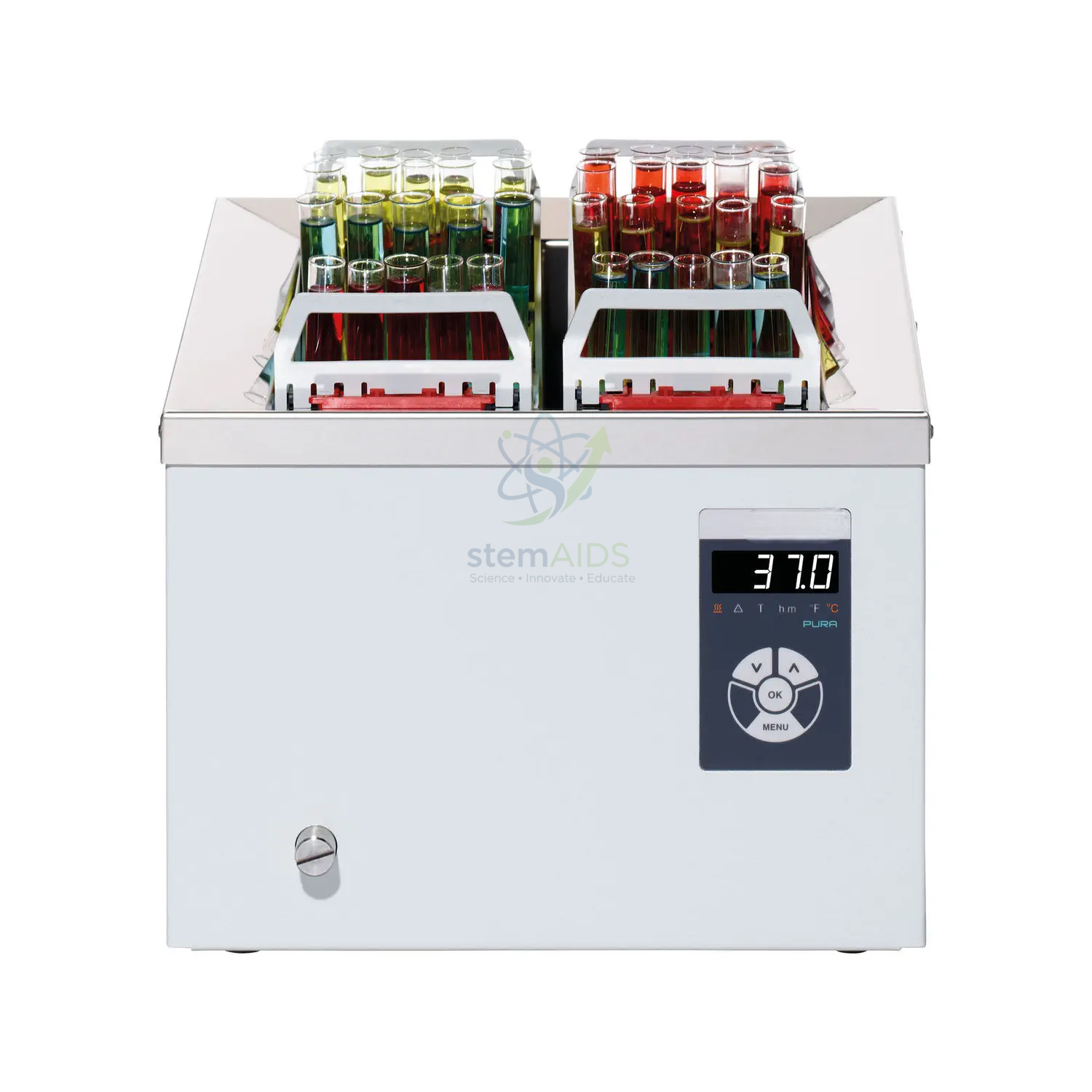
Quick Answer: The Pura Water Bath is a heated laboratory water bath, pictured with a white housing, a stainless steel top and tank, a front control panel with a digital display and a drain tap at the front, used for warming, incubating and thawing samples in tubes, bottles and flasks.
Controls at the Front, Samples on Top
PURA is the name JULABO gives to its range of laboratory water baths. Unlike the CORIO circulators, where a control head sits over the tank, the Pura water bath keeps its electronics in the front panel of the housing. The photo shows the display reading 37.0 with a small keypad beneath it, so the setting can be read and changed without reaching over hot water or wet racks.
Pura baths warm the water without a circulation pump. For most routine jobs that is all that is needed: tubes in racks, bottles of media and frozen aliquots sit in a body of water whose temperature changes slowly and evenly, and a lid keeps the heat in and limits evaporation. Where uniformity from position to position matters more, a circulating bath such as the CORIO C-B is the step up.
The stainless steel top in the photo has a sloping surround that sheds drips back into the tank, and a tap low on the front lets the bath be emptied without lifting it. A matching Pura lid cover is listed separately for keeping the water covered between uses.
Specifications
| Type | Heated laboratory water bath |
| Range | PURA, as titled |
| Housing | White, with a stainless steel top and tank, as pictured |
| Controls | Front panel with digital display and keypad, as pictured |
| Drain | Tap at the front of the housing, as pictured |
| Bath volume and temperature range | Confirm at enquiry |
Care & Handling
- Fill with distilled or deionised water, keep the level above the minimum and top up regularly.
- Close the lid during long incubations to cut evaporation.
- Drain through the front tap once the water has cooled and wipe the tank dry; change the water weekly, or sooner if it clouds.
- Keep the front panel dry and wipe spills from the top surface promptly.
Routine Jobs for a Pura Bath
- Thawing frozen reagents, sera and cell stocks in tubes
- Warming culture media and buffers to 37 °C before use
- Holding molten agar at around 50 °C until plates are poured
- Incubating tube reactions in teaching and research labs
Why Choose LabEquip
Microbiology rooms, cell biology labs and teaching departments buy the Pura bath for everyday warming and thawing. LabEquip lists it in General Lab Products; tell us how many racks or bottles must fit at once through the contact page so a suitable size can be suggested.
Frequently Asked Questions
Does the Pura bath circulate the water?
No. It heats the water without a circulation pump, which suits warming, thawing and general incubation. For tighter uniformity across the tank, a circulating thermostatic bath is the better choice.
Why is the display on the front?
A front panel can be read and adjusted without reaching over the open, hot tank. It also stays clear of the steam and drips that rise from the water.
What is the drain tap for?
It empties the tank in place, so the bath does not have to be lifted or tipped. Let the water cool first and run it into a bucket or a sink.
How often should the water be changed?
At least weekly in regular use, and sooner if it turns cloudy. Standing warm water supports algae and bacteria, which can contaminate the outside of tubes and bottles.
Can a disinfectant be added to the water?
Only a product made for water baths and compatible with stainless steel. Chlorine bleach should not be used, because chlorides can pit stainless steel over time.
Which racks fit the bath?
Racks must fit the tank footprint and keep tube tops above the water; the photo shows two tube racks side by side. Tell us your tube sizes and the bath size you are considering, and we will suggest suitable racks.
Last Updated: October 2026




Reviews
There are no reviews yet.