
Quick Answer: Pop beads are small plastic beads with a peg on one side and a socket on the other, so they snap together into chains and pull apart again by hand. Biology, chemistry and maths teachers use them to model chromosomes in cell division, base sequences, polymer chains and repeating patterns.
How Pop Beads Link Together
Each pop bead pushes onto the next with a simple peg-and-socket fit, so no string, glue or tools are needed. A chain can be lengthened, shortened, split or re-ordered in seconds, which suits any lesson where students build a sequence, change one part of it and compare the result with a partner’s.
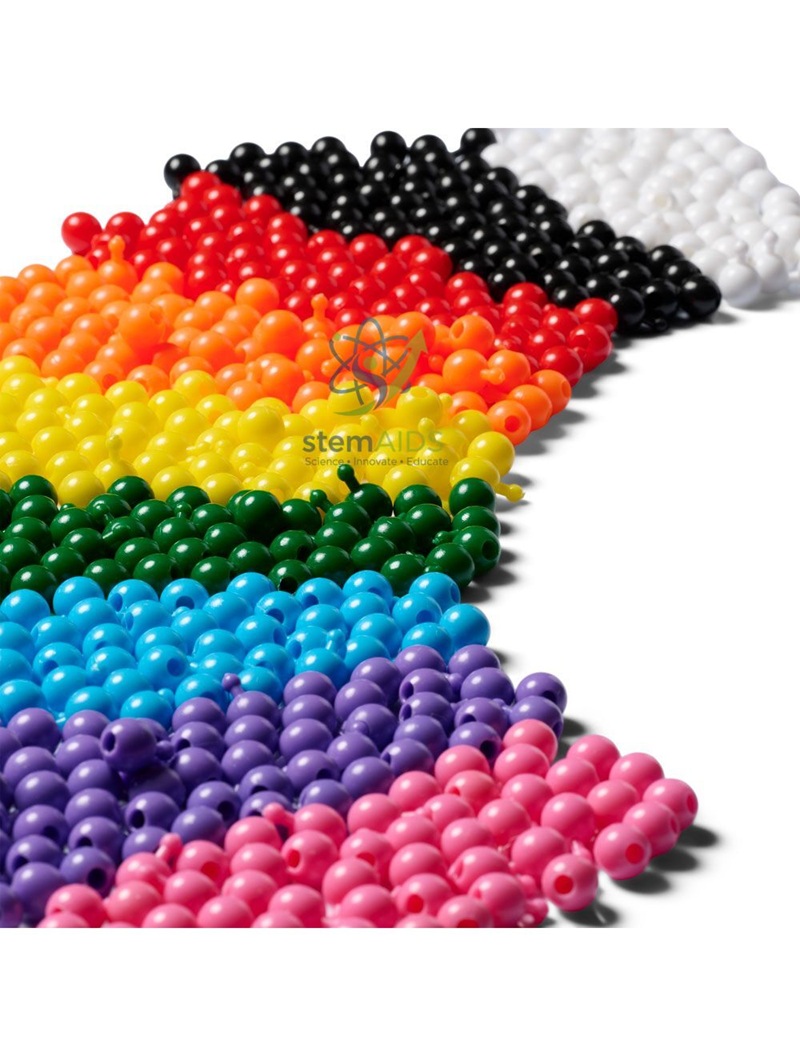
The listing photograph shows beads in red, orange, yellow, green, blue, purple, pink, black and white. Colour is what turns a chain of beads into a model: one colour can stand for a chromosome inherited from one parent, a second colour for its partner, and a repeating colour pattern for the units of a polymer. The number of beads in a set and the colour mix supplied are worth confirming when ordering class quantities.
Applications
- Building sister chromatids and homologous pairs to act out mitosis and meiosis, including crossing over
- Writing a DNA or mRNA base sequence in colour, one colour per base, and swapping a bead to show a point mutation
- Modelling monomers joining into homopolymers and copolymers in chemistry lessons on plastics
- Counting, grouping and pattern work in primary mathematics
Modelling Chromosomes, Genes and Polymers
Pop-bead chromosomes are a long-standing biology activity. Students build two identical strands as sister chromatids, join them at a centromere, and then move the chromosomes through prophase, metaphase, anaphase and telophase on a desk marked with a cell outline. For meiosis, homologous chromosomes built in two colours are paired and a few beads are swapped between non-sister chromatids, so crossing over and the variation it produces can be seen and handled.
In chemistry each bead can stand for a monomer, so the same set doubles as a polymer model: a single-colour chain for a homopolymer, an alternating pattern for a copolymer.
Specifications
| Item | Snap-together plastic beads |
| Joining method | Peg-and-socket push fit, no string needed |
| Colours shown | Red, orange, yellow, green, blue, purple, pink, black and white |
| Material | Plastic |
| Reuse | Beads separate by hand and are used again for the next class |
| Beads per set and colour assortment | Confirm at enquiry |
Care & Handling
- These beads are small parts and a choking hazard, so keep them away from young children and count sets back in after lessons with younger classes.
- Store each colour in its own labelled box or bag; sorting mixed beads at the start of a lesson wastes practical time.
- Pull beads straight apart rather than twisting them, which strains the peg and loosens the fit over time.
- Wash shared sets in warm soapy water inside a mesh bag and air-dry them; very hot water can distort plastic pegs.
Why Choose LabEquip
Pop beads are bought by biology departments preparing genetics practicals and by primary teachers for maths corners, usually in class quantities. For a structured cell-division set, LabEquip also offers the Meiosis Manipulatives Kit, and chemistry teachers can move from bead-chain models to real polymers with the Crosslinked Polymer Synthesis kit. See General Lab Products for related items, or send class sizes through our contact page.
Frequently Asked Questions
How do pop beads show crossing over in meiosis?
Build two homologous chromosomes in different colours, each made of two sister chromatids. Pair them, then swap an equal run of beads between one chromatid of each homologue. After the two divisions, some gametes carry chromatids with both colours, which shows how new combinations of alleles arise.
How is a centromere represented in a bead chromosome?
Teachers commonly join the two sister chromatid strands with a bead of a contrasting colour or a small clip at the same position on each strand. The join must hold the chromatids together until anaphase, when students pull them apart to opposite poles.
Can the beads model a DNA base sequence?
Yes, as a single strand. Give each of the four bases its own colour, write a short sequence on the board for students to build, then have them build the complementary strand beside it. Swapping one bead shows a point mutation. For the double helix itself, a dedicated DNA model is clearer.
How does a bead chain help teach polymers?
Each bead stands for a monomer, and snapping beads together shows many small molecules joining into one long chain. A single-colour chain models a homopolymer such as poly(ethene), alternating colours model a copolymer, and comparing long and short chains supports discussion of how chain length changes a plastic.
Are pop beads suitable for young children?
They are small enough to be a choking hazard, so they suit older primary and secondary pupils working under supervision. For early-years counting, larger beads threaded on a lace are a safer choice.
How should the beads be cleaned between classes?
Put them in a mesh laundry bag or a sieve, wash in warm soapy water, rinse and spread them on a towel to dry before storing. Avoid boiling or dishwasher cycles, since heat can soften or distort the pegs.
Last Updated: September 2026





Reviews
There are no reviews yet.