
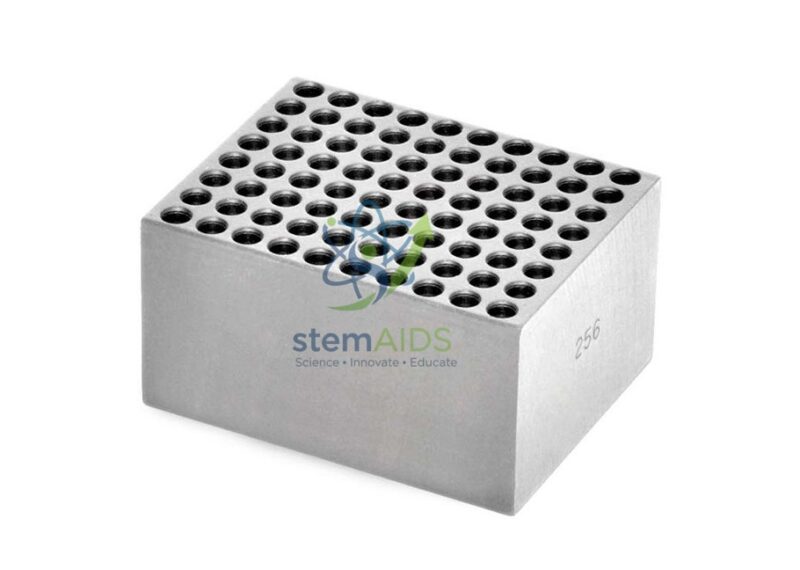
Quick Answer: The PCR Plate, tube, strip tubes listing is pictured as a PCR plate block: a metal dry-bath block with a dense grid of wells in the 96-well layout that holds a PCR plate, single PCR tubes or strip tubes at one set temperature.
A Block, Not the Consumables
The title lists PCR plates, tubes and strip tubes, which reads like a consumables listing, but the photo shows a metal block with a dense grid of small wells in the 96-well layout. The item is most likely a dry-bath block that takes those three formats, which share the same well spacing. Because title and photo point in different directions, confirm with LabEquip whether any plastics are included.
A block like this holds every well at one temperature. That makes it useful for the steps around PCR rather than PCR itself: enzyme digests, ligations, heat inactivation, denaturing samples before loading, or keeping a set-up warm or cool. Thermal cycling, with its repeated rapid changes, needs a thermal cycler.
Wells shaped for thin-walled PCR plastics give close contact, which matters because PCR volumes are small and change temperature quickly. For the plastics themselves, LabEquip lists a PCR Plate and a PCR Tube Strip separately.
Specifications
| Item pictured | Metal block with a 96-well layout grid |
| Accepts | PCR plate, single PCR tubes or strip tubes, as titled |
| Use | One set temperature in a dry bath or block heater |
| Not suited to | Thermal cycling, which needs a thermal cycler |
| Heater fit and included items | Confirm at enquiry |
Applications
- Restriction digests and ligations set up in PCR tubes or plates
- Heat-inactivating enzymes after a reaction
- Denaturing DNA or RNA samples before loading on a gel
- Holding plates or strips at a fixed temperature during set-up
Care & Handling
- Press plates and strips fully into the PCR plate block so each well touches the metal.
- Keep the wells free of dust and spilled liquid; clean them with a soft brush and mild detergent.
- Dry the block after cold use so water does not collect in the small wells.
- Seal plates or cap tubes to limit evaporation at higher temperatures.
Why Choose LabEquip
Molecular biology and teaching labs use a plate-format block to run pre- and post-PCR steps on a simple dry bath. LabEquip lists dry baths and blocks in General Lab Products; ask about block fit and contents through the contact page.
Frequently Asked Questions
Is this a pack of PCR plates and tubes?
The photo shows a metal block with a 96-well layout grid, not consumables. The title lists the plastics the block accepts. Contact LabEquip to confirm what is supplied.
Can this block run PCR?
No. PCR needs rapid, repeated temperature changes, which only a thermal cycler provides. A dry-bath block holds one temperature at a time.
Why can one block take plates, strips and single tubes?
PCR plates, strip tubes and single PCR tubes share the same standard well spacing and a similar tube shape, so one grid of wells holds all three.
Do I need a cover or seal?
At higher temperatures small volumes evaporate quickly, so seal plates or cap tubes. A simple dry bath has no heated lid, so spin the tubes briefly afterwards to collect any condensate.
Will the block fit my dry bath?
Blocks are built for specific heaters. Compare the block’s dimensions with your instrument’s block bay before ordering.
How do I clean the small wells?
Use a soft, narrow brush with mild detergent, rinse with water and dry the block fully. Avoid sharp tools that could scratch the well surfaces.
Last Updated: October 2026




Reviews
There are no reviews yet.