























In Stock
Nickel Crucible
High-Purity Nickel Composition: Fabricated from 99.0% minimum pure nickel to provide exceptional oxidation resistance at temperatures up to 600°C, ensuring minimal sample contamination during repeated heating cycles.
Heavy-Gauge Spun Design: Engineered with seamless, uniform wall thickness and a polished interior surface to facilitate complete sample recovery and maximize resistance against aggressive chemical erosion during peroxide fusions.
$7.33
Quick Answer: A Nickel Crucible is a small cup made of nickel metal, used to heat and melt samples at high temperature, especially for alkaline fusions with sodium hydroxide, potassium hydroxide or sodium peroxide. A nickel crucible for alkaline fusions stands up to molten alkali that would dissolve the surface of porcelain or silica crucibles.
Why Nickel for Alkali Melts
Many minerals, ores, slags and refractory materials do not dissolve in acids. Analysts bring them into solution by fusion: the finely ground sample is heated with a flux until the mixture melts, and the cooled melt is then dissolved in water or acid. When the flux is an alkali such as sodium hydroxide or sodium peroxide, the choice of crucible becomes critical. Molten alkali attacks silica and the glassy phase in porcelain, so those crucibles are etched and the dissolved silica contaminates the result.
Nickel is attacked far more slowly by these melts, which is why nickel crucibles are the long-standing choice for peroxide and hydroxide fusions in geochemistry, cement, metallurgy and teaching labs. Nickel is not inert, however. At red heat in air the surface oxidises, and a little nickel always passes into an alkaline melt, so nickel crucibles are unsuitable when nickel itself is to be determined and are not used for ignitions to constant mass. They are also attacked by acidic fluxes such as potassium pyrosulfate and by nitric acid.
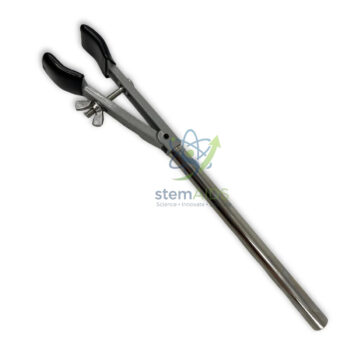
The listing does not give the capacity or say whether a lid is supplied. For acid-flux and general ignition work, compare the porcelain squat-form crucible, and handle a hot crucible with straight crucible tongs.
Where Nickel Crucibles Are Used
- Sodium peroxide fusion of ores, rocks and slags before determining metals by titration or spectroscopy.
- Hydroxide fusions to decompose silicates and refractory oxides in geology and cement labs.
- Demonstrating fusion as a sample-decomposition technique in undergraduate analytical chemistry.
- Melting small quantities of alkali hydroxides for preparative inorganic work.
Care and Safe Heating
- Wear eye protection and heat-resistant gloves: peroxide fusions react vigorously, and a spilled alkaline melt causes severe burns.
- Heat gently at first so moisture escapes and the flux melts quietly, then raise the temperature.
- Allow the crucible to cool before leaching the melt, and add water or acid slowly.
- Clean promptly after use; darkening is normal on nickel, but pitted or thinned crucibles should be retired.
Specifications
| Material | Nickel metal |
| Main use | Alkaline fusions with sodium or potassium hydroxide and sodium peroxide |
| Heating | Burner flame on a pipe-clay triangle, or muffle furnace |
| Not suited to | Acidic fluxes, nitric acid, nickel determinations, constant-mass ignitions |
| Capacity and lid | Confirm at enquiry |
Why Choose LabEquip
Nickel crucibles are bought by analytical, geochemical, cement and metallurgical labs, and by colleges that teach fusion methods alongside gravimetric work. LabEquip supplies them within the General Lab Products range; to discuss sizes and quantities, use the contact page.
Frequently Asked Questions
Why use a nickel crucible instead of porcelain?
Molten sodium hydroxide and sodium peroxide attack the silica in porcelain and silica crucibles, etching the vessel and contaminating the sample. Nickel resists these alkaline melts much better, so it is the usual choice for alkaline fusions.
Can a nickel crucible be used for sodium peroxide fusion?
Yes, peroxide fusion is one of its main uses. Expect some attack and a small amount of nickel in the melt, so keep fusions short, and do not use the method if nickel is one of the elements being measured.
Is a nickel crucible suitable for ignition to constant weight?
No. Nickel oxidises in air at high temperature, so its mass changes from one heating to the next. Gravimetric ignitions are normally done in porcelain, silica or platinum crucibles that stay at constant mass.
Which fluxes should not be used in nickel?
Avoid acidic fluxes such as potassium pyrosulfate or bisulfate, and do not dissolve melts in nitric acid inside the crucible, since these attack nickel. Porcelain or silica crucibles are the normal choice for acid-flux work.
How should a hot nickel crucible be handled?
Lift it with crucible tongs, set it on a pipe-clay triangle or a heat-resistant surface, and let it cool before adding water to leach the melt. Wear eye protection throughout, since alkaline melts spatter.
Why has my crucible turned dark after heating?
Nickel forms a dark oxide layer when heated in air. A thin film is normal and does not stop the crucible being used. Heavy scaling, pitting or thinning of the wall means it should be replaced.
Last Updated: September 2026
You must be logged in to post a review.
Bestsellers




Reviews
There are no reviews yet.