
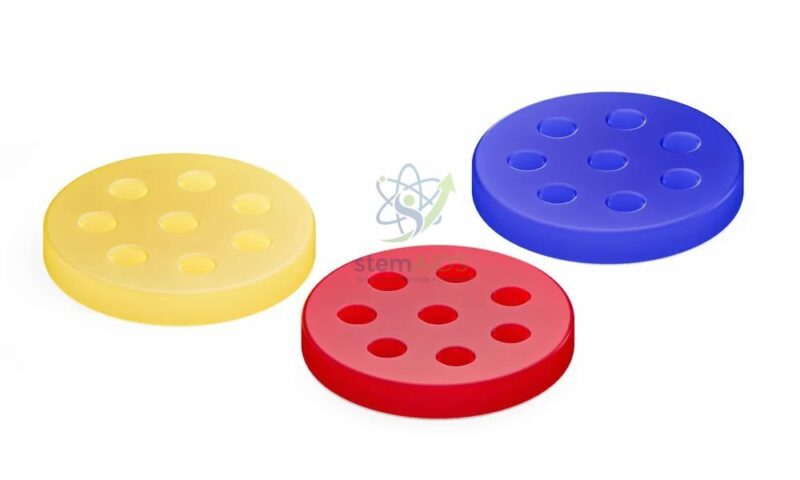
Quick Answer: Mini floating foam racks for bain-marie are small round foam discs, pictured in yellow, red and blue, with a ring of holes that grip microtubes so the tubes float upright in a water bath with their lower ends in the water.
How a Floating Foam Rack Holds Tubes
Microtubes are too small and light to stand in a water bath on their own; they tip over or bob about. A floating foam rack solves this: the foam is buoyant, each hole grips a tube body, and the disc rides on the surface so every tube sits at the same depth whatever the water level. Bain-marie is simply another word for a water bath.
The photo shows three round discs in different colours. Colour does useful work here: one colour per sample set, time point or user keeps samples apart in a shared bath. A round, compact disc also fits small baths and even a beaker of warm water, where a rectangular rack would not.
For larger batches, a rigid plastic float rack holds more tubes and survives more cycles, while a stainless steel rack for 16 tubes stands on the bath floor for full-size test tubes.
Where Floating Racks Are Handy
- Thawing frozen enzymes, competent cells or serum aliquots in a water bath
- Heat-shock steps in bacterial transformation, where tubes go in and out of a 42 °C bath together
- Short incubations of microtube reactions at a set temperature
- Holding tubes upright in an ice-water mix
Specifications
| Form | Round foam discs with holes, as pictured |
| Colours pictured | Yellow, red and blue |
| Use | Floating on a water bath or bain-marie |
| Tube type | Microtubes |
| Behaviour in water | Buoyant; stays on the surface when loaded |
| Holes per rack and hole size | Confirm at enquiry |
Care & Handling
- Load tubes before placing the rack on the water, and close all lids so bath water cannot get in.
- Rinse racks in clean water after use and air dry them; wipe with 70% ethanol when they need disinfecting.
- Check the rack’s temperature limit before using it near boiling, as foam can soften or shrink.
- Replace racks whose holes have stretched and no longer grip tubes firmly.
Why Choose LabEquip
Molecular biology and microbiology labs buy floating racks in mixed colours for thawing and heat-shock steps. LabEquip lists them in General Lab Products; tell us your tube size and quantity through the contact page.
Frequently Asked Questions
Which tubes fit the floating racks?
They are made for microtubes, the small snap-cap tubes used in molecular biology. The hole size decides the exact fit, so match the rack to the tube size in use.
Will the rack tip over when fully loaded?
A foam disc spreads the load over its whole area and floats level when tubes are placed evenly. Fill positions around the ring evenly rather than all on one side.
Can the racks be autoclaved?
Foam racks are generally not made for autoclaving and can shrink or distort in steam. Clean them with water and disinfect with ethanol instead, unless a rack is specifically rated for autoclaving.
Why use a floating rack rather than one on the bath floor?
A floating rack keeps every tube at the same depth even if the water level changes, and lifts out in one piece. That makes timed steps, such as a heat shock, easy to start and stop together.
Can floating racks be used in ice?
Yes. In an ice-water mix they hold tubes upright and cold. In crushed ice without water they do not float, but they still work as a simple tube holder.
Why are the racks different colours?
Colours make sample sets easy to tell apart when several people share one bath, or when tubes from different time points incubate together.
Last Updated: October 2026






Reviews
There are no reviews yet.