
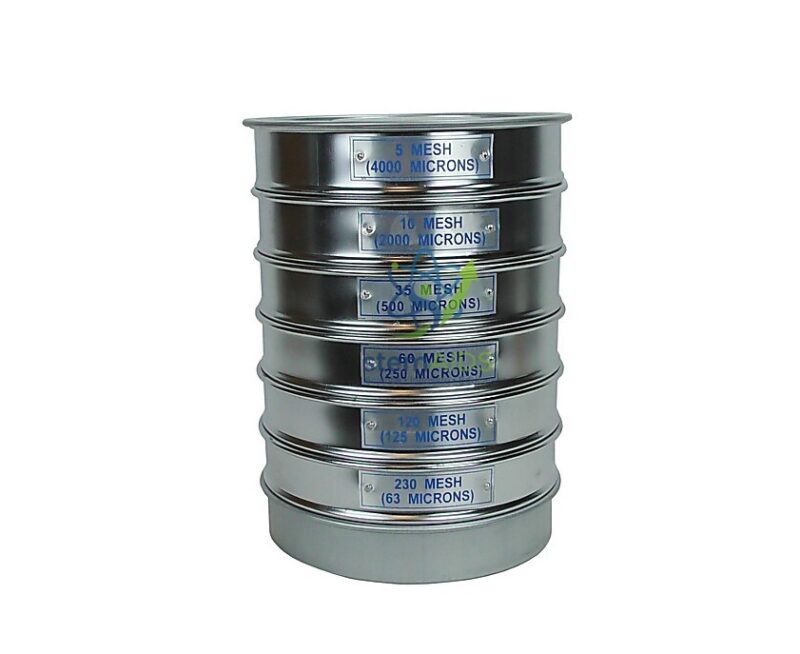
Quick Answer: Metal sieves are round frames with a woven metal mesh base, pictured as a nested stack with labelled rims, used to separate and grade particles by size. Laboratories and schools use them for soil texture, sand grading and powder analysis.
How a Sieve Stack Grades Particles
Each sieve passes particles smaller than its mesh opening and keeps the larger ones. Stacked with the coarsest mesh at the top and the finest at the bottom, above a collecting pan, the sieves split a sample into fractions in one operation. Weighing what each one retains, and dividing by the total mass, gives the percentage of the sample in each size range.
The nesting design visible in the photograph lets each frame sit snugly in the one below, so fine dust stays inside the stack while it is shaken. The printed labels on the rims identify each aperture. The apertures in this set are not given in the title, so confirm them with LabEquip against the method your course or lab follows.
Plotting the cumulative percentage passing against sieve size produces a grading curve. A steep curve shows a well-sorted sediment such as dune sand, while a gentle curve shows a mixed material such as glacial till, which makes the set useful in geography and geology as well as soil science and engineering.
Applications
- Soil texture and particle size analysis in agriculture and environmental science
- Sand and gravel grading in civil engineering materials labs
- Sediment sorting studies in geography and geology fieldwork
- Separating mixtures of solids by size in school chemistry
- Sieving powders and granules in food and pharmacy practicals
Sieving Technique & Care
- Dry samples before sieving; wet or clay-rich soil clogs the mesh
- Brush the mesh gently from the underside to release trapped grains, never poking through with a sharp tool
- Wash in warm water with mild detergent, rinse and dry fully before storage
- Store nested with the lid so the mesh is not dented by other equipment
Specifications
| Product | Metal laboratory sieves |
| As pictured | Nesting round frames with woven mesh and labelled rims |
| Purpose | Separating and grading particles by size |
| Used with | Collecting pan, lid and a balance |
| Apertures and frame diameter | Confirm at enquiry |
Why Choose LabEquip
Schools, agricultural colleges and materials labs order sieves as a set so a whole grading analysis can be run at once. LabEquip also offers the finer pollen sieve for biology and other general lab products; send your required apertures through the contact page.
Frequently Asked Questions
In what order should the sieves be stacked?
Coarsest mesh at the top, finest at the bottom, with the collecting pan underneath and a lid on top. Material then falls through until it reaches a sieve whose openings are too small.
How long should a sieve stack be shaken?
Follow the time given in your method. Shake until the mass on each sieve stops changing noticeably; for hand sieving, a few minutes of steady side-to-side motion with tapping is typical.
How do I work out the result?
Weigh the material retained on each sieve and in the pan, divide each mass by the total and multiply by 100. The percentages should add up to close to 100; a large shortfall means material was lost.
Can wet soil be sieved?
Dry soil is easier to sieve. Wet sieving, washing the fine fraction through the mesh with water, is used for clay-rich soils, but the sample and sieves must then be dried before weighing.
How should a clogged mesh be cleaned?
Turn the sieve over and brush gently from the underside with a soft brush, then wash in warm water with detergent. Pushing grains through from above with a sharp object stretches or tears the mesh.
Are metal sieves suitable for powders such as flour?
Yes, for separation and simple grading. For food work, keep a set reserved for food samples, and clean and dry it thoroughly after each use.
Last Updated: October 2026





Reviews
There are no reviews yet.