


In Stock
LED Grow Light
Lampe Horticole LED is engineered with a targeted blue and red wavelength ratio to maximize chlorophyll absorption, delivering high Photosynthetically Active Radiation (PAR) for accelerated vegetative and reproductive development.
Passive Thermal Management System features high-efficiency aluminum heat sinks and low-wattage SMD LED technology that minimizes radiant heat emission, maintaining stable ambient temperatures without the need for noisy active cooling fans.
$14.04
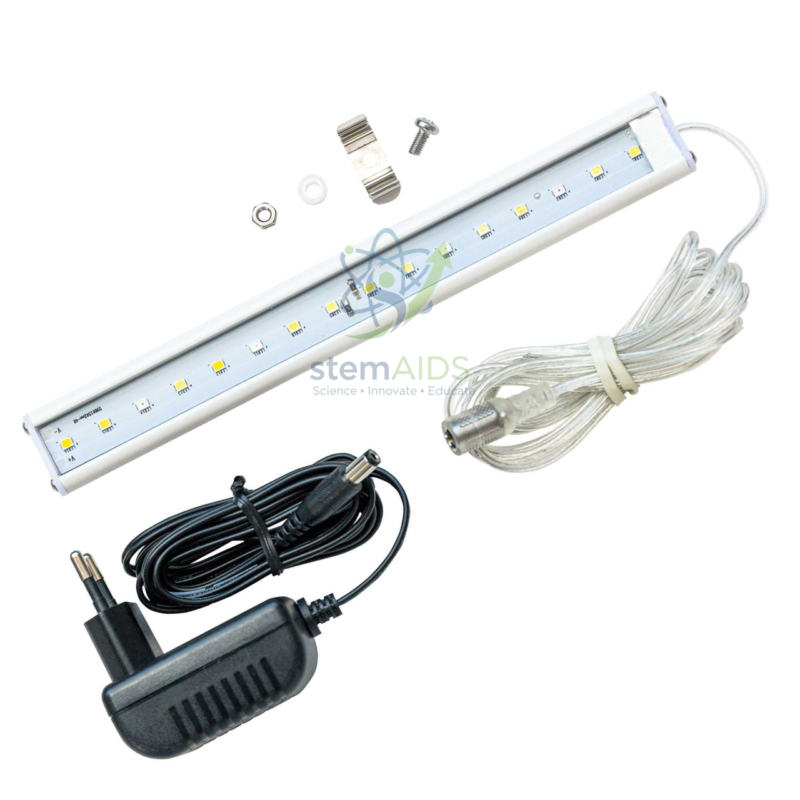
Quick Answer: The LED Grow Light is a strip-type LED light bar, pictured with a mains power adapter and mounting clips, for growing plants indoors on a bench or shelf. Schools use an LED grow light to raise seedlings away from windows and to control light for photosynthesis and photoperiod experiments.
Light for Plants Indoors
Plants use mainly the blue and red parts of the visible spectrum for photosynthesis, since chlorophyll absorbs those wavelengths strongly, but they also grow well under the broad white light of many modern LEDs. The unit in the photo shows white LEDs in a slim bar; its exact spectrum, light output and power rating are not in the title and should be confirmed where an experiment depends on them.
Light intensity at the plants falls quickly with distance, so the height of the bar above the leaves is the main control. Seedlings under a lamp that is too high grow tall and spindly as they stretch for light, while lowering the bar gives sturdier growth. A plug-in timer lets a class set a fixed day length, such as 12 or 16 hours, and keep it the same over weekends.
LEDs give out much less heat than older incandescent or halogen lamps, so the bar can be placed close to leaves without scorching and adds little warmth to a small enclosure. For a complete indoor growing space, the bar can be fixed above a propagator such as the Indoor Greenhouse BoQube, with the Heating Blanket supplying warmth from below.
Specifications
| Type | LED light bar for plant growth |
| Pictured parts | Light bar with white LEDs, power adapter, mounting clips and screws |
| Heat output | Low compared with incandescent or halogen lamps |
| Mounting | Clips for fixing under a shelf or above a tray |
| Spectrum, power rating and plug type | Confirm at enquiry |
Growing and Experiments
- Raising seedlings for germination and growth practicals in rooms without good daylight
- Investigating how light intensity affects photosynthesis by changing lamp distance
- Photoperiod experiments with short-day and long-day plants
- Lighting plants in rhizotrons, hydroponics set-ups or propagators
Care & Handling
- Keep the power adapter and connections dry and above the level of any watering.
- Wipe dust from the LEDs with a dry cloth while the unit is switched off.
- Avoid looking directly into the LEDs at close range.
- Mount the bar securely so it cannot fall into trays of water or soil.
Why Choose LabEquip
Schools with dim classrooms, college plant-science labs and hydroponics trainers use an LED grow light to keep growing experiments running whatever the weather. LabEquip includes it in the General Lab Products range.
Frequently Asked Questions
How high should the light be above the plants?
Start with the bar a short distance above the leaves and adjust by watching the plants. Spindly, pale seedlings mean the light is too weak or too far away; bleached or curled leaves mean it is too close.
How many hours a day should the light be on?
Many seedlings and leafy plants grow well with 12 to 16 hours of light a day, followed by a dark period. A plug-in timer keeps the pattern steady, which matters in experiments.
Is white LED light suitable for plants?
Yes. White LEDs emit across the visible spectrum, including the blue and red wavelengths that chlorophyll absorbs, and plants grow well under them. Red-blue grow lights put more of their output into those bands but look pink to the eye.
Can the light be used for a photosynthesis rate experiment?
Yes. Place pondweed in a tube of water at measured distances from the bar and count the oxygen bubbles per minute. Because LEDs give off little heat, the water temperature changes less than with a filament lamp.
Does the light bar warm the plants?
Only slightly. Most of the electrical energy becomes light rather than heat, which is why the bar can sit close to leaves. Warmth for germination is better supplied from below with a heat mat.
Can the light bar be used in a humid propagator?
Keep the adapter and connectors outside the humid space and dry, and mount the bar above the cover or where condensation cannot drip onto it. Water and mains-powered adapters must be kept apart.
Last Updated: September 2026
You must be logged in to post a review.
Bestsellers




Reviews
There are no reviews yet.