
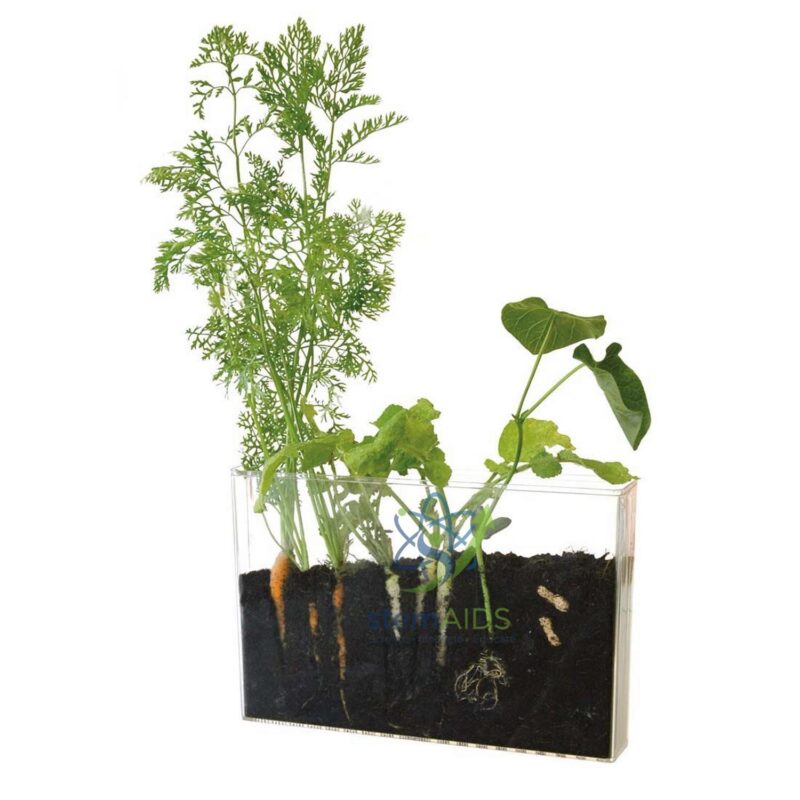
Quick Answer: Kit 2 Rhizotrons is a set of two root-viewing boxes, each a narrow soil-filled container with a transparent face, so plant roots grow against the clear wall where they can be seen and measured. The listing photo shows one planted with carrot and bean seedlings, their roots visible through the side.
Watching Roots Without Digging
Roots are normally hidden, and pulling up a plant to look at them ends the experiment. The kit solves this by making part of the root system grow along a transparent panel. Because the soil layer is thin, many roots meet the panel and can be followed day by day as they elongate, branch and form root hairs.
Two points of technique make a big difference. First, keep the clear face covered with a dark sheet or card between observations, since roots grow away from light and algae would otherwise coat the soil surface. Second, tilt the box slightly so the transparent face is underneath; gravity then steers roots downwards onto the panel, and they keep growing along it.
Having two units in one kit makes simple comparisons possible: two soil types, watered and dry conditions, or a tap-rooted plant like carrot against a fibrous-rooted grass or cereal. The monocotyledon root model helps students link what they see through the panel to internal root structure.
Root Experiments
- Measuring root growth rate by marking root tips on the panel every day
- Comparing tap-root and fibrous-root systems side by side
- Showing gravitropism by turning one box on its side and watching root tips bend downwards
- Studying how compacted or dry soil changes root spread
- Observing earthworm burrows or fungal threads that form against the clear face
Specifications
| Contents | Two root-viewing units |
| Design | Narrow soil box with a transparent viewing face |
| Growing medium | Soil or compost, filled before sowing |
| Suitable plants | Fast-growing seeds such as beans, peas, maize, radish, carrot or grasses |
| Dimensions and panel material | Confirm at enquiry |
Care & Handling
- Fill the soil evenly and firm it lightly so it stays in contact with the panel; gaps leave roots growing in air.
- Water gently from the top and avoid waterlogging, which starves roots of oxygen.
- Keep the viewing face covered except during observations.
- Clean the panel with water and a soft cloth between uses to keep the viewing area free of scratches and stains.
Why Choose LabEquip
Biology teachers, agriculture colleges and plant-science clubs use a rhizotron kit to turn root growth into something students can measure rather than imagine. LabEquip includes it in the General Lab Products range; an LED Grow Light keeps the plants growing on a shelf away from windows.
Frequently Asked Questions
Why does a rhizotron need to be tilted?
Roots grow downwards under gravity. When the box leans with the transparent face underneath, roots that reach the panel keep following it instead of turning back into the soil, so more of the root system stays visible.
Which seeds grow fastest for root observation?
Broad beans, peas, maize, radish and cress show root growth within days. Carrot and other tap-rooted plants are slower but produce a strong main root, which contrasts well with the fibrous roots of grasses and cereals.
Why should the clear panel be covered between observations?
Light on the panel encourages algae to grow on the soil surface and can make roots grow away from the glazing. A dark sleeve or card keeps conditions close to those underground.
How is root growth measured?
Mark the position of selected root tips on the panel with a fine marker each day and measure the distance between marks. Plotting length against time gives a growth rate that can be compared between the two units.
Can the units be reused?
Yes. Empty the soil after each experiment, wash the frames and panel with water, and let them dry before refilling. Avoid scouring the clear face, which would cloud the view.
What kind of soil should be used?
A fine, sieved soil or seed compost gives good contact with the panel and lets roots be seen clearly. Coarse material with stones and lumps leaves gaps and hides roots.
Last Updated: September 2026





Reviews
There are no reviews yet.