



In Stock
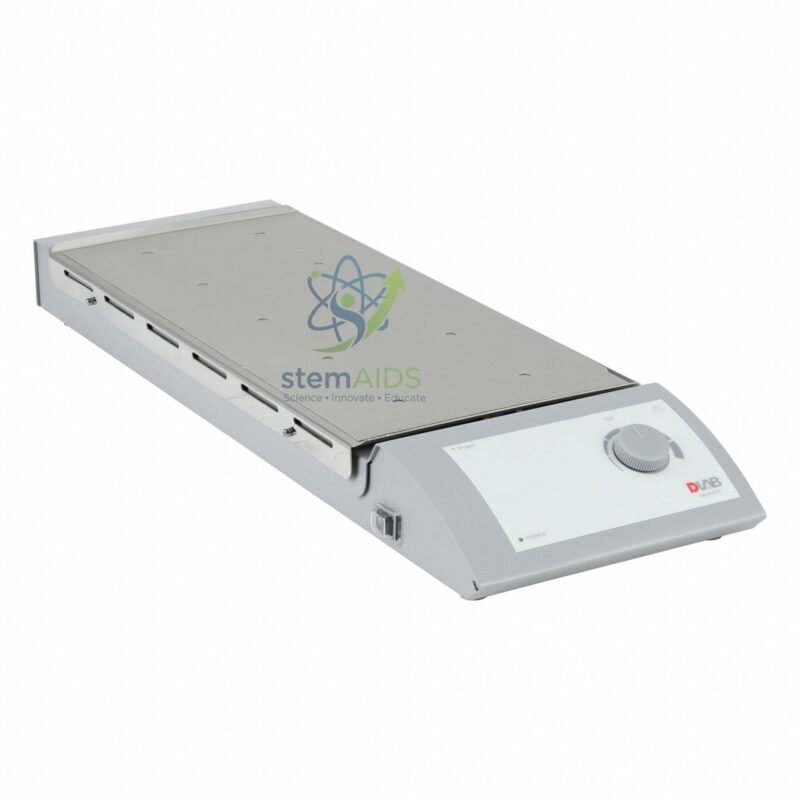
Non-heating magnetic stirrer
₹60,523.00
Quick Answer: Non-heating magnetic stirrer is a stirring-only bench unit that mixes liquids with a rotating stir bar and has no heater under its top plate. A non-heating magnetic stirrer is chosen when samples must stay at room temperature, or when heat would be a hazard or a source of error.
When No Heater Is the Better Choice
A hotplate stirrer with its heater off still has a heating element under the top and a knob that can be turned by mistake. For some work that risk is not worth taking: dissolving a heat-sensitive enzyme, stirring a solution whose temperature is itself the measurement, or leaving a slurry to equilibrate for hours. A unit without a heater removes the possibility altogether, and it is also a simpler choice for younger students.
Stirring still adds a little energy. Motor warmth passes through the plate, and the spinning bar warms the liquid slightly by friction, so over long runs a small volume can creep up by a degree or so. Checking the temperature at intervals keeps this under control where it matters.
The web address of this product carries DLAB’s code MS-M-S10, which DLAB uses for a ten-position stirrer without heating. The title itself describes a non-heating stirrer without mentioning positions, so confirm at enquiry whether the ten-position model or a single-position unit will be supplied.
Typical Room-Temperature Work
- Measuring a temperature change, as in dissolving ammonium nitrate or a neutralisation, where outside heat would distort the result
- Keeping enzyme or protein solutions mixed without warming them
- Long equilibration runs, such as a dye being adsorbed onto activated charcoal
- Stirring with younger classes, where a hot surface would add a risk
Specifications
| Type | Magnetic stirrer without heater |
| Temperature | Stirs at room temperature |
| Model reference in page address | DLAB MS-M-S10 |
| Suited vessels | Flat-bottomed beakers, flasks and bottles |
| Number of stirring positions | Confirm at enquiry |
Good Practice
- Check the vessel temperature during long runs if the result depends on it.
- Use the lowest speed that keeps the liquid moving; faster stirring adds friction heat and splashing.
- Keep the stirrer dry, and unplug it before wiping the top.
Why Choose LabEquip
Schools and colleges often buy a non-heating stirrer for general benches and keep heated units for the prep room. LabEquip lists it in General Lab Products along with the non-heating multi-position magnetic stirrer for class sets; confirm the model you need through the contact page.
Frequently Asked Questions
Why buy a stirrer without a heater?
It cannot warm a sample by mistake, has no hot surface for students to touch and suits temperature-sensitive work. It is also a simpler unit for routine mixing where heat is never needed.
Can a non-heating stirrer be used in a calorimetry practical?
Yes. Stand an insulated cup inside a beaker on the plate with a small stir bar in the cup, so the liquid is mixed evenly while the temperature change of a reaction or dissolving process is recorded.
Does stirring warm the liquid at all?
Slightly. Motor warmth and friction from the spinning bar can raise a small volume by about a degree over a long run. For most work this is negligible; check it where temperature is being measured.
Can I stir a sample in an ice bath?
Yes. Stand the sample vessel in a beaker of ice and water on the plate, keeping the ice bath shallow enough that the bar stays coupled. Dry off any condensation from the stirrer afterwards.
What is MS-M-S10 in the page address?
It is a DLAB model code for a multi-position stirrer without heating. Whether that model or a single-position stirrer is supplied should be confirmed at enquiry.
Which speed should I use?
The lowest speed that keeps the whole liquid moving, with a shallow dimple at the surface. Higher speeds splash, add friction heat and make the bar more likely to decouple.
Last Updated: September 2026
You must be logged in to post a review.
Bestsellers




Reviews
There are no reviews yet.