





In Stock
Culture room and educational incubator
Chambre de culture et incubateur didactique features a programmable heating element and a full-spectrum LED array engineered to simulate precise photoperiods and diurnal thermal cycles required for sensitive bio-assays.
High-Transmittance UV-Stabilized Chassis Constructed with an optically clear, gasket-sealed interface and modular ventilation ports to maintain internal atmospheric equilibrium while providing distortion-free visual access for specimen documentation.
₹25,600.00
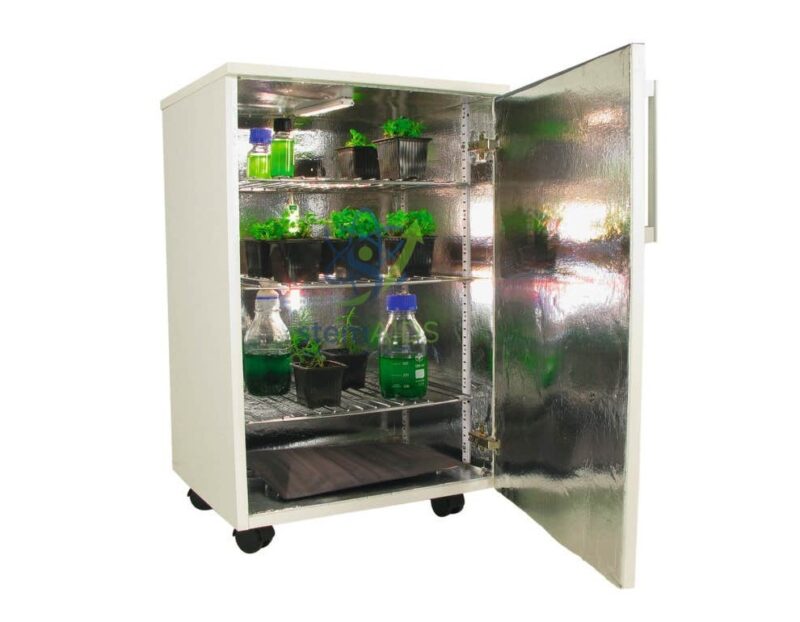
Quick Answer: The Culture Room and Educational Incubator is a free-standing growth cabinet, pictured on castors with reflective inner walls, wire shelves and internal lighting, holding potted plants and culture bottles. Schools and colleges use this educational incubator to grow plants, algae and other cultures under steady, repeatable conditions.
A Controlled Space for Growing
Growth on a windowsill varies with the weather, the season and the time of day, which makes experiments hard to repeat. A closed cabinet with its own lighting reduces that variation: every shelf gets the same day length, and the inside stays steadier in temperature than an open room. The reflective walls visible in the listing photo bounce light back towards the plants, so lower leaves and the sides of pots receive more light.
The title calls the unit an incubator, which implies temperature control, but the lighting type, temperature range, timer functions and any humidity control are not stated. Those details decide which experiments it can run, from seed germination at a set temperature to photoperiod tests, so they should be confirmed before planning a course around it. An incubator thermometer on each shelf is a simple way to check that conditions match the setting.
The castors let the cabinet move between a prep room and a classroom, and the wire shelves allow air to circulate around pots and flasks. For smaller-scale growing on a bench, the LED Grow Light above a propagator gives similar control of light at a desk.
Specifications
| Type | Growth cabinet and educational incubator |
| Pictured features | Reflective inner walls, wire shelves, internal lighting, castors |
| Door | Single hinged door, as pictured |
| Typical contents | Seed trays, potted plants, algae or culture flasks |
| Lighting, temperature range and controls | Confirm at enquiry |
Experiments It Supports
- Germination tests comparing seeds at the same temperature and light
- Photoperiod studies with day length controlled by the lighting
- Growing algae cultures for photosynthesis and food-chain practicals
- Raising plants for genetics crosses or tropism experiments through the year
- Incubating sealed agar plates from environmental sampling at temperatures suited to school microbiology
Care & Handling
- Stand the cabinet on a level floor, lock the castors and keep ventilation openings clear.
- Wipe shelves and walls with a mild disinfectant between projects to prevent mould and algae build-up.
- Keep water away from electrical parts and lighting, and put water trays on the lower shelves.
- Keep agar plates taped and unopened, and sterilise them before disposal.
Why Choose LabEquip
Biology departments, agriculture colleges and teacher-training institutes use a growth cabinet of this kind to run plant and culture work all year. LabEquip lists it in the General Lab Products range; send your temperature and lighting requirements through the contact page before ordering.
Frequently Asked Questions
What is the difference between a growth chamber and an incubator?
A growth chamber is mainly about light and day length for plants, while an incubator is mainly about holding a set temperature for cultures. A cabinet that does both lets plant and microbiology work share one controlled space.
What temperature should school microbiology plates be incubated at?
School guidance commonly recommends no more than about 25 to 30 °C, below body temperature, so that organisms adapted to the human body are less likely to grow. Plates should stay sealed with tape and be incubated upside down.
Why are the walls reflective?
Reflective walls send light that would otherwise be absorbed by the cabinet back onto the plants. That raises the light reaching lower shelves and the sides of pots and makes growth more even across the cabinet.
How can students check the conditions inside?
Place a thermometer or data logger on each shelf and record readings at set times. Light can be compared with a light meter or a phone light sensor. Recording conditions is part of a fair test.
Can algae or duckweed be grown in the cabinet?
Yes. Flasks of algae culture or trays of duckweed grow well under steady light and temperature, and the cabinet keeps them away from draughts and direct sun. Swirl algae flasks daily to keep cells in suspension.
Where should the cabinet be located?
In a room with stable temperature, away from radiators and direct sunlight, with space around it for air circulation and a socket nearby. The castors make it easier to move for cleaning.
Last Updated: September 2026
You must be logged in to post a review.
Bestsellers




Reviews
There are no reviews yet.