
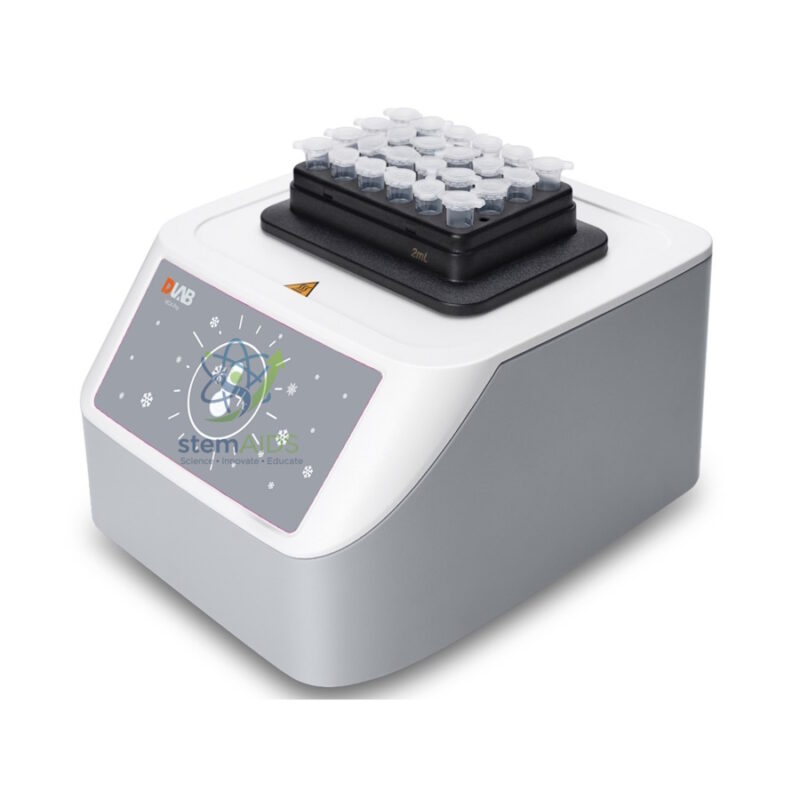
Quick Answer: The CT4-Pro Dlab Cooled Dry Bath is a bench-top block instrument from DLAB that holds tubes in a metal block cooled below room temperature, replacing an ice bucket for cold sample work; the photo shows a white housing with a round control panel and a dark tube block on top.
Cold Without Ice
An ice bucket is cheap, but its temperature drifts as the ice melts, water pools around the tubes and labels smear. A cooled dry bath does the same job with a metal block held at a set temperature, so tubes stay dry and every position is alike. That suits enzyme set-ups, PCR preparation and any sample that should stay cold while it is pipetted.
Block coolers of this kind generally rely on thermoelectric (Peltier) elements under the block, which pump heat out of the metal and release it through a heat sink and fan. Many such units can also run in reverse to heat, but the title only states cooling, so the CT4-Pro’s actual range and any heating function should be confirmed.
The photo shows the CT4-Pro with a dark block fitted. Whether a block is included, or bought separately to suit your tubes, is not clear from the title. A clear cover for tube block is listed for keeping room air off the samples.
Specifications
| Type | Cooled dry bath (block cooler) |
| Model and brand | CT4-Pro, DLAB, as titled |
| Housing | White, with round control panel, as pictured |
| Block | Dark tube block shown fitted in the photo |
| Cooling | Block held below room temperature |
| Range, included block and power supply | Confirm at enquiry |
Applications
- Keeping enzymes, master mixes and competent cells cold during set-up
- Holding samples cold between steps in nucleic acid and protein work
- Chilling tubes quickly after a heating step
- Replacing ice buckets in teaching labs where melted ice causes mess
Care & Handling
- Leave space around the CT4-Pro so its fan can move air; blocked vents reduce cooling.
- Wipe condensation from the block after cold runs and let it dry before storage.
- Pipette over the block, not over the controls, and keep liquids out of the housing.
- Clean the wells with a soft brush and mild detergent, without scratching the metal.
Why Choose LabEquip
Molecular biology and biochemistry labs choose a cooled block when they want repeatable cold without ice. LabEquip supplies DLAB instruments and dry-bath accessories through General Lab Products, and confirms block options through the contact page.
Frequently Asked Questions
How does this instrument differ from a refrigerator?
A refrigerator cools the air around samples, which takes time to reach them. Here the tubes sit in contact with a cold metal block, so they reach its temperature quickly and stay there while you work.
Can it go below freezing?
That depends on the CT4-Pro’s specified range, which the title does not give. Peltier block coolers vary, and the lowest temperature reached also depends on how warm the room is.
Why is there condensation on the block?
Moist room air condenses on any surface colder than its dew point. A cover over the block and a dry room reduce it; wipe the block dry after use.
Does it need ice or coolant?
No. The block is cooled electrically, so there is no ice to replace and no water collecting around the tubes.
Which tubes can I use?
The tubes must match the wells of the block fitted. Blocks are made for microtubes, PCR tubes and other formats, so choose the block for the tubes you use most.
Where should the instrument be placed?
On a stable bench with free air flow around the vents, away from heat sources and direct sun. Warm surroundings make the cooling system work harder.
Last Updated: October 2026





Reviews
There are no reviews yet.