





In Stock
Crucible, Porcelain, Squat Form
High-Alumina Refractory Grade: Formulated with specialized ceramic material rated for sustained use at 1050°C, providing the mechanical strength necessary to support heavy metallic samples without structural deformation or gas permeability.
Vitrified Non-Porous Glaze: Internally coated with a lead-free, chemically resistant finish that prevents molten flux penetration and minimizes sample adhesion, ensuring high-purity results in quantitative trace element analysis.
₹540.00
Quick Answer: A squat form crucible, also called a low form crucible, is a glazed porcelain crucible that is wider than it is tall, used for ignition, ashing and heating samples to constant mass where a large exposed surface and a stable base help.
Low, Wide and Stable
Porcelain crucibles come in tall (high), medium and squat (low) forms. The squat form spreads a sample over a wider base, so more of it is exposed to air and heat. That speeds ashing of organic material, where oxygen must reach the sample, and helps a hydrated salt lose its water evenly. The low shape also has a lower centre of gravity, so it sits steadily on a triangle and is less likely to tip when handled with tongs.
Tall forms are preferred when a sample may froth, spit or creep, because the higher walls contain it. For ordinary ignitions to constant mass, heating residues, and school experiments such as burning magnesium in a lidded crucible, the squat form is the convenient choice. Glazed porcelain resists most acids and can be taken to red heat over a Bunsen or in a muffle furnace, provided it is heated and cooled gradually.
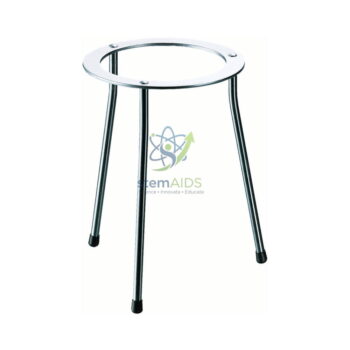
Support the crucible on a clay pipe triangle over a tripod, and move it only with crucible tongs. The capacity, and whether a lid is supplied, are not stated in the listing.
Applications
- Burning magnesium ribbon to find the empirical formula of magnesium oxide.
- Ash content of foods, feeds, soils and plant material.
- Heating hydrated salts to find the number of molecules of water of crystallisation.
- Igniting precipitates to constant mass in gravimetric analysis.
Specifications
| Item | Crucible, squat (low) form |
| Material | Glazed porcelain |
| Shape | Wider than tall, with a broad base |
| Heating | Pipeclay triangle over a burner, or muffle furnace |
| Typical uses | Ignition, ashing, removing water of crystallisation |
| Capacity and lid | Confirm at enquiry |
Care & Handling
- Mark crucibles with a heat-stable ink or number, never a paper label.
- Heat slowly at first, especially if the crucible is damp.
- Cool on a heat-resistant tile and then in a desiccator before weighing.
- Remove inorganic residues with a dilute acid; organic residues can be burned off.
Why Choose LabEquip
School chemistry departments, food and agricultural testing labs and colleges teaching gravimetric methods buy squat form crucibles in sets. LabEquip lists them in General Lab Products; tell us the capacity and number needed through the contact page.
Frequently Asked Questions
What is the difference between squat, medium and tall form crucibles?
They differ in height relative to width. Squat forms are low and wide for a large exposed surface and stability; tall forms have high walls that contain frothing or spitting samples; medium forms sit between the two.
Why is a squat crucible preferred for ashing?
Ashing needs oxygen to reach the burning organic matter. A low, wide crucible spreads the sample in a thin layer, so it burns more completely and quickly.
Can a porcelain crucible be heated to red heat?
Yes, glazed porcelain crucibles are routinely heated to red heat over a Bunsen burner and in muffle furnaces. Heat and cool them gradually to avoid cracking.
Why use a lid when burning magnesium?
The lid stops magnesium oxide smoke from escaping, which would lower the measured mass. It is lifted briefly from time to time with tongs to let air in so the magnesium keeps burning.
How should a hot crucible be cooled before weighing?
Let it cool briefly on a heat-resistant tile, then place it in a desiccator until it reaches room temperature. Weighing a warm crucible gives low readings because of convection currents.
Can a squat form crucible be used on a hot plate?
It can be warmed on a hot plate for drying, but a hot plate does not reach the temperatures needed for ignition or ashing. For those, a Bunsen flame on a triangle or a muffle furnace is needed.
Last Updated: September 2026
You must be logged in to post a review.
Bestsellers




Reviews
There are no reviews yet.