



In Stock
Burette Clamp Double, Pressure Die Casting, Euro Design
Pressure Die-Cast Metal Construction: Durable and sturdy body that withstands repeated laboratory use while remaining lightweight for ease of adjustment.
Double Clamp Design: Holds two burettes at once, improving efficiency in experiments requiring parallel measurements.
₹250.00
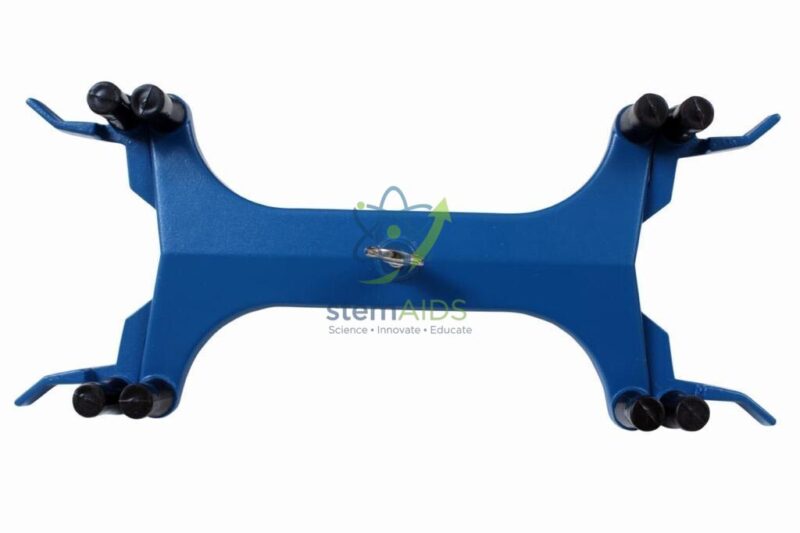
Quick Answer: The Burette Clamp Double, Pressure Die Casting, Euro Design is a double burette clamp of the butterfly type: it fixes to a single retort stand rod through its centre and grips one burette in each wing. The listing image shows a blue coated die-cast frame with rubber-tipped fingers at both ends.
Two Burettes on One Stand
Holding a burette in each wing is what makes back titrations and paired titrations practical from one stand. Excess standard acid can be run from one burette and the unreacted amount titrated with alkali from the other, without moving glassware between stands. In a teaching lab the same arrangement lets two students work from one base, or a teacher run a blank beside a sample. A typical pairing is two PTFE key burettes, which need no greasing.
Pressure die casting forces molten metal into a steel mould under pressure, giving bodies of consistent shape and wall thickness. For a double clamp that consistency matters, because both wings must hold their burettes parallel to the stand rod; a twisted wing leans one burette and makes its meniscus harder to read square-on. The title does not name the alloy, and ‘Euro design’ describes the pattern of the casting, not a standard.
Burettes are pushed into the fingers from the front and held round the barrel. Before filling, sight each burette against a vertical edge such as a door frame, from the front and the side, and adjust the stand until both hang straight.
Applications
- Back titrations, with acid in one burette and standard alkali in the other
- Running a sample titration and a blank titration side by side
- Shared practical stations where two students titrate from one stand
- Keeping a rinsed spare burette ready beside the one in use during long assessments
Specifications
| Holds | Two burettes, one in each wing |
| Body | Pressure die-cast, Euro design pattern |
| Mounting | Centre fixing onto a retort stand rod |
| Grip | Fingers with rubber tips at each end (as pictured) |
| Finish | Blue coating shown in the listing image |
| Burette diameter range | Confirm at enquiry |
Care & Handling
- Insert and remove burettes with a straight push or pull at the fingers, not by twisting the barrel, which strains the glass near the tap.
- Fill each burette below eye level, lowering the double burette clamp if necessary, and remove the filling funnel before titrating.
- Check the finger tips regularly; if a rubber tip is lost, bare metal can chip the burette.
- Where only one burette is fitted, turn the stand so the loaded wing sits over its base.
Why Choose LabEquip
School chemistry departments that run titration practicals for whole classes are the main buyers of double clamps, since one stand then serves two burettes. LabEquip supplies it in the General Lab Products range alongside single clamps; tell us how many stations you are equipping.
Frequently Asked Questions
What is a double burette clamp used for?
It holds two burettes on one retort stand. The usual reasons are back titrations, running a blank beside a sample, or letting two students share a stand during a practical.
Does a double burette clamp need a boss head?
The butterfly pattern shown fits straight onto the stand rod through its centre and is fixed there by a screw, so no separate boss head is used. Clamps supplied on their own rod are the ones that need a boss head.
What does pressure die casting mean?
It is a process in which molten metal is injected under pressure into a steel mould. It gives a dense, consistently shaped casting, which helps both wings hold their burettes in line.
Will it hold plastic burettes as well as glass?
Generally yes, provided the outside diameter falls within the grip of the fingers. Plastic burettes are lighter, so check that the fingers still grip firmly enough that the barrel does not turn when the tap is used.
How do I make sure each burette is vertical?
Look at each burette from the front and from the side against a vertical edge such as a door frame. Adjust the stand or the burette in the fingers until it lines up in both views, then read the meniscus at eye level.
Can one burette be removed while the other is in use?
Yes. Each wing grips its own burette, so one can be taken out for rinsing or refilling while the other stays in place. Steady the stand with your free hand while you do it.
Last Updated: September 2026
You must be logged in to post a review.
Bestsellers




Reviews
There are no reviews yet.