









In Stock
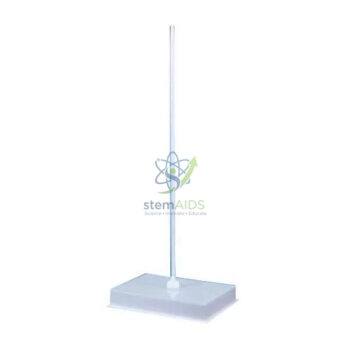
Bernard’s Complete Calcimeter on Base
Calcimètre de Bernard Complet sur Socle Allows for high-frequency chemical reactivity analysis of carbonate samples, enabling the evaluation of soil fertility and pH buffering capacity.
Méthode éprouvée ensures pressure equalization for accurate volumetric reading, allowing students to mitigate systemic measurement errors during displacement analysis.
$163.56
Quick Answer: Bernard’s Complete Calcimeter on Base is a gas-volume apparatus that estimates the calcium carbonate content of soil, rock or sediment. Hydrochloric acid releases carbon dioxide from the sample, and the gas volume is read on a graduated tube linked to a levelling reservoir, with the whole Bernard calcimeter mounted on one base.
How the Bernard Calcimeter Measures Carbonate
The calcimeter works on a simple reaction: calcium carbonate and hydrochloric acid give calcium chloride, water and carbon dioxide. The sample is weighed into a small reaction flask, a short tube of dilute acid is stood upright inside it, and the flask is stoppered and joined to the measuring tube. Tilting the flask spills the acid onto the sample. The carbon dioxide released pushes liquid down the graduated tube, and the change in level gives the volume of gas.
The levelling reservoir is what makes that reading meaningful. It is joined to the foot of the graduated tube by flexible tubing, and before each reading it is raised or lowered until the liquid stands at the same height in both, so the gas is measured at atmospheric pressure. Running the same procedure on a weighed portion of pure calcium carbonate gives a reference volume, and the carbonate content of the sample is then worked out by proportion. Doing both on the same day cancels most of the effect of room temperature and air pressure.
The word ‘complete’ in the title indicates an assembled set on its own base rather than loose glass parts. The exact items supplied, such as the reaction flask, acid tube, tubing, reservoir and clamps, are not itemised in the listing and are worth confirming before a laboratory order.
Specifications
| Instrument | Bernard calcimeter, gasometric (gas-volume) type |
| Measures | Volume of carbon dioxide released from carbonates by hydrochloric acid |
| Main parts | Graduated gas tube, levelling reservoir, reaction flask with acid tube, connecting tubing |
| Mounting | Supplied complete on a base |
| Reference | Pure calcium carbonate run under the same conditions |
| Graduation range and parts list | Confirm at enquiry |
Where the Calcimeter Is Used
- Soil science practicals comparing the carbonate (lime) content of soils from different sites or soil horizons
- Geology classes classifying limestones, marls and calcareous sandstones by their carbonate percentage
- Agriculture and environmental courses studying how carbonate content relates to soil pH and nutrient availability
- Demonstrations of gas evolution and of measuring a gas volume at atmospheric pressure
Care & Handling
- Wear eye protection and gloves when dispensing hydrochloric acid, and lower the acid tube into the flask with forceps so it stays upright until the stopper is in.
- Test for leaks before each series by raising the reservoir and watching whether the level in the graduated tube holds steady.
- Empty and rinse the reaction flask after every sample, since leftover acid and soil affect the next run.
- Keep the apparatus out of direct sunlight and away from heaters while measuring; warming the flask expands the gas and inflates the reading.
Why Choose LabEquip
Soil laboratories in agricultural colleges and geology departments usually need one calcimeter per working group, plus spare reaction flasks. LabEquip lists this apparatus under General Lab Products, and a 250 ml borosilicate conical flask is handy for weighing out and pre-testing samples. Parts lists and group quantities can be arranged through the contact page.
Frequently Asked Questions
What does a Bernard calcimeter actually measure?
It measures the volume of carbon dioxide given off when a sample is treated with hydrochloric acid. That gas comes from the carbonates in the sample, so the volume is converted into an equivalent calcium carbonate percentage by comparison with a pure calcium carbonate standard.
Why is a calcium carbonate standard run alongside the samples?
Gas volume changes with temperature and air pressure. Measuring a known mass of pure calcium carbonate under the same conditions gives a reference volume, so the sample result is calculated by proportion and the day-to-day conditions largely cancel out.
Why must the reservoir be levelled before reading the volume?
If the liquid in the reservoir sits higher or lower than in the graduated tube, the trapped gas is compressed or expanded relative to atmospheric pressure and the reading is wrong. Bringing both levels together puts the gas at room pressure before it is read.
Does the calcimeter distinguish calcite from dolomite?
Not in a single quick reading. Dolomite reacts far more slowly with cold dilute acid than calcite, so a short reading mainly reflects calcite. Recording the volume at intervals shows whether a slow second release of gas is taking place.
What liquid goes in the measuring tube?
Water is commonly used, often as a salt solution with a few drops of dye so the level is easy to see. Salt reduces how much carbon dioxide dissolves in the liquid, which would otherwise make the measured volume slightly low.
How much soil should be weighed for each test?
Enough to give a clear gas volume without overrunning the graduated tube. Carbonate-rich soils need a smaller mass than soils with little carbonate, so a quick fizz test with a drop of dilute acid is a useful way to judge the amount before weighing.
Last Updated: September 2026
You must be logged in to post a review.
Bestsellers




Reviews
There are no reviews yet.