
Quick Answer: The Bec Mecker with tap for all gases is a Meker burner: a laboratory gas burner whose wide mouth is closed by a metal grid, fitted with its own tap, which produces a short, hot and evenly spread flame for heating crucibles and small items to high temperature.
What Makes a Meker Burner Different
Bec Mecker in the title is the French form of the name: bec means burner, and the design is named after the French chemist Georges Méker, so the English spelling is Meker. In a Bunsen burner the gas and air burn as one cone with a cooler inner zone. The Meker head carries a metal grid that splits the stream into many small flames side by side, each with only a tiny inner cone, so the hottest part of the flame sits just above the grid and is spread across the whole head.
That flat bed of heat is what analytical chemists want when a crucible has to reach red heat evenly, for example when igniting a precipitate to constant mass. A Bunsen flame of similar size heats a crucible more patchily, with a hot ring and a cooler centre.
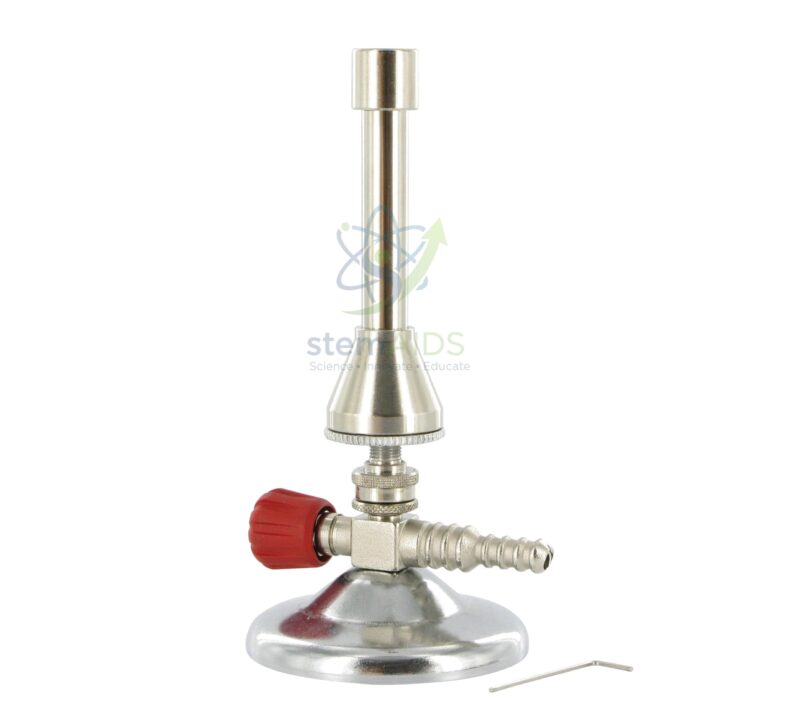
The listing photo shows a round weighted base, a red-knobbed tap with a ribbed hose nozzle and a small hex key; its narrow top tube over a conical lower barrel looks more like a Teclu-type burner than a grid head, so ask us to confirm the head design before ordering. ‘For all gases’ refers to gas type: natural gas and liquefied petroleum gas need different jet settings, and a burner sold for all gases is set up for the gas actually in use.
Jobs Where a Meker Burner Earns Its Place
- Igniting precipitates in porcelain or silica crucibles during gravimetric analysis
- Heating small samples to constant mass, or to red heat, on a pipe-clay triangle
- Fusions and ashing of small samples where a Bunsen flame is too cool or too uneven
- Showing students how flame structure changes between a Bunsen and a grid-head burner
Specifications
| Burner type | Meker (grid-head) laboratory burner, as titled |
| Gas control | Tap on the burner body, as pictured |
| Gases | Titled for all gases; set up for natural gas or LPG as used |
| Base | Round weighted base, as pictured |
| Hose connection | Ribbed side nozzle for burner tubing |
| Head shown in photo | Confirm grid-head design at enquiry |
Care & Handling
- Connect with safety burner tubing pushed fully onto the nozzle, and replace tubing that has hardened or cracked.
- Keep the head clear: once the burner is cold, brush off soot and anything that has dropped onto it, because blocked openings make the flame uneven.
- Adjust gas and air until the flame forms a steady bed of small blue cones; a yellow or lifting flame needs resetting.
- Close the burner tap and the supply valve after use, and remember the head and barrel stay hot for several minutes.
Why Choose LabEquip
Colleges and analytical teaching labs running gravimetric practicals buy this grid-head burner when crucibles must reach red heat. LabEquip lists it in General Lab Products alongside crucible triangles; tell us your gas type through the contact page so the burner is set up to match.
Frequently Asked Questions
Is a Meker burner hotter than a Bunsen burner?
Generally yes. The grid breaks the flame into many small cones, so the hottest zone is spread across the whole head and sits just above it. Objects placed there reach a higher and more even temperature than in the single cone of a Bunsen flame.
Why is it called Bec Mecker in the title?
Bec Meker is the French name, bec meaning burner. The burner is named after Georges Méker, so the usual English spelling is Meker, without the letter c. It is the same type of burner.
Can one burner run on both LPG and natural gas?
It is titled for all gases, meaning it can be set up for either, but not for both at the same time. LPG and natural gas need different gas flows through the jet, so the burner has to match the gas actually connected.
Where should a crucible sit in the flame?
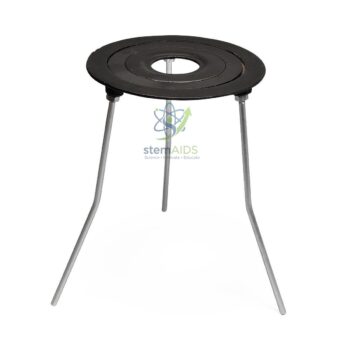
Support it in a pipe-clay triangle on a tripod with the crucible base just above the grid, where the small blue cones end. Holding it much higher wastes heat, and resting it on the grid blocks openings and disturbs the flame.
Why does the flame burn yellow or lift off the head?
A yellow, sooty flame usually means too little air or a partly blocked grid. A flame that lifts and roars means too much gas or air. Reset the tap and the air setting, and clean the head once it is cold.
Is this burner needed for sterilising loops?
No. A Bunsen or cartridge burner flames loops well. The grid-head burner is better kept for high-temperature jobs such as igniting crucibles.
Last Updated: October 2026




Reviews
There are no reviews yet.