
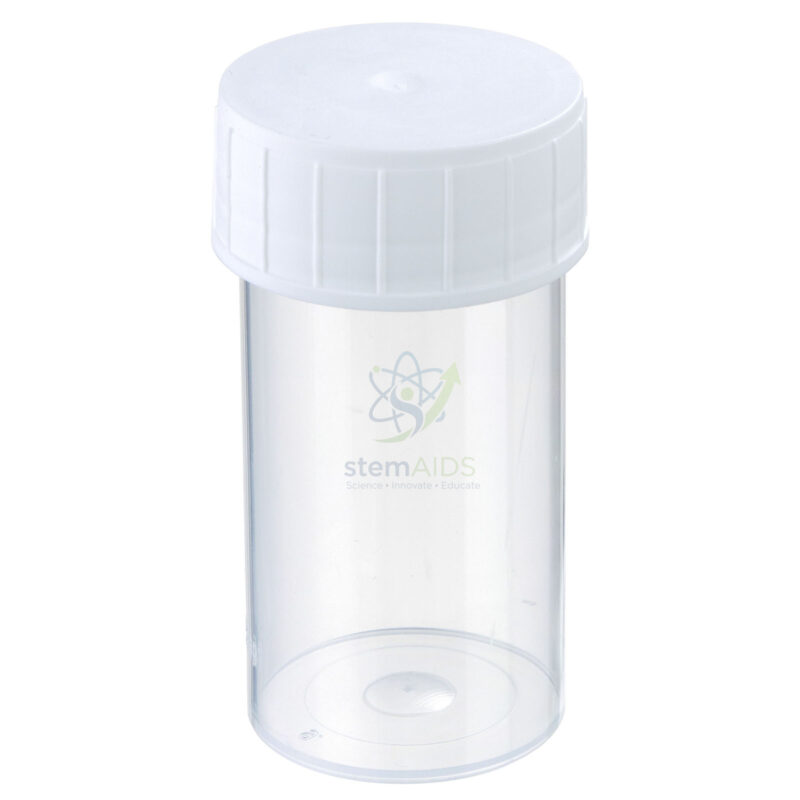
Quick Answer: Aerated Hunting Flasks are clear plastic collecting pots with white screw caps, as pictured, described as aerated so that live insects, spiders and other small animals can be carried from the field for a short time. In entomology practicals they hold the catch from nets, beating trays and aspirators until it is examined and released.
Collecting Pots for Fieldwork
In the field, each find is usually kept separately so that predators do not eat prey and fragile animals are not crushed. Small, clear pots suit this well: the animal can be seen from every side, the screw cap closes firmly in a pocket or bag, and the pot can be labelled with the site and time. A pot of this shape also stands upright on a bench for drawing and identification.
Ventilation matters when animals are kept alive, and the title describes these flasks as aerated. The listing photo shows a plain clear pot and cap without visible holes, so check how ventilation is provided before relying on the flasks for longer holds. A small piece of leaf or damp tissue inside adds humidity and shelter.
The catch from a Japanese Umbrella beating tray or an aspirator can be tipped straight into a flask. For closer examination through a lens, move the animal to a Magnifying Glass Box.
Uses in Entomology
- Holding individual insects collected during a school grounds survey
- Carrying spiders or beetles back to the lab for identification with a key
- Short-term observation of feeding or behaviour before release
- Keeping specimens separate for photographs and size measurements
Care & Handling
- Keep occupied flasks in the shade; a closed pot in sunlight heats up quickly.
- Put only one animal, or several of the same small species, in each flask.
- Release animals where they were found, ideally the same day.
- Wash flasks with warm soapy water after use and dry them with the caps off.
Specifications
| Type | Clear collecting pot with screw cap |
| Described as | Aerated, for live specimens (per title) |
| Pictured | Clear plastic pot with white screw cap |
| Suitable for | Insects, spiders, woodlice and other small invertebrates |
| Capacity and pack quantity | Confirm at enquiry |
Why Choose LabEquip
Primary and secondary teachers, field-study centres and entomology clubs buy collecting pots in quantity so that every group can keep its finds separate. LabEquip lists these flasks in the General Lab Products range.
Frequently Asked Questions
How long can an insect be kept in a collecting flask?
For a few hours at most during normal fieldwork, and less on hot days. Add a leaf or damp tissue, keep the flask cool and shaded, and release the animal once it has been identified.
Why keep each animal in its own flask?
Some insects and spiders are predators and will attack others in a shared pot, and larger animals can crush small ones. Separate flasks also make it easy to label each find with its site and time.
Can the flasks be used to preserve specimens?
They can hold specimens in ethanol for a reference collection if the cap seals well, but check that the plastic suits the preservative first. For live collecting, keep preservatives out entirely.
How should a flask be labelled in the field?
Write the site, date, time and collector on a small label or on masking tape stuck to the pot, using pencil or waterproof ink. A matching number in a field notebook links the pot to notes about the habitat.
How do I get an insect into the flask without touching it?
Hold the open flask below the insect and use the cap or a card to guide it in, or tip it from a net or beating tray. Small insects can be sucked up with an aspirator and then emptied into the flask.
Are the flasks reusable?
Yes. Wash them with warm soapy water, rinse and let them air dry with the caps off. Replace any that crack or whose caps no longer close firmly.
Last Updated: September 2026




Reviews
There are no reviews yet.