








Sale
In Stock
Plant Genetics Meiosis Chart
Original price was: ₹340.00.₹160.00Current price is: ₹160.00.
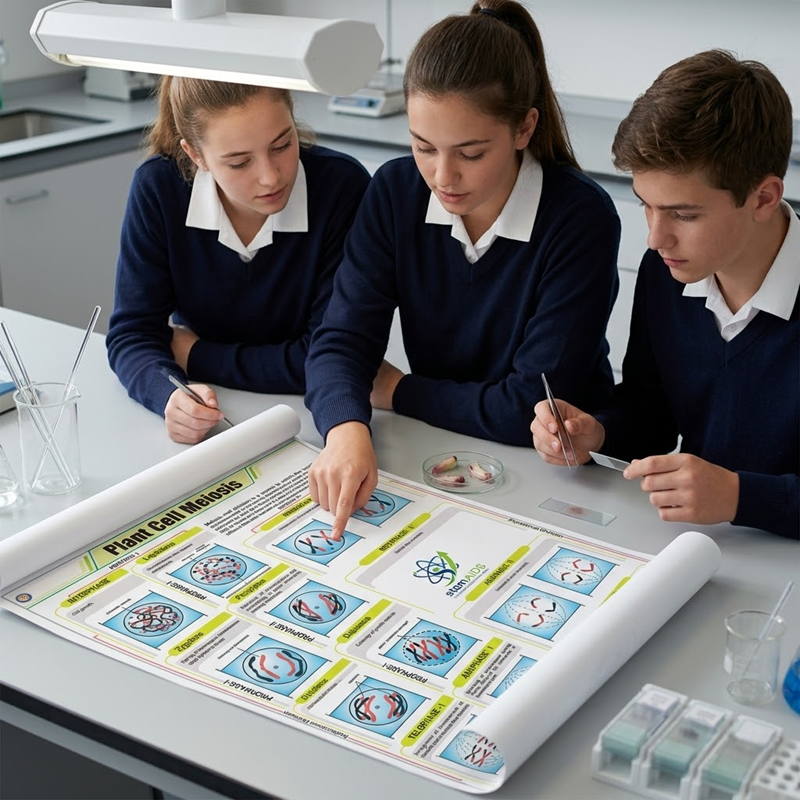
Quick Answer: The Plant Genetics Meiosis Chart is a biology wall chart that shows meiosis stage by stage, from the pairing of homologous chromosomes and crossing over in prophase I to the four haploid cells at the end of meiosis II, set in the context of plant reproduction. This meiosis chart is used to teach cell division and the basis of inheritance.
Meiosis, Stage by Stage
Meiosis is the division that halves the chromosome number, and it is easiest to follow as a sequence. A chart of this kind usually draws a cell with a small number of chromosome pairs, often in two colours so students can tell maternal from paternal copies, and follows it through meiosis I, where homologous chromosomes pair and then separate, and meiosis II, where sister chromatids separate as in mitosis. The result is four cells, each with one set of chromosomes.
Prophase I carries most of the labels. Homologous chromosomes pair up as bivalents, and non-sister chromatids exchange segments by crossing over, visible later as chiasmata. Detailed charts name the substages, leptotene, zygotene, pachytene, diplotene and diakinesis, while simpler ones show pairing and crossing over in one or two drawings. In metaphase I, pairs rather than single chromosomes line up on the equator, and the random way each pair orients is the basis of independent assortment.
The plant angle is what sets this chart apart from a general cell-division chart. In flowering plants, meiosis takes place in the anthers, where each pollen mother cell gives four microspores that become pollen grains, and in the ovule, where a megaspore mother cell gives four megaspores, of which usually one survives to form the embryo sac. Some editions show these as extra panels.
Applications
- Teaching meiosis alongside mitosis and asking students to list the differences
- Explaining the chromosomal basis of Mendel’s laws of segregation and independent assortment
- Supporting an anther squash practical in which students look for meiotic stages in young flower buds
- Revising the diploid-to-haploid change in the plant life cycle
Specifications
| Process shown | Meiosis I and meiosis II, stage by stage |
| Key events labelled | Homologous pairing, crossing over, chiasmata, separation of homologues and chromatids |
| Prophase I detail | Substages from leptotene to diakinesis in fuller editions |
| Plant context | Microspore and megaspore formation in anther and ovule |
| Level | Senior secondary biology and undergraduate genetics |
| Size, finish and panel set | Confirm at enquiry |
Care & Handling
- Display the meiosis chart low enough that students can follow each stage with a pointer during group work.
- Keep it away from the area used for acetocarmine squashes; the stain leaves permanent red marks.
- Roll with the printed side out for storage so the stage drawings do not crack.
Why Choose LabEquip
Biology and botany departments teaching genetics buy this chart for the cell-division unit, and it leads naturally into the Genetics and Evolution Study Charts, which follow those chromosomes across generations. LabEquip supplies both through its Educational Charts range and handles department orders via the contact page.
Frequently Asked Questions
What is the main difference between meiosis and mitosis?
Mitosis produces two cells genetically identical to the parent, with the same chromosome number, for growth and repair. Meiosis produces four cells with half the chromosome number, and because of crossing over and independent assortment they differ genetically from each other and from the parent.
What happens during crossing over?
In prophase I, paired homologous chromosomes lie closely side by side, and a non-sister chromatid from each breaks and rejoins with the other at matching points. This swaps segments of genetic material, creating new combinations of alleles on the same chromosome.
Why is meiosis important in plants?
It keeps the chromosome number constant across generations; without halving before fertilisation, the number would double each time gametes fused. In plants, meiosis produces spores, microspores in the anther and megaspores in the ovule, which develop into the pollen and embryo sac that produce the gametes.
What are chiasmata?
Chiasmata are the X-shaped points where non-sister chromatids of a homologous pair remain connected after crossing over. They become visible in diplotene and diakinesis and help hold the pair together until anaphase I separates them.
How can students see meiosis in a plant?
Use young flower buds, such as onion or Tradescantia, before the anthers turn yellow. Squash the anthers on a slide in acetocarmine stain, warm gently, add a coverslip and press. Under high power, pollen mother cells at different stages of meiosis can often be found.
Why do the four cells produced by meiosis differ from one another?
Two processes shuffle the genes. Crossing over swaps segments between homologous chromosomes, and in metaphase I each pair lines up independently of the others, so maternal and paternal chromosomes are sorted into the daughter cells in many different combinations.
Last Updated: September 2026
Bestsellers


Sale


Sale

