
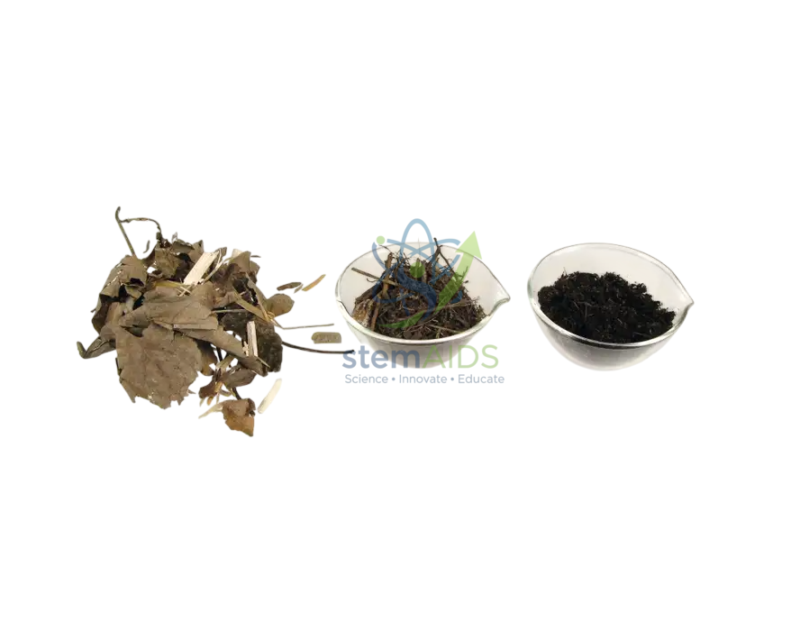
Quick Answer: Compost 3 Stages of Decomposition is a teaching set showing organic matter at three stages of decomposition, from recognisable plant litter to dark, crumbly compost. It is used in soil ecology and nutrient-cycle lessons to show what decomposers achieve over time.
Reading the Three Stages
Composting turns dead plant material into humus-rich compost, and three stages side by side make that change visible. In the first, leaves and stems are still whole and easy to identify. In the second, they are fragmented, darkened and matted, with fungal threads and the tunnels of small animals running through them. In the third, the original material can no longer be recognised: the compost is dark brown, crumbly and smells earthy, like woodland soil. The product photo shows samples of this kind in three dishes.
The organisms behind these changes are the real subject. Bacteria and fungi do most of the chemical breakdown, digesting sugars first, then cellulose and finally the tougher lignin. Earthworms, woodlice, millipedes, springtails and mites shred and mix the material, increasing the surface on which microbes work. In a well-managed heap, microbial activity warms the centre, which speeds decomposition before the heap cools and matures.
For the small animals that do the shredding, see the soil microfauna and mesofauna specimens.
Specifications
| Contents | Organic matter at three stages of decomposition |
| Stage 1 | Fresh or dry plant litter, still recognisable |
| Stage 2 | Partly decomposed, fragmented and darkened material |
| Stage 3 | Mature, crumbly, dark compost |
Lessons It Supports
- Nutrient cycling and the carbon cycle: how elements in dead matter return to the soil
- The role of decomposers and detritivores in food webs
- Setting up a school compost bin and judging when compost is ready
- Comparing soil texture, colour and water retention with and without compost
Care & Handling
- Keep the samples in closed containers when not in use, to limit drying, dust and mould spores in the room.
- Handle compost with gloves or wash hands afterwards, since it contains live microorganisms.
- Moisten dry samples lightly before handling so dust and spores are not breathed in.
Why Choose LabEquip
Primary and secondary teachers use a staged set when a real compost heap is not practical, or when all three stages are needed in one lesson. It is part of LabEquip’s biology lab products, and you can ask how the samples are packed through the contact page.
Related Products
- Compost Pile: A garden composting bag for making compost in the school grounds and studying decomposition first hand.
- Large Diameter Magnifying Glass: A wide-lens magnifier for looking closely at fungal threads and small animals in partly decomposed material.
- Biodegradable Pot: Plant pots made to break down in soil, which suit investigations comparing how different materials decompose.
- Fresh Mousse for Extracting Microfauna: Living moss for extracting tardigrades, rotifers and nematodes, tiny animals of damp, ground-level habitats.
Frequently Asked Questions
What are the three stages of decomposition in this compost set?
Stage one is fresh or dry plant litter that is still recognisable as leaves and stems. Stage two is partly decomposed material, fragmented, darkened and matted. Stage three is mature compost: dark, crumbly and earthy, with no trace of the original material. Side by side they show what decomposers achieve over time.
What is the difference between a decomposer and a detritivore?
Decomposers, mainly bacteria and fungi, break down dead material chemically by releasing enzymes onto it and absorbing the products. Detritivores, such as earthworms, woodlice, millipedes and springtails, eat dead material and break it into smaller pieces, which gives decomposers more surface to work on.
How long does compost take to mature?
It depends on the materials, moisture, air and temperature. A well-managed, regularly turned hot heap can give usable compost within a few months, while a cool, untended heap may take a year or more. The three stages in this set show that progression rather than fixed times.
Why does a compost heap get hot in the middle?
Bacteria breaking down fresh material respire rapidly and release heat, and a large heap holds that heat in. The warmth speeds decomposition and can kill many weed seeds and disease organisms; as the easily digested material runs out, the heap cools and slower organisms take over.
How can students tell when compost is ready to use?
Finished compost is dark brown and crumbly, smells like woodland soil, contains no identifiable original material, and no longer heats up when turned. Comparing a sample with the stage three material in this set gives students a reference to judge against.
Why is compost good for soil?
Compost adds humus, which helps sandy soils hold water and opens up heavy clay, and it slowly releases nutrients such as nitrogen, phosphorus and potassium as it breaks down further. It also feeds soil organisms, so adding compost returns nutrients from dead plants to living ones and completes the nutrient cycle.
Last Updated: November 2026




Reviews
There are no reviews yet.