














Sale
In Stock
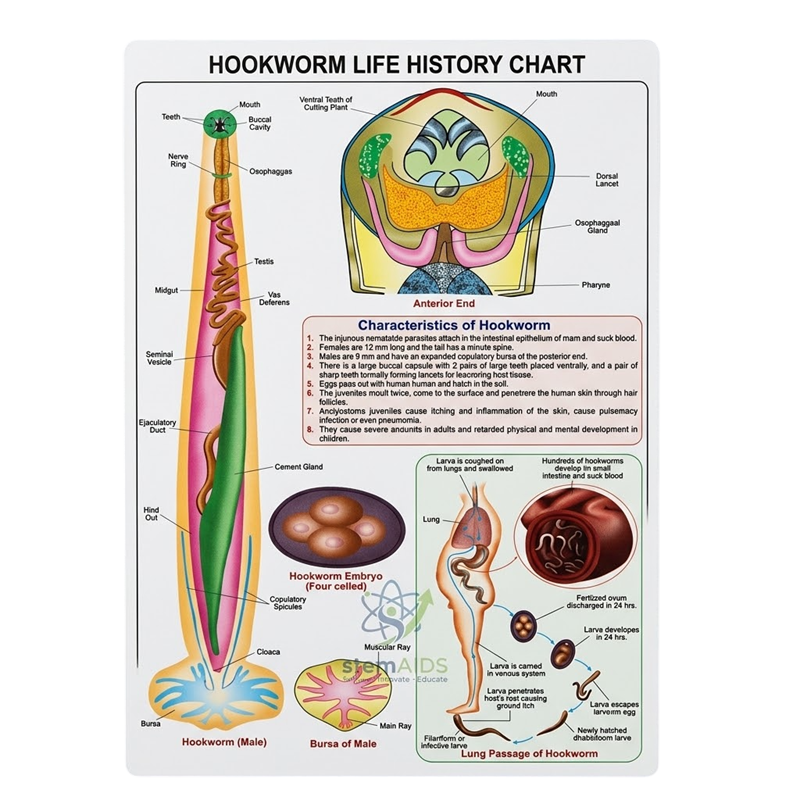
Hookworm Life History Chart
Original price was: $3.84.$1.80Current price is: $1.80.
Quick Answer: The Hookworm Life History Chart is a zoology wall chart tracing the life history of the human hookworm, Ancylostoma duodenale or Necator americanus, from eggs in soil through free-living larvae and skin penetration to adult worms attached in the small intestine. It supports parasitology and health lessons.
A Life History That Begins in the Soil
Unlike the tapeworm, the hookworm needs only one host, and part of its life is spent free in the soil. A life-history chart usually starts with the adults in the human small intestine, where they grip the lining with cutting plates or teeth in the mouth capsule and feed on blood. Female worms release eggs that leave the body in the faeces.
In warm, moist, shaded soil the eggs hatch into rhabditiform larvae, which feed on bacteria and moult to become slender filariform larvae, the infective stage. When someone walks barefoot on contaminated ground, these larvae penetrate the skin, often between the toes, enter the bloodstream and are carried to the lungs. They move up the windpipe, are swallowed and reach the small intestine, where they mature and the cycle closes.
Charts commonly include the male’s copulatory bursa at the tail end, which helps students tell the sexes apart, and a panel on why the infection matters: heavy infections cause blood loss and anaemia, especially in children. Wearing footwear and using latrines break the cycle at its soil stage.
Care & Handling
- Put the hookworm chart up for a school hygiene campaign as well as in the zoology room; the soil stage makes the footwear message concrete.
- Mount it with clips on a rail so it can be moved between classrooms.
- Store it flat or rolled with the other parasite charts.
Applications
- Teaching roundworm (nematode) parasites and the idea of an infective larval stage
- Tracing the lung migration route with students before tests
- Hygiene lessons on footwear, sanitation and school deworming days
- Comparing a one-host, soil-transmitted parasite with the two-host tapeworm cycle
Specifications
| Organism | Human hookworm (Ancylostoma duodenale, Necator americanus) |
| Host | Humans only, with a free-living stage in soil |
| Stages shown | Egg, rhabditiform larva, filariform larva, adult male and female |
| Route of infection | Skin penetration, blood, lungs, trachea, small intestine |
| Level | Secondary zoology and community health education |
| Size and finish | Confirm at enquiry |
Why Choose LabEquip
Hookworm is taught in both zoology and health education, so buyers include science teachers and school health coordinators. It pairs with the Tapeworm Life Cycle Chart and the Prevent the Diseases Charts for a hygiene-focused wall, all from LabEquip’s Educational Charts range.
Frequently Asked Questions
How does a hookworm enter the body?
The infective filariform larvae live in contaminated soil and burrow through the skin, usually of bare feet. They do not need to be swallowed with food, which is why going barefoot on ground polluted with human faeces is the main risk.
Why does the larva travel through the lungs?
After entering the skin the larvae are carried in the blood to the lungs, where they break into the air sacs, move up the trachea to the throat and are swallowed. This route takes them to the small intestine, where they settle and mature.
Why can hookworm infection cause anaemia?
Adult hookworms attach to the intestinal wall with their mouthparts and feed on blood. Each worm takes only a little, but with many worms over months the loss of blood and iron adds up, which can lead to anaemia, especially in children and pregnant women.
What is the difference between rhabditiform and filariform larvae?
Rhabditiform larvae are the first stage to hatch from the egg; they feed in the soil and are not infective. After moulting they become filariform larvae, which are thinner, do not feed and are able to penetrate human skin.
How can hookworm infection be prevented?
Wearing footwear outdoors, using latrines so that human faeces do not contaminate soil, and washing hands are the main measures. In many countries, schools also take part in regular deworming programmes run by health authorities.
How is the male hookworm different from the female?
The male is smaller and has a fan-like copulatory bursa at its tail end, used to hold the female during mating. The female is larger, with a straight, pointed tail. Charts show both so students can tell them apart.
Last Updated: September 2026
Bestsellers


Sale


Sale

