
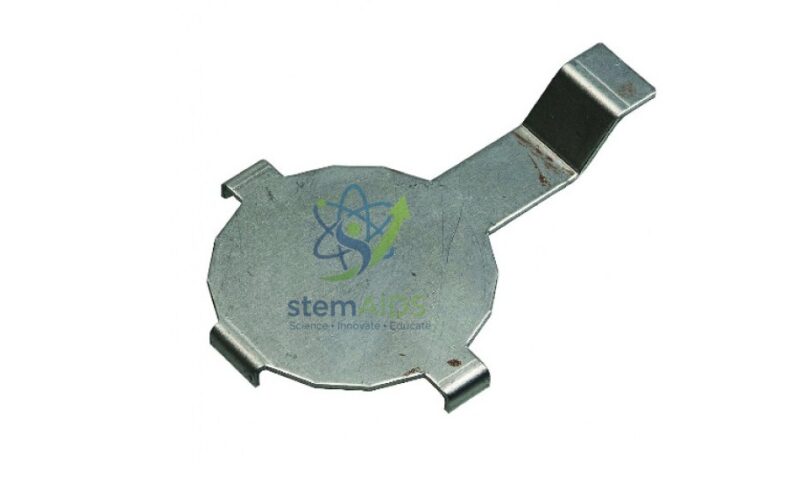
Quick Answer: The solid fuel burning plate is a small round metal plate with an angled handle and bent tabs, used to hold a solid sample in the heat of a burner. Students can watch small pieces of fuel, such as charcoal or wood, ignite, burn and leave ash without anyone handling the sample directly.
A Holder for Burning Solids
Liquids go in test tubes and gases in jars, but a solid that must burn in the open needs something flat to sit on. The solid fuel burning plate provides that. In the listing photo it is a round metal disc with short tabs bent downwards around the rim and a flat handle angled up from one side, a shape that lets it seat over a burner and be lifted off by the handle.
Typical samples are small: a piece of charcoal, a wood shaving, a strip of paper or a little candle wax. Placed on the plate and heated from below, each sample can be watched as it chars, ignites and burns down to ash or residue, and the results compared side by side.
Compared with the metal powder combustion set, which pairs a slotted plate with a blade for powders, this plate is meant for lumps, shavings and small pieces. Both keep burning material off the burner itself and make the residue easy to examine once the plate has cooled.
Specifications
| Item | Plate for heating and burning small solid samples |
| Form | Round metal disc with bent rim tabs and an angled handle (photo) |
| Heat source | Placed over a laboratory burner |
| Typical samples | Charcoal, wood shavings, paper strips, wax |
Applications
- Comparing how quickly different solid fuels ignite and how much ash each leaves
- Showing complete and incomplete combustion by watching the smoke and soot from different samples
- Showing that charcoal glows rather than flames, because its volatile components have already been driven off
- Heating a small solid to observe melting before burning, as with candle wax
Care & Handling
- Use pea-sized samples; larger pieces produce more smoke and can flare beyond the plate.
- Burn smoky or sulfur-containing samples only in a fume cupboard.
- Move the plate with tongs or a heat-resistant glove, as the handle warms up too.
- Tip out ash once the plate is cold and wash it before storing.
Why Choose LabEquip
Science teachers covering fuels, combustion and energy transfer are the usual buyers of the solid fuel burning plate. It sits with other chemistry lab equipment in LabEquip’s range; for help pairing it with a burner, write through the contact page.
Related Products
- Metal Powder Combustion Together: A metal powder combustion set with a slotted plate and blade, for burning powders rather than lumps.
- Model ‘Energy of a Fuel’: A fuel energy apparatus that measures the heat released by a burning fuel through the temperature rise of water.
- Combustion Gas Characterization Device: A combustion gas device that draws gases from above a flame to test them for carbon dioxide and water.
- Tongs, Crucible, Straight: Straight crucible tongs for moving the hot plate and its samples safely.
Frequently Asked Questions
What samples can be burnt on the solid fuel burning plate?
The plate is for small solid samples: a piece of charcoal, a wood shaving, a strip of paper or a little candle wax. The solid fuel burning plate holds each one in the heat of a burner so students can watch it char, ignite and burn down to ash without handling it.
Why does charcoal glow instead of burning with a tall flame?
Wood gives off flammable gases when heated, and these burn as flames. Charcoal has already lost most of its volatile matter, so it burns at the surface, combining directly with oxygen from the air and glowing red with only a small blue flame.
How can students compare how easily different fuels catch fire?
Use pieces of similar size, place each on the plate in turn and heat it the same way, timing how long it takes to ignite and how long it burns. Recording the flame colour, smoke and ash for each fuel makes a fair comparison.
How can the burning plate show incomplete combustion?
A smoky, yellow flame, for example from wax or paper, is a sign of incomplete combustion. Holding a cold porcelain dish briefly above the flame with tongs collects black soot, showing unburnt carbon.
Is the handle of the burning plate safe to hold while a sample burns?
The handle is angled up from the metal disc, but metal conducts heat, so it warms during burning. Move the plate with tongs or a heat-resistant glove, and let it cool on a heat-proof mat before touching.
How do I clean soot and ash from the burning plate?
Let the plate cool, tip off loose ash, then scrape away residue and brush the surface with a wire brush. Wash and dry it if tar remains, so old residue does not burn off and confuse the next test.
Last Updated: November 2026






Reviews
There are no reviews yet.