

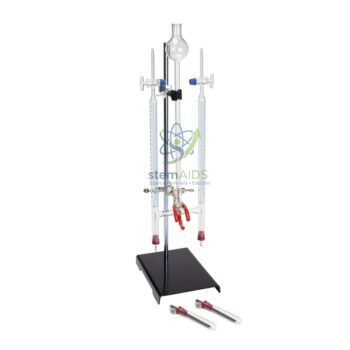
Quick Answer: A recovery assembly is a glass distillation set-up used to remove a solvent from an extract or solution and collect it for reuse. In a solvent recovery assembly the solvent boils off, condenses and runs into a receiver, while the dissolved extract is left concentrated in the flask.
Getting Solvent Back After an Extraction
Extractions often end with a large volume of solvent holding a small amount of product, such as fat from a Soxhlet run or a plant extract in ethanol. Evaporating that solvent in the open wastes it and fills the room with vapour. A recovery assembly distils it off instead, so the solvent is condensed and collected and the product stays in the flask as a concentrate or residue.
Solvent recovery set-ups are generally a boiling flask, a still head or bend, a condenser and a receiver, sometimes arranged to take the flask from a Soxhlet apparatus directly so the extract does not have to be transferred. Heating is by water bath or mantle, kept steady and stopped before the residue overheats. Some set-ups can also run under reduced pressure for heat-sensitive extracts, which needs round-bottomed flasks and a trap.
Recovered solvent is not always pure enough for every use; it may carry traces of water or co-extracted material, so label it clearly and test it before using it in sensitive work. The recovery assembly pairs naturally with the Soxhlet extraction apparatus, and for purifying high-boiling liquids see the vacuum distillation assembly.
Applications
- Recovering petroleum ether or hexane after Soxhlet fat determination, leaving the fat in a weighed flask
- Concentrating ethanolic plant extracts in pharmacognosy and natural product practicals
- Cutting solvent purchases and waste in teaching laboratories that run many extractions
- Removing solvent from a reaction mixture where a rotary evaporator is not available
Specifications
| Purpose | Distilling solvent off an extract and collecting it for reuse |
| Typical parts | Flask, still head or bend, condenser, receiver |
| Heating | Water bath or heating mantle; no open flame for flammable solvents |
| Result | Concentrated extract in the flask; reclaimed solvent in the receiver |
Care & Handling
- Never distil the flask to dryness; stop while a little solvent remains and finish drying as the method directs.
- Test ethers and similar solvents for peroxides before recovering them, as peroxides concentrate in the residue.
- Keep the receiver cool and away from the heat source, and run the assembly in a fume cupboard or well-ventilated area.
- Store reclaimed solvent in a bottle labelled as recovered, separate from fresh stock.
Why Choose LabEquip
Food testing laboratories, pharmacy colleges and research groups that run repeated extractions use a solvent recovery assembly to cut solvent use and fumes. Browse it with the rest of LabEquip’s chemistry lab equipment, and share the flask size and parts required on the contact page.
Related Products
- Soxhlet Extraction Apparatus: A Soxhlet extraction apparatus whose flask of solvent and extract is concentrated in this assembly.
- Reflux Assembly: A reflux assembly, the related set-up in which condensed vapour returns to the flask instead of being collected.
- Vacuum Distillation Assembly: A vacuum distillation assembly for recovering solvent at lower temperature from heat-sensitive extracts.
- Receiver Adapter, Straight Delivery: A straight delivery adapter used where a steeply descending condenser feeds the recovered solvent receiver.
Frequently Asked Questions
How is a solvent recovery assembly different from an ordinary distillation?
The aim is reversed. In an ordinary distillation the distillate is usually the product; in solvent recovery the solvent that distils over is collected for reuse, and the product is the concentrated extract left behind in the flask.
Can solvent from a recovery assembly be reused?
Often, yes, for the same kind of extraction, provided it is clean, dry and free of the extract. Check it, for example by its boiling range or appearance, before reuse, and redistil it if it will be used for work where purity matters.
Why should solvent recovery stop before the flask is dry?
Near dryness the residue can overheat, char or decompose, and the last traces are hard to drive off without damaging the extract. With some solvents, such as ethers, dangerous peroxides concentrate in the residue. Stop with a little solvent left and finish gently.
What heat source should be used for solvent recovery?
A water bath or heating mantle, kept steady. Most extraction solvents are flammable, so no open flame should be used, and the receiver should be cooled and kept away from ignition sources.
Can a recovery assembly work under reduced pressure?
Yes, if the glassware is sound and a vacuum connection is added after the condenser. Lower pressure lowers the boiling point, which protects heat-sensitive extracts. Use round-bottomed flasks and a cold trap, and work behind a safety screen.
How is the Soxhlet flask used in solvent recovery?
After a Soxhlet extraction, the flask holds the extract dissolved in the solvent. Some recovery set-ups take that flask directly, so the solvent can be distilled off and collected without transferring the extract to another vessel, which avoids losses.
Last Updated: November 2026






Reviews
There are no reviews yet.