






In Stock
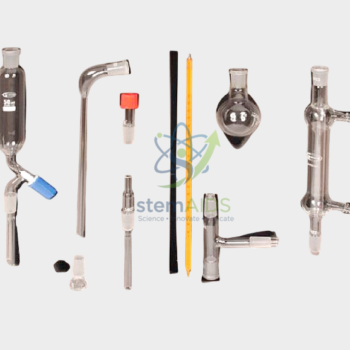
Receiver Adapter, Vertical With Vacuum Connection
Standard Taper CNC-Ground Joints: Features a 1:10 ratio, interchangeable ground-glass interfaces with a high-vacuum matte finish, ensuring hermetic sealing and universal compatibility across modular glassware systems.
Reinforced Serrated Vacuum Port: Engineered with a specialized hose nozzle designed for high-tensile connection to vacuum tubing, enabling stable depressurization without compromising structural integrity under thermal stress.
$4.85
Quick Answer: A vertical vacuum receiver adapter is a glass fitting that carries distillate straight down from a condenser into the receiver and has a side tube for connecting a vacuum line. It is used where the condenser stands upright or the receiver must sit directly beneath it during reduced-pressure work.
Straight Path, Vacuum Take-Off
Upright condensers are common in solvent recovery and in compact stills, and vacuum set-ups often use them because a vertical coil or double-surface condenser drains fully. This adapter continues that line into the receiver while its side tube takes the vacuum tubing, so pumping happens after condensation. Keep the side tube above the drip so liquid cannot run into the line.
Choosing between this and the bent vacuum adapter comes down to geometry. If the condenser slopes, the bent version brings the receiver upright; if the condenser is already vertical, this one avoids an unnecessary bend. It also works at normal pressure, with the side tube serving as a vent or as the inlet for a gentle stream of nitrogen.
The title does not give joint sizes or the form of the side-tube end, so these need matching to the condenser, the receivers and the vacuum tubing in use.
Applications
- Solvent removal under reduced pressure using a vertical condenser and a round-bottomed receiver
- Vacuum distillation with downward-pointing condensers
- Collecting distillate under nitrogen, with the side tube connected to a gas line and bubbler
- Venting a vertical atmospheric distillation through a guard tube
Care & Handling
- Place a cold trap between the side tube and the pump, and make sure the trap is cold before evacuating.
- Evacuate only undamaged round-bottomed receivers, with a safety screen in front of the apparatus.
- Clip every joint; a vertical stack under vacuum can separate suddenly when air is readmitted.
- Readmit air slowly through the line once heating has stopped and the flask has cooled.
Specifications
| Type | Receiver adapter, vertical, with vacuum connection |
| Flow path | Straight down from condenser to receiver |
| Side connection | Tube for vacuum or gas tubing |
| Suited to | Vertical condensers and upright receivers |
| Joint sizes and side-tube finish | Confirm at enquiry |
Why Choose LabEquip
Labs recovering solvents or distilling under reduced pressure with vertical condensers buy this adapter to complete the train. LabEquip supplies it in its chemistry lab equipments section along with the bent vacuum receiver adapter for sloping condensers; confirm joint sizes via the contact page.
Frequently Asked Questions
When should I choose the vertical rather than the bent vacuum adapter?
Choose vertical when the condenser stands upright above the receiver. The bent type suits a sloping condenser, turning the distillate down into an upright flask.
Where should the vacuum tubing go from the side tube?
To a cold trap, then on to the pump or water aspirator. A manometer in the line lets the pressure be recorded together with the boiling point.
Why do I need a cold trap?
Solvent vapour that passes the condenser under vacuum condenses in the trap instead of in the pump oil or the drain. That protects the pump and keeps solvent out of the environment.
Can this adapter be used without vacuum?
Yes. Leave the side tube open or fit a drying tube, and it vents the apparatus during atmospheric distillation.
What can make the vacuum poor at this adapter?
Ungreased or dirty joints, a cracked side tube, or tubing that is not rated for vacuum. Close the line and watch whether the pressure holds to find the leak.
What receivers can be used?
Round-bottomed or pear-shaped flasks with a ground neck matching the lower joint. They withstand evacuation, unlike flat-bottomed or conical flasks.
Last Updated: September 2026
You must be logged in to post a review.
Bestsellers






Reviews
There are no reviews yet.