



In Stock
Plastic Stopper
Standardized Tapered Geometry: Precision-molded with a specific 1:10 taper ratio to ensure a friction-fit, airtight seal within standard ground-glass joints without the risk of seizing or material bonding.
Biologically Inert Polypropylene: Constructed from high-purity, autoclavable resins that maintain structural integrity and chemical resistance during repeated exposure to aggressive acids, alkalis, and organic solvents.
$1.41
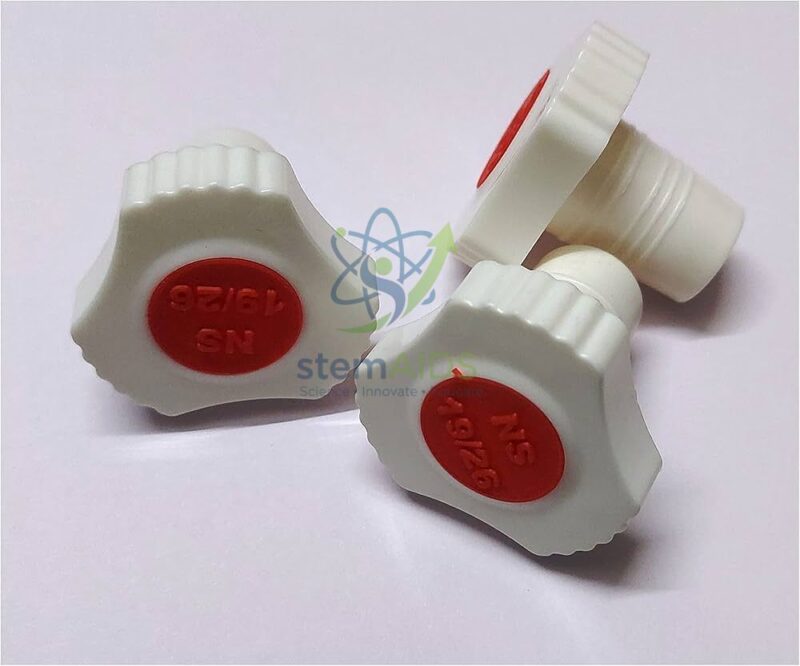
Quick Answer: A plastic stopper is a moulded closure with a tapered shank that fits into the ground socket of a flask or bottle. The listing photo shows white stoppers with lobed grip heads and a red top marked NS 19/26, the way stoppers for standard taper joints are labelled by size.
Closing a Joint Without Glass on Glass
Flasks with interchangeable ground joints are normally closed with glass stoppers, which seal well but can seize. Alkali solutions, dried sugar syrups and salts crystallising in the joint are all known for freezing a glass stopper in place. A stopper moulded from polypropylene or polyethylene slips into the same socket, seals by the slight give of the plastic, needs no grease and rarely sticks.
In the listing photo the shank carries raised rings, which press against the ground surface to improve the seal, and the knurled, three-lobed head gives a firm grip. The NS marking gives the joint size, with the first figure being the cone’s largest diameter in millimetres; the photo shows 19/26, but other sizes are made, so confirm that the size ordered matches your flasks.
Typical partners are interchangeable joint glassware and the glass volumetric flask, whose neck socket is usually closed with a stopper of this kind.
Applications
- Closing volumetric flasks while a standard solution is mixed by inversion
- Sealing round bottom flasks with ground necks between steps of a synthesis
- Stoppering flasks that hold sodium hydroxide solution, which can seize a glass stopper
- Replacing lost or broken glass stoppers in a set of jointed glassware
Care & Handling
- Push and turn the stopper gently into place; never force a stopper into a socket of a different size.
- Keep these stoppers away from heat, and remove them before a flask is heated or placed under vacuum.
- Rinse after use and let them dry apart from the glassware, then store them with the flasks they fit.
Specifications
| Item | Moulded stopper with tapered shank for ground joint sockets |
| Head | Knurled, lobed grip head (listing photo) |
| Size marking | NS joint size moulded on top; photo shows NS 19/26 |
| Advantage | Seals without grease and resists seizing |
| Sizes and plastic type | Confirm at enquiry |
Why Choose LabEquip
Chemistry labs with sets of jointed glassware keep moulded stoppers on hand to replace lost glass ones and to close flasks that tend to seize. LabEquip lists them in its chemistry lab equipment range; send your joint sizes through the contact page.
Frequently Asked Questions
What does NS 19/26 on the stopper mean?
It gives the joint size in millimetres: 19 is roughly the outside diameter of the ground cone at its widest point, and 26 is how long the ground zone is. The stopper fits a socket carrying the same marking.
Why choose plastic over a glass stopper?
Moulded polypropylene or polyethylene stoppers seal without grease and are much less likely to seize, which is a common problem with alkali solutions in glass joints. They also do not chip the socket.
Is the stopper airtight?
It gives a good seal for storage and mixing by inversion. For vacuum work or reactions under pressure, a greased glass stopper or a proper clip is more reliable.
Can these stoppers be autoclaved?
Polypropylene stoppers are generally autoclavable at 121 °C, while polyethylene ones generally are not. Remove the stopper or leave it loose in the flask during autoclaving.
Will it fit a reagent bottle neck?
Only if the bottle has a ground socket of the same joint size. Plain bottle necks without a standard taper need their own caps or stoppers.
Which solvents should be kept away from the stopper?
Chlorinated and aromatic solvents can swell or soften polyethylene and polypropylene over time. For flasks holding such solvents, a glass stopper with a PTFE sleeve is a better choice.
Last Updated: September 2026
You must be logged in to post a review.
Bestsellers






Reviews
There are no reviews yet.