
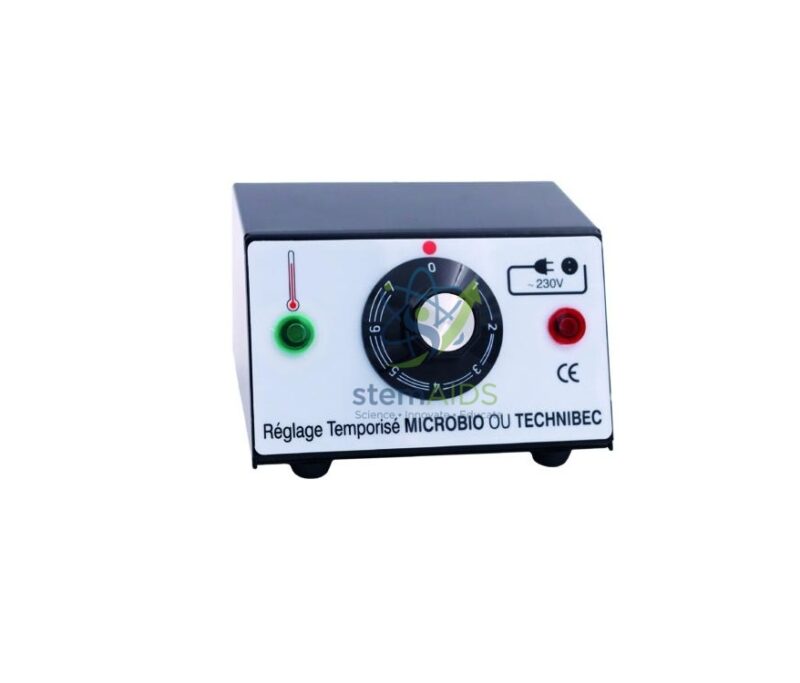
Quick Answer: The electric burner dimmer, listed as ‘Electric Beak Dimmer’, is a bench control box that sets the heat output of a compatible electric laboratory burner. Its front panel in the listing photo is printed ‘Réglage Temporisé MICROBIO OU TECHNIBEC’, naming the two burner families it is meant for, and carries a numbered dial between two indicator lamps.
Reading the Panel: What This Dimmer Controls
‘Beak’ in the title is the French ‘bec’ once more, the ordinary word for a laboratory burner, so this is a dimmer for an electric burner. The panel states its purpose in French: ‘réglage temporisé’, roughly ‘timed adjustment’, followed by the names MICROBIO and TECHNIBEC. In this range those names point to the LAB Microbiology electric Bunsen burner and the Technibec 2.0 electric burner.
The photo shows a small dark box with a white front panel. A rotary dial with a numbered scale sits in the middle, with a green lamp marked by a thermometer symbol on its left and a red lamp on its right, and a plug-and-socket symbol in the top corner. Regulators described as ‘temporisé’ generally vary heat by switching the heater on and off in timed cycles rather than dimming it continuously, so a low setting gives short heating periods with longer pauses between them. Follow the instructions supplied with the unit for the exact behaviour.
Why regulate at all? Sterilising a wire loop needs full heat, but many chemistry tasks do not: warming a broth tube, evaporating a few millilitres of solution, or holding a small beaker of water below the boil. With the dimmer placed between the wall socket and the burner, one burner can cover both kinds of work. The panel names only the Microbio and Technibec models, so use with other burners should not be assumed.
Specifications
| Item | Timed power regulator (‘dimmer’) for electric laboratory burners |
| Listed as | Electric Beak Dimmer |
| Panel marking | ‘Réglage Temporisé MICROBIO OU TECHNIBEC’ (photo) |
| Controls | Numbered rotary dial; green heat lamp and red lamp (photo) |
| Mains rating and plug type | Confirm at enquiry |
Applications
- Setting a Technibec burner to low heat for warming tubes of culture medium without boiling them over
- Gentle evaporation of salt or copper sulfate solution in a small dish before crystallisation
- Switching one Microbio burner between loop sterilising at full setting and slow warming at a low one
- Keeping the heat modest during younger students’ first heating practical
Care & Handling
- Connect the electric burner dimmer only to a Microbio or Technibec burner, as named on its panel; never plug in hot plates, kettles or other heaters.
- Turn the dial to zero before connecting or disconnecting the burner.
- Keep the control box to one side of the burner, out of the rising heat and away from spills.
- Unplug both units after use and include them in the school’s routine electrical safety inspections.
Why Choose LabEquip
Schools that already own Microbio or Technibec electric burners buy this dimmer when a single fixed heat is not enough for their practicals. It is listed with LabEquip’s chemistry lab equipment; tell us which burner model you use through the contact page so the plug and supply can be matched.
Frequently Asked Questions
Which burners does this dimmer work with?
The panel is printed with the names MICROBIO and TECHNIBEC, so it is intended for those electric burner models. Other burners, including the Hofmann burner that has its own regulator, should not be connected unless compatibility has been confirmed.
Why is it called a beak dimmer?
Beak is a mistranslation of the French word bec, which means burner. The item is a dimmer, or power regulator, for an electric laboratory burner and has nothing to do with a beak.
What does réglage temporisé mean?
It translates roughly as timed adjustment. Regulators described this way usually control heat by switching the burner on and off in cycles, with longer on periods at higher settings, rather than lowering the power continuously.
Is a low setting enough to sterilise an inoculating loop?
Sterilising a loop needs the whole wire to glow red, which is normally done at full heat. Keep the lower settings for warming and evaporating, and turn the dial up before flaming loops.
Can the dimmer make a burner hotter than normal?
No. A regulator can only reduce the power reaching the burner, so its highest setting gives at most the burner’s normal full output. It cannot push a burner beyond its own design.
Can I leave the burner running on a low setting unattended?
No. Even at a low setting the burner surface gets hot enough to burn skin or ignite paper and solvent vapour. Turn the dial to zero and unplug when the practical ends.
Last Updated: September 2026




Reviews
There are no reviews yet.