

Quick Answer: A laboratory distillation apparatus is a glass set-up that boils a liquid mixture, carries the vapour through a condenser and collects the condensed liquid in a receiver. It is used to purify liquids and to separate a liquid from dissolved solids or from other liquids with a different boiling point.
The Parts and What Each Does
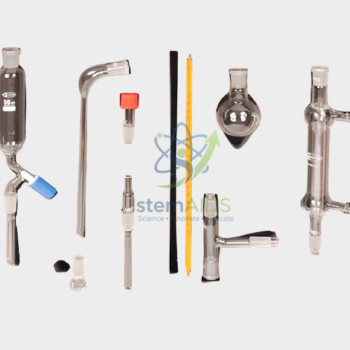
Every distillation set, whatever its size, follows the same path. A boiling flask holds the mixture over a heat source. A still head or side-arm neck turns the vapour sideways, and a thermometer placed at that outlet records the temperature of the vapour actually leaving. A water-cooled condenser, sloping downwards, turns the vapour back into liquid, and an adapter guides the distillate into a receiving flask.
In jointed glassware these pieces connect through ground glass cones and sockets, which lets the same parts be rearranged for other techniques; older teaching sets join them with bored corks or rubber bungs.
LabEquip also lists more specialised set-ups: the simple type distillation assembly for introductory practicals and the vacuum distillation assembly for high-boiling or heat-sensitive liquids.
Specifications
| Principle | Separation by differences in boiling point |
| Typical components | Boiling flask, still head or side arm, thermometer, condenser, adapter, receiver |
| Connections | Ground glass joints or bungs, depending on the set |
| Heat source | Heating mantle, water bath or sand bath, according to the liquid |
Applications
- Preparing distilled water from tap water in a practical on purification
- Separating ethanol from a fermented sugar solution and testing the distillate
- Recovering a solvent such as ethanol after an extraction
- Finding the boiling range of an unknown liquid as a check on its purity
Care & Handling
- Drop anti-bumping granules into the mixture while it is still cold; adding them to hot liquid can set off sudden boiling.
- Never heat a closed system: the receiver end must remain open to the air.
- Fill the boiling flask no more than about two-thirds full and never distil to dryness.
- Clamp the flask neck and the condenser separately so that no joint carries a strained load.
Why Choose LabEquip
Schools, colleges and polytechnics usually want one distillation set per bench group, with spare condensers and flasks. LabEquip supplies laboratory distillation apparatus as part of its chemistry lab equipment; agree the parts list and quantities through the contact page.
Related Products
- Distillation Assembly, Simple Type: A simple distillation assembly with fewer parts for separating a liquid from dissolved solids.
- Vacuum Distillation Assembly: A vacuum distillation assembly for high-boiling or heat-sensitive liquids at reduced pressure.
- Condenser, Liebig (Sampling): A Liebig condenser, the standard straight-tube water-cooled condenser for distillation.
- Flask, Distillation: A side-arm distillation flask for set-ups joined with bungs rather than ground joints.
- Receiver Adapters: Receiver adapters that carry distillate from the condenser outlet into the receiving vessel.
Frequently Asked Questions
What are the main parts of a laboratory distillation apparatus?
A distillation apparatus has a boiling flask over a heat source, a still head or side-arm neck that turns the vapour sideways, a thermometer at that outlet, a sloping water-cooled condenser, an adapter and a receiving flask. In jointed glassware these parts connect through ground-glass cones and sockets; simpler sets use bored bungs.
Where should the thermometer bulb sit in a distillation set-up?
Place the top of the thermometer bulb level with the bottom of the side arm leading to the condenser. There it measures the temperature of the vapour actually leaving the flask. Set too high, the bulb reads low because vapour flows past beneath it; set down in the liquid, it measures the boiling mixture rather than the distilling vapour.
Which way should water flow through a distillation condenser?
Water should enter at the lower end of the condenser and leave at the upper end, flowing against the direction of the vapour. This keeps the jacket completely full of water with no air pocket at the top and gives the coldest water where the distillate leaves, so cooling is as efficient as possible.
Why should a flask never be distilled to dryness?
As the last of the liquid boils off, the residue overheats and can char, decompose or crack the flask. With some organic liquids, such as ethers, explosive peroxides concentrate in the residue. Stop heating while a little liquid still covers the bottom of the flask, which also keeps any non-volatile impurities out of the distillate.
What is the difference between simple and fractional distillation?
Simple distillation boils and condenses the mixture once, which separates a liquid from dissolved solids or from liquids with very different boiling points. Fractional distillation adds a fractionating column between flask and still head; repeated condensing and re-boiling on the column surfaces separates liquids with close boiling points, such as ethanol and water.
Which heat source should be used for a laboratory distillation?
An electric heating mantle that fits the flask is the usual choice because it heats evenly and has no flame. A water bath suits liquids boiling well below 100 °C, and a sand or oil bath suits higher boiling points. A Bunsen burner and gauze is acceptable only for non-flammable aqueous mixtures, never for flammable organic liquids.
Last Updated: November 2026





Reviews
There are no reviews yet.