
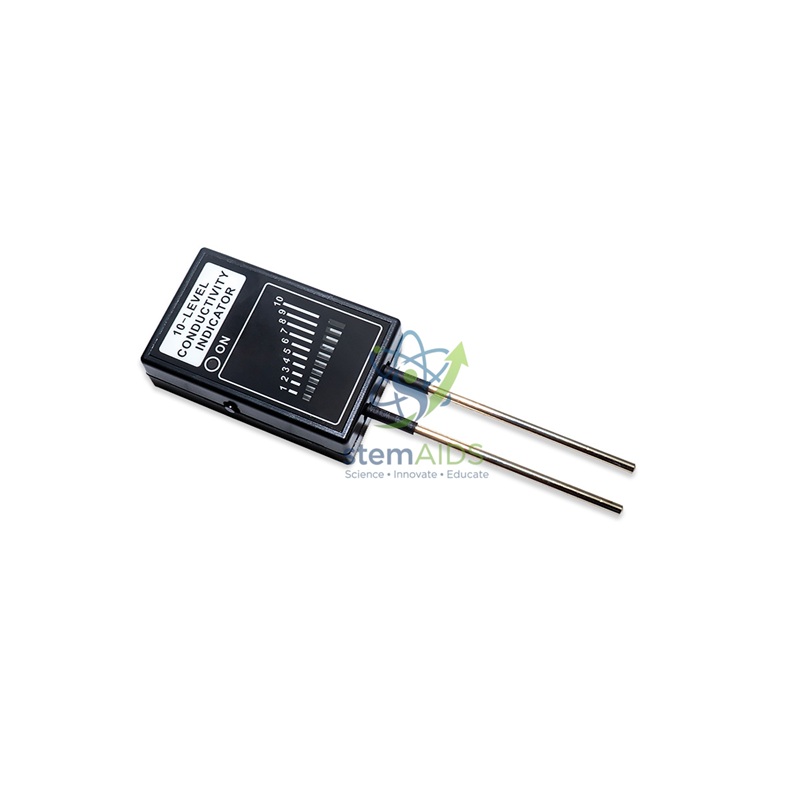
Quick Answer: The conductivity tester is a handheld probe that shows how well a solution or wet sample conducts electricity. The listing photo shows a black unit labelled ’10-Level Conductivity Indicator’, with an ON lamp, a ten-step bar display and two metal prongs that are dipped into the sample.
From Lit Bars to Ions in Solution
This handheld tester answers a simple question quickly: does this liquid carry a current, and roughly how well? With both prongs in a sample, the tester applies a small voltage between them and the display lights more bars as more current flows. Distilled water should light very few bars, while a strong salt solution lights many more.
The reason is ions. Ionic compounds such as sodium chloride dissolve into charged particles that move between the prongs, while sugar and ethanol dissolve as neutral molecules and conduct hardly at all. Comparing equal concentrations of hydrochloric and ethanoic acids shows the difference between strong and weak electrolytes, because the weak acid is only partly ionised.
The ten levels are a comparison scale, not a calibrated reading. For values in microsiemens per centimetre, a laboratory conductivity meter is required, or the wireless conductivity sensor, which logs readings to a device. The tester’s strength is speed: one dip gives a visible answer that the whole group can see at once.
Specifications
| Item | Handheld conductivity tester |
| Display | Ten-level bar indicator with ON lamp (photo) |
| Probe | Two parallel metal prongs (photo) |
| Output | Relative conductivity level, not a calibrated value |
Applications
- Sorting solutions into strong, weak and non-electrolytes
- Showing that solid salt does not conduct while its solution does
- Comparing tap, distilled, rain and mineral water samples
- Tracking how conductivity rises as more salt is dissolved in water
Care & Handling
- Rinse the tester’s prongs with distilled water and dry them between samples to avoid carrying ions across.
- Dip only the prongs, never the body of the tester, into liquids.
- Switch the tester off at the end of each session.
- Wipe deposits off the prongs with a soft cloth rather than scraping them with metal tools.
Why Choose LabEquip
Lower-secondary science teachers and chemistry departments teaching electrolytes buy conductivity testers because students get a visible answer in seconds. LabEquip lists this tester in its chemistry lab equipment; ask about sets for group work on the contact page.
Related Products
- Wireless Conductivity Sensor Redy: A wireless conductivity sensor that logs values in microsiemens for quantitative graphs.
- Electrical Conductivity Pack: An electrical conductivity pack for comparing how well different solid materials conduct.
- Automatic Electrically Heated All Glass Distillation Apparatus: An automatic all-glass water still producing distilled water to test as a low-conductivity sample.
- pH Paper, Wide Range: Wide range pH paper for testing the same acids and alkalis whose conductivity is compared.
Frequently Asked Questions
What does a conductivity tester show?
It shows how well a solution or wet sample conducts electricity. With both prongs in the sample, more bars light on the ten-level display as more current flows, giving a relative reading rather than a calibrated value.
Why does salt water conduct but distilled water does not?
Current in a solution is carried by ions. Dissolved salt separates into sodium and chloride ions that move to the prongs, while distilled water contains very few ions, so it lights very few bars.
How can a conductivity tester distinguish ionic and covalent substances?
Ionic compounds such as salt give many lit bars in solution because they release ions. Covalent substances such as sugar dissolve as neutral molecules and give little or no reading, even though they dissolve well.
Can the tester show the difference between strong and weak electrolytes?
Yes, in relative terms. At similar concentrations a strong acid like hydrochloric acid lights more bars than a weak acid like ethanoic acid, because it is fully ionised while the weak acid is only partly ionised.
How do you use a conductivity tester to compare water samples?
Rinse the prongs with distilled water, dip them to the same depth in each sample and note the number of lit bars. Tap water, rainwater, distilled water and salt solutions give a clear range for a class investigation.
How should the prongs of the tester be cleaned?
Rinse them with distilled water after every sample and dry them, so ions from one solution are not carried into the next. Do not leave the prongs standing in corrosive solutions.
Last Updated: November 2026





Reviews
There are no reviews yet.