

Quick Answer: A straight bore glass key burette is a graduated glass tube with a glass stopcock at its lower end, in which the hole through the key runs straight across. Turning the key lines the bore up with the burette to deliver titrant, or turns it across to stop the flow.
The Classic Titration Burette
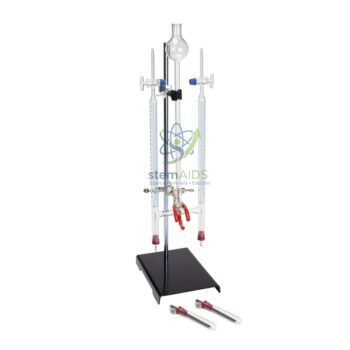
For generations of chemistry students, the straight bore glass key burette has been the burette of the acid-base titration: a long graduated tube clamped vertically, a conical flask on a white tile below, and a glass tap turned with one hand while the other swirls the flask. The straight bore is the simplest stopcock design. The hole runs straight through the key, so a quarter turn takes it from shut to fully open, and any position in between regulates the rate.
The key and barrel are both ground glass. They need a thin film of stopcock grease to turn smoothly and seal, and they are usually matched to each other during manufacture, so keys are not freely swapped between burettes. The all-glass construction resists acids, oxidising agents and most solvents, and the stopcock can be seen through, which helps when checking for trapped bubbles.
Its weak point is alkali. Sodium hydroxide left in the stopcock dries into a glassy film that locks the key, so after an alkali titration the burette should be drained and rinsed with water before it is put away. A strip of paper placed between key and barrel for storage is an old laboratory habit that keeps the two surfaces from sticking.
Specifications
| Item | Graduated burette with glass stopcock |
| Key | Ground glass key with a straight-through bore |
| Operation | Quarter turn from closed to fully open |
| Lubrication | Stopcock grease, applied as a thin film |
Applications
- Acid-base titrations such as hydrochloric acid against sodium carbonate with methyl orange
- Standardising sodium hydroxide against potassium hydrogen phthalate using phenolphthalein
- Precipitation titrations with silver nitrate, such as chloride determination
- Teaching burette technique: filling, removing bubbles, reading and recording titres
Care & Handling
- Rinse the burette with a few cubic centimetres of the titrant before filling, so leftover water does not dilute it.
- Remove the filling funnel before taking the first reading; drips from it change the volume in the burette.
- Drain and rinse after alkali titrations, and store the key loosened or with a paper strip in the joint.
- Keep keys with their own burettes, labelled if several are stored together.
Why Choose LabEquip
Schools and colleges buy straight bore glass key burettes in class sets for the core titration practicals of the chemistry syllabus. LabEquip lists them in the chemistry lab equipment range, and for alkali-heavy work the PTFE key burette is the greaseless alternative. Send quantities through the contact page.
Related Products
- Burette, Screw Type Glass Key: A screw type glass key burette whose threaded fitting keeps the glass key in place.
- Burette, PTFE Key: A PTFE key burette that needs no grease, useful where alkali titrants are common.
- Burette Holder Clamp: A burette holder clamp to keep the burette vertical for accurate readings.
- Brush, Burette: A burette brush for cleaning the bore before and after titration.
Frequently Asked Questions
What is a straight bore glass key burette?
It is a graduated glass tube with a glass stopcock at its lower end, in which the hole through the key runs straight across. A quarter turn lines the bore up with the burette to deliver titrant, or turns it across to stop the flow.
How do you read a burette correctly?
Keep the burette vertical, bring your eye level with the bottom of the meniscus and read the graduation it touches. A white card held behind the burette makes the meniscus easier to see. Record readings to the precision the graduations allow.
Why should a burette be rinsed with titrant before filling?
Water left inside would dilute the titrant and change its concentration. Rinsing two or three times with small portions of the titrant, run out through the tip, replaces the water with solution of the correct concentration.
Why must air be removed from the burette tip?
An air bubble below the stopcock can escape during the titration, and the reading will then include a volume of air instead of liquid. Run titrant through the tip briskly after filling until no bubbles remain.
How much grease does a glass burette key need?
Only a thin film on the key, kept away from the hole. Too little and the key sticks or leaks; too much and grease is pushed into the bore and tip, where it can block flow or contaminate the titrant.
How should a glass key burette be stored?
Rinse it with distilled water, remove or loosen the key, and place a strip of paper between key and barrel so they cannot fuse. Store it upside down or in a rack so it drains and stays free of dust.
Last Updated: November 2026




Reviews
There are no reviews yet.