










In Stock
Sling Psychrometer
₹678.00
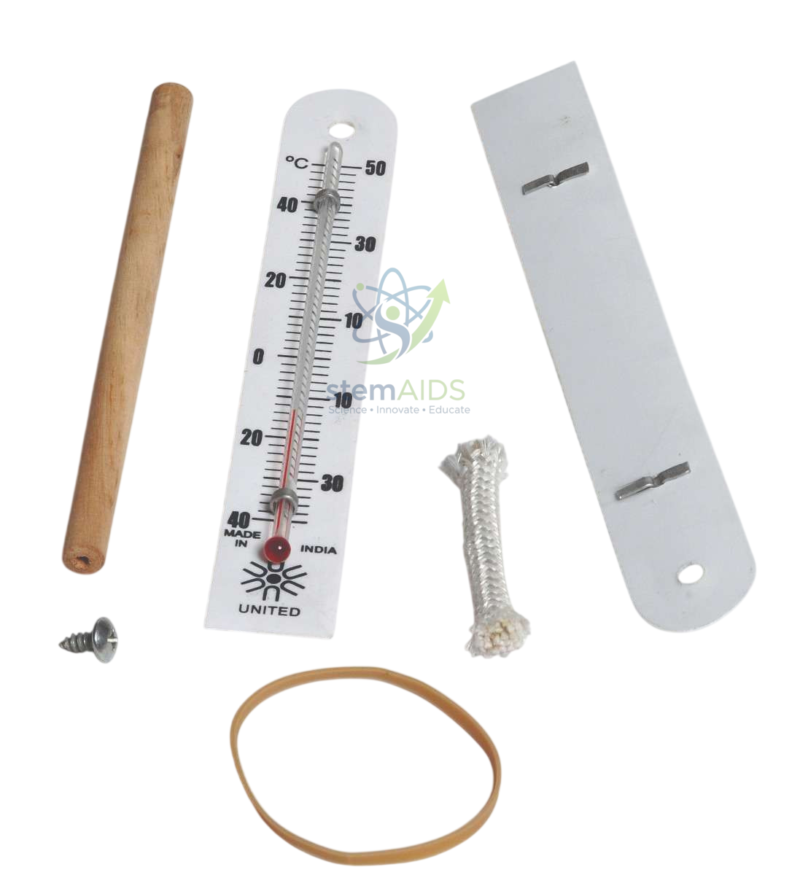
Quick Answer: A sling psychrometer is a hand-whirled instrument with a dry-bulb and a wet-bulb thermometer used to measure relative humidity. The difference between the two readings after whirling is looked up in a psychrometric table. The listing photograph shows the parts laid out separately, including a plastic-backed thermometer, a wooden handle, a cotton wick, a band and a screw.
How Two Thermometers Measure Humidity
One thermometer measures ordinary air temperature. The other has its bulb wrapped in a cotton wick soaked in clean water. When the instrument is whirled, air rushes past the wet wick and water evaporates from it, taking heat with it, so the wet-bulb reading falls. In dry air evaporation is fast and the drop is large; in humid air evaporation is slow and the two readings stay close. When the air is saturated, they are the same.
The difference between the readings, called the wet-bulb depression, is looked up against the dry-bulb temperature in a psychrometric table to give relative humidity. Whirling for a minute or two, reading, and whirling again until the wet-bulb reading stops falling gives a reliable result. Readings should be taken in shade, with the instrument held at arm’s length so body heat and breath do not affect it.
In biology, humidity matters because it controls transpiration: plants lose water faster in dry air. A sling psychrometer lets students compare the humidity inside a woodland with an open field, inside and outside a greenhouse, or around a potometer experiment. The listing photograph suggests the unit is supplied as parts for assembly; the number of thermometers, their range and the assembly guide should be confirmed at enquiry.
Applications
- Measuring relative humidity at school weather stations
- Comparing microclimates in woodland, grassland and near water
- Linking air humidity to transpiration rate in plant experiments
- Checking humidity inside greenhouses or growth rooms
Specifications
| Item | Whirling psychrometer for measuring relative humidity |
| Principle | Dry-bulb and wet-bulb temperature difference |
| Parts shown | Plastic-backed thermometer, wooden handle, wick, band and screw (listing photograph) |
| Result | Relative humidity from a psychrometric table |
| Thermometer count, range and assembly | Confirm at enquiry |
Care and Safe Use
- Clear a space of at least an arm’s length and a little more before whirling, and never whirl near other people.
- Wet the wick with distilled or clean rainwater; tap-water minerals build up in the cotton and slow evaporation.
- Replace the wick when it becomes stiff or discoloured, and dry the instrument before storage.
Why Choose LabEquip
Geography and biology departments buy psychrometers for weather and ecology fieldwork. LabEquip lists this one in Biology Lab Products with the separate plastic-backed thermometer for simple air and water temperature readings. Confirm the parts list through the LabEquip contact page.
Frequently Asked Questions
How does a sling psychrometer measure humidity?
Water evaporating from the wet wick cools the wet-bulb thermometer. The drier the air, the faster the evaporation and the bigger the gap between wet-bulb and dry-bulb readings. The gap and the dry-bulb temperature give relative humidity from a table.
How long should the psychrometer be whirled?
Whirl it steadily for about a minute, read the wet bulb first, then whirl again and re-read. Stop when the wet-bulb reading no longer falls; that lowest steady value is the one to use.
Why should the wick be wetted with distilled water?
Minerals in tap water collect in the cotton as it dries and form a crust that slows evaporation. That makes the wet-bulb reading too high and the humidity result too high.
What does it mean if both thermometers read the same?
It means no net evaporation is taking place, so the air is saturated: relative humidity has reached 100 per cent. It often happens in fog or just after rain.
How is the reading turned into relative humidity?
Subtract the wet-bulb reading from the dry-bulb reading. Find the dry-bulb temperature and this difference in a psychrometric table, which gives the relative humidity as a percentage.
Can the psychrometer be used below freezing?
It becomes unreliable, because the wick freezes and different tables are needed for an iced bulb. For classroom and fieldwork use, take readings when the air is above freezing.
Last Updated: September 2026
You must be logged in to post a review.
Bestsellers




Reviews
There are no reviews yet.