
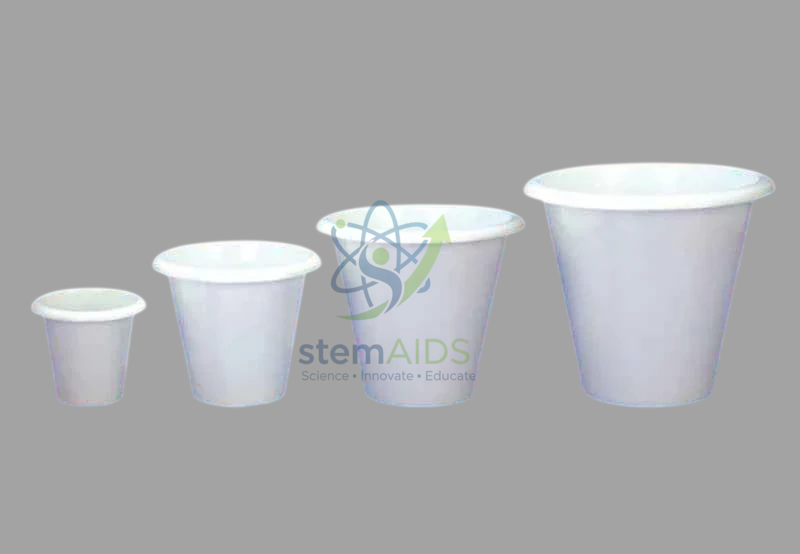
Quick Answer: Plastic plantation pots are lightweight containers for growing plants in soil or potting mix, used in school and college biology for germination, plant growth and plant response experiments. Plastic plant pots hold moisture longer than clay pots and are easy to label, move and clean.
Pots as Experimental Units
In a plant experiment each pot is one experimental unit. Using identical pots, the same potting mix and the same number of seeds per pot lets students change only one factor, such as light, water, fertiliser or soil type, and compare growth fairly. Several pots per treatment give results less affected by one weak seedling, and seeds can be started on moist paper in a plastic Petri dish before transplanting.
Drainage holes stop water collecting at the bottom, where roots rot. Plastic holds water longer than terracotta, so watering should be less frequent and guided by feeling the soil rather than a fixed timetable.
Classic experiments that rely on pots include phototropism, in which seedlings on a windowsill bend towards the light; geotropism, shown by laying a potted seedling on its side; the effect of nitrogen, phosphorus and potassium on growth; and growth in sand, clay and loam compared side by side.
Specifications
| Material | Plastic (per title) |
| Use | Growing plants for biology practicals and projects |
| Drainage | Holes are usual in plant pots; check for this listing |
| Reuse | Washable and reusable between seasons |
Applications
- Germination and seedling growth practicals
- Phototropism and geotropism demonstrations
- Fertiliser, watering and soil-type comparisons
- School gardens, nurseries and botany department plant collections
Care & Handling
- Wash pots with water and mild detergent between uses to remove soil pests and fungal spores.
- Keep empty pots in shade; long exposure to strong sun can make some plastics brittle.
- Number pots with a waterproof marker or tag before sowing.
- Stand pots on trays to protect benches from water and soil.
Why Choose LabEquip
School biology departments, botany and agriculture colleges and eco-clubs use pots in sets for class experiments and garden projects. LabEquip supplies them in the Biology Lab Products range; send the sizes and numbers you need through the contact page.
Related Products
- Peat Pots: Peat pots that are planted whole, for comparing transplanting with and without root disturbance.
- Biodegradable Pot: Biodegradable pots that break down in soil, for decomposition and transplanting investigations.
- Mini Greenhouses: A mini greenhouse for raising seedlings under cover before moving them into pots.
- Petri Dish, Plastic: Plastic Petri dishes for germinating seeds on damp paper before planting them in pots.
Frequently Asked Questions
What are plastic plantation pots used for in biology practicals?
They are reusable plastic containers for growing plants in soil or potting mix. In school and college biology they are used for germination, plant growth experiments, tropism demonstrations and longer projects on fertilisers, soil types or watering, as well as for keeping plants for later lessons.
Are plastic pots or clay pots better for plant growth experiments?
Plastic pots hold moisture longer because water cannot evaporate through their walls, are light, do not break when dropped and are easy to label and wash. Clay pots dry out faster and can suit plants that dislike wet roots. For fair tests the key point is to use identical pots of one type for every treatment.
Do plant pots need drainage holes?
Yes. Without drainage, extra water collects at the bottom, air is driven out of the soil and the roots begin to rot. Water until a little runs out of the base, then empty the saucer. Because plastic pots keep compost moist for longer, check the surface before watering again rather than watering on a fixed schedule.
How many pots are needed for a fair plant experiment?
Use several pots for each treatment, commonly three to five, all the same size, with the same potting mix and the same number of seeds. Repeats mean one weak seedling or a pot near a draughty window does not decide the result, and students can calculate a mean for each treatment.
How can pots be used to show phototropism in a classroom?
Grow seedlings such as cress or beans in two pots. Put one inside a box with a hole cut in one side, so light comes from only that direction, and leave the other in even light. After a few days the shoots in the box bend towards the hole, showing that shoots grow towards light.
How should plastic pots be cleaned before they are reused?
Knock out old soil and roots, wash the pots in warm soapy water with a brush, rinse them and let them dry. Cleaning removes fungal spores and pests that could attack the next set of seedlings, and it means old compost does not mix into the new experiment.
Last Updated: November 2026







Reviews
There are no reviews yet.