




In Stock
Peat Pollen Extraction Kit
Kit Extraction de pollens de la tourbe Includes high-purity heavy liquid reagents calibrated to isolate sporopollenin structures from denser minerogenic and organic fractions with minimal morphological distortion or chemical interference.
Micron-Precision Filtration Suite Features specialized laboratory-grade sieves with specific mesh apertures optimized for the sequential retention of varying pollen taxa while ensuring the efficient removal of obstructive humic debris.
$11.27
Quick Answer: The Peat Pollen Extraction Kit is a pollen extraction kit for separating preserved pollen grains from a peat sample so they can be examined under a microscope. It is used in biology, geography and earth-science teaching to show how pollen records reveal past vegetation and climate.
Pollen in Peat: What the Kit Reveals
Peat forms in waterlogged, acidic bogs where there is little oxygen, so plant material decays very slowly. Pollen grains are protected by an outer wall of sporopollenin, one of the most decay-resistant natural materials known, and they survive in peat for thousands of years. Layer by layer, a peat bog therefore keeps a record of the plants that grew around it, and palynology, the study of pollen and spores, reads that record.
The extraction follows the principle used in research labs, simplified for teaching. A small amount of peat is broken up in a reagent that dissolves the humic material around the grains; the standard reagent for this step is potassium hydroxide solution, which is corrosive. The mixture is then sieved or diluted, the grains are concentrated by settling or centrifuging, and a drop is mounted on a slide. Under a microscope, grains of pine, birch, hazel, oak or grasses can be told apart by size, shape and the number of pores or furrows.
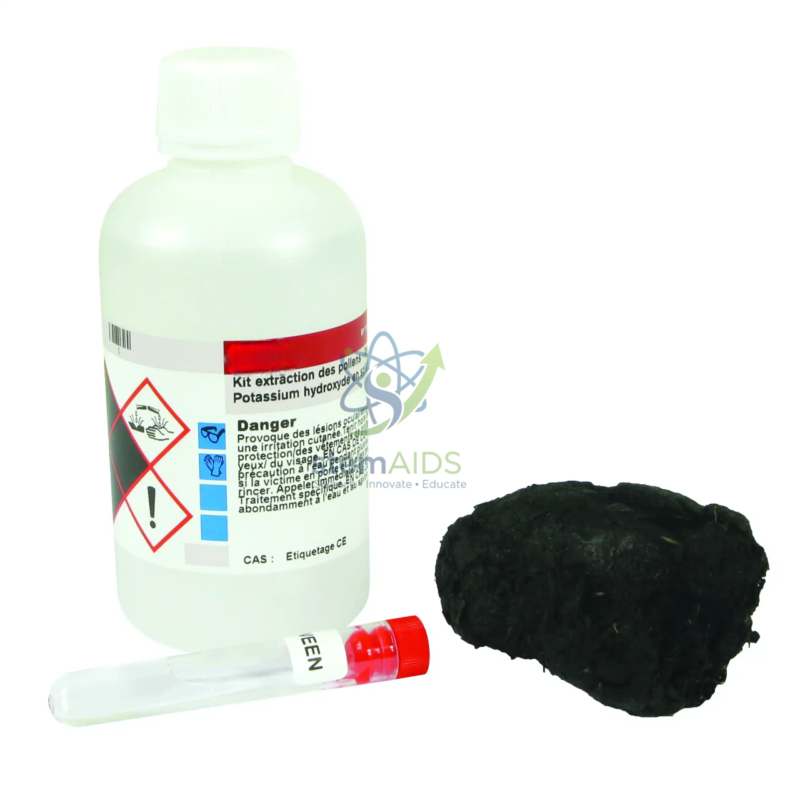
The product photo shows a reagent bottle with hazard labelling, a tube and a peat sample, but the listing does not give a contents list, so confirm what is included and read the reagent’s label and safety data sheet before use. Slides from the prepared slides range help students practise microscope work before they mount their own extracts.
What Students Investigate
- Identifying pollen types and relating them to trees, shrubs and grasses
- Comparing samples from different depths to show how vegetation changed over time
- Introducing the proxy records used to reconstruct past climate
- Microscope-skill practicals: mounting, focusing and counting grains
Specifications
| Purpose | Extracting preserved pollen grains from peat for microscope study |
| Method principle | Chemical breakdown of peat, concentration of grains, slide mounting |
| Equipment usually needed alongside | Compound microscope, slides and cover slips, centrifuge or settling time |
| Subjects | Biology, palynology, geography, earth science |
| Contents and reagent identity | Confirm at enquiry |
Safety and Storage
- Wear safety glasses and gloves when handling the extraction reagent, because alkaline solutions such as potassium hydroxide damage skin and eyes.
- Neutralise and dispose of used reagent as its safety data sheet and your laboratory’s waste rules direct.
- Keep the reagent bottle tightly closed; strong alkalis absorb carbon dioxide from the air and can seize glass stoppers.
- Store peat samples sealed and labelled with their source and depth so that modern pollen does not contaminate them.
Why Choose LabEquip
University geography departments, pre-university biology classes and field-study centres use pollen extraction to connect microscopy with environmental history. The kit is part of LabEquip’s biology lab products; send questions about its contents through the contact page.
Frequently Asked Questions
Why does pollen survive in peat?
Pollen walls contain sporopollenin, which resists decay, and peat bogs are waterlogged, acidic and low in oxygen, so the microbes that would break organic matter down work very slowly. Grains can survive there for thousands of years.
What does a pollen diagram show?
It plots the percentage of each pollen type against depth. Because deeper peat is older, changes in the curves show how the surrounding vegetation changed, for example woodland giving way to grassland after forest clearance.
What magnification is needed to identify pollen?
Most pollen grains are roughly 10 to 100 micrometres across, so a compound microscope is needed. Grains can be spotted at around 100 times magnification, but seeing the surface features clearly usually needs about 400 times.
Is the extraction safe for school students?
It can be done in schools and colleges with supervision, eye protection and gloves, because the reagent that breaks down peat is usually a strong alkali. Research methods that use hydrofluoric acid should never be used in schools.
How can students tell pollen types apart?
They look at size, overall shape and the number and arrangement of pores and furrows in the wall. Pine pollen has two air sacs, grass pollen has a single pore and birch pollen usually has three pores. Reference slides or photo keys help.
Can the method be used on other sediments?
The same principle applies to lake muds and some soils, although mineral-rich sediments need extra steps to remove clay and sand. Peat is used in teaching because it is rich in pollen and breaks down easily.
Last Updated: September 2026
You must be logged in to post a review.
Bestsellers




Reviews
There are no reviews yet.