






In Stock
Model with 3 lumbar vertebrae
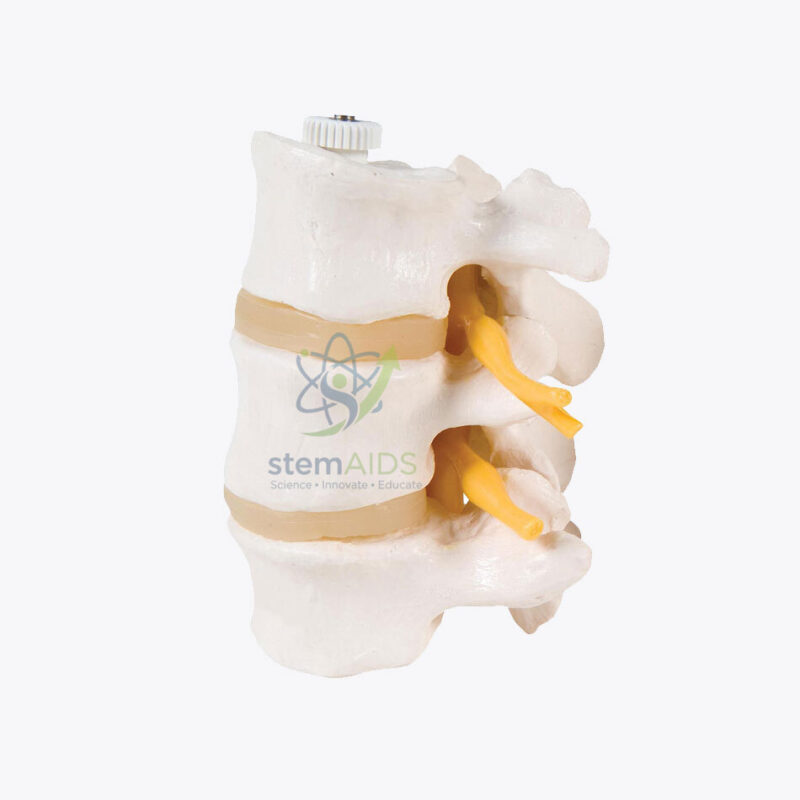
Modèle 3 vertèbres lombaires Features a specialized intervertebral disc with a dorsolateral prolapse (herniated disc) to demonstrate nerve root compression and mechanical spinal instability in a standardized clinical format.
Neurological Architecture includes an anatomically precise representation of emerging spinal nerve roots and the cauda equina, allowing for the tactical mapping of neuro-musculoskeletal pathways within the lumbar region.
₹1,240.00
Quick Answer: The Model with 3 Lumbar Vertebrae is a 3 lumbar vertebrae model showing three bones of the lower back joined by two intervertebral discs, with spinal nerves leaving between them. It is used in anatomy, physiotherapy and nursing lessons on how the lumbar spine moves and how a disc problem can press on a nerve.
Vertebrae, Discs and Nerve Roots Together
The product photo shows three lumbar vertebrae stacked on a central rod, with pale discs between the vertebral bodies and yellow spinal nerves emerging from the gaps at the sides. Two neighbouring vertebrae, with the disc and small facet joints between them, form what anatomists call a motion segment, the basic working unit of the spine. Three vertebrae give two such segments, enough to show how movement at one level relates to the next.
Each disc has two parts. The tough outer ring, the annulus fibrosus, is built from layers of fibres running in alternating directions; the soft, gel-like centre, the nucleus pulposus, spreads load across the vertebral body. With age and repeated strain the annulus can develop tears, and part of the nucleus may push out backward, usually a little to one side. There it can press on a nerve root in or near the intervertebral foramen, the opening through which each spinal nerve leaves. In the lower lumbar spine this is a common cause of sciatica: pain, tingling or weakness running down the back of the leg.
For the individual bones in more detail, the human lumbar vertebrae model concentrates on vertebral features. The listing for this model does not state its size, whether it can be bent on its rod or which vertebral levels it represents, so check these points when ordering.
Specifications
| Model of | Three human lumbar vertebrae with two intervertebral discs |
| Nerves | Spinal nerves emerging between the vertebrae, as shown in the product photo |
| Mounting | Stacked on a central rod |
| Topics | Motion segment, disc structure, nerve root compression |
| Size, flexibility and vertebral levels | Confirm at enquiry |
Teaching Applications
- Explaining disc prolapse and sciatica in physiotherapy and nursing courses
- Showing where spinal nerves exit through the intervertebral foramina
- Back care and manual handling training on why lifting with a bent, twisted spine loads the discs
- Anatomy lessons on the structure of the intervertebral disc
Care & Handling
- Hold the 3 lumbar vertebrae model by the vertebral bodies or the rod, not by the yellow nerves, which are thin and can bend or snap.
- If the model flexes on its rod, bend it only within a natural range and return it to a neutral position after use.
- Clean with a soft, slightly damp cloth and store it upright where it will not be knocked over.
Why Choose LabEquip
Physiotherapy schools, nursing colleges and manual handling trainers buy a short spinal segment because it puts discs and nerves at eye level for a small group. The model sits in LabEquip’s biology lab products; for size and mounting questions, use the contact page.
Frequently Asked Questions
What is a motion segment?
It is two adjacent vertebrae with the intervertebral disc between them and the facet joints and ligaments that link them. It is the smallest part of the spine that shows how the whole column moves and carries load.
What is the difference between the annulus fibrosus and the nucleus pulposus?
The annulus fibrosus is the tough outer ring of the disc, made of layers of crossing fibres. The nucleus pulposus is the soft, gel-like centre that spreads pressure evenly across the vertebral bodies.
How does a slipped disc cause leg pain?
The disc does not actually slip. Part of the nucleus bulges or pushes through a tear in the annulus and can press on a nearby nerve root. In the lower back, irritation of the roots that form the sciatic nerve causes pain down the leg.
Why do lumbar discs carry so much load?
The lumbar spine supports the weight of the head, arms and trunk above it, and bending forward while lifting raises the pressure inside the discs sharply. That is why manual handling training teaches bending the knees and keeping loads close to the body.
Where do spinal nerves leave the lumbar spine?
Each nerve leaves through an intervertebral foramen, the opening formed between the notches of two neighbouring vertebrae, just behind the disc and in front of the facet joint.
How is this model different from a full lumbar spine model?
This model isolates three vertebrae with their discs and nerves, which is enough to show a motion segment clearly. A full lumbar column shows all five lumbar vertebrae and the curve of the lower back.
Last Updated: September 2026
You must be logged in to post a review.
Bestsellers




Reviews
There are no reviews yet.