
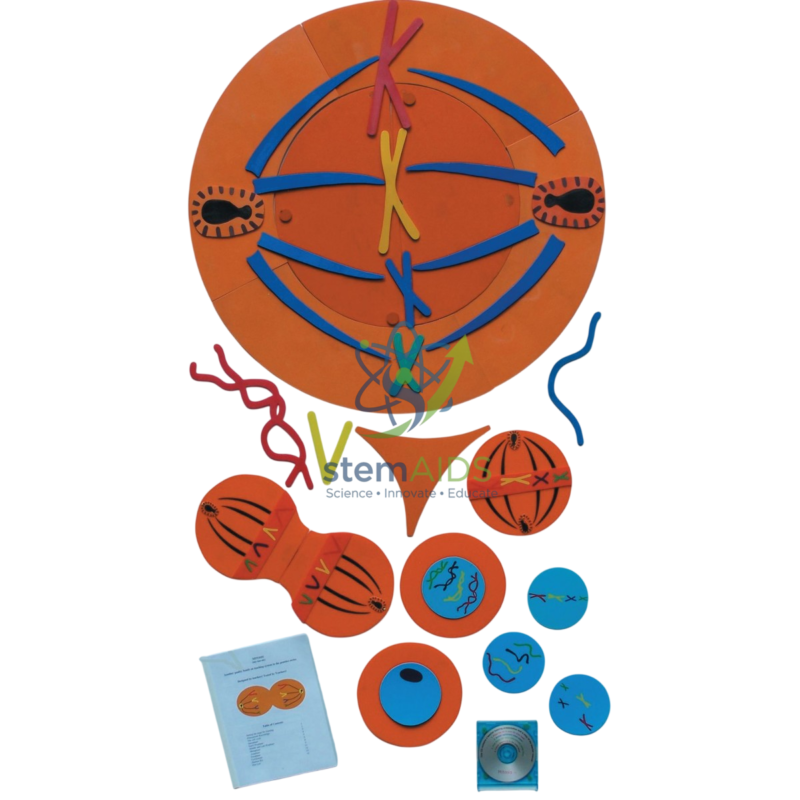
Quick Answer: The Mitosis Manipulatives Kit is a hands-on teaching set of cell, spindle and chromosome pieces that students arrange to model each stage of mitosis. It helps biology classes see how a cell copies its chromosomes and shares them equally between two daughter cells.
Modelling Mitosis with Movable Pieces
Diagrams of mitosis show frozen moments; manipulatives make students do the moving themselves. The product photo shows a large cell outline with blue spindle fibres, coloured chromosome pieces, smaller discs representing cells at different stages and a printed instruction sheet. Working in groups, students place chromosomes in the cell for interphase, duplicate them into pairs of sister chromatids, line them up at the equator for metaphase and pull the chromatids to opposite poles for anaphase.
Moving the pieces exposes misunderstandings that a worksheet can hide. Students must decide when DNA is copied (during the S phase of interphase, not in prophase), how many chromosomes each daughter cell ends with (the same number as the parent) and why the sister chromatids are identical. Colour-coded pieces make it easy to show that each daughter cell receives both members of every homologous pair, one of maternal and one of paternal origin.
The kit covers mitosis, the division used for growth and repair. Meiosis, with crossing over and two divisions, needs extra pieces and a different sequence.
Classroom Activities
- Sequencing activity: groups build each stage in turn and photograph or sketch it
- Linking the model to real dividing cells in an onion root tip squash under the microscope
- Assessing understanding by asking students to show the chromosome and chromatid count at each stage
- Extending the topic with a chromatid chromosomes set for chromosome structure
Specifications
| Item | Manipulative model set for mitosis |
| Pieces shown in the photo | Cell outline with spindle, chromosome pieces, stage discs, instruction sheet |
| Stages modelled | Interphase, prophase, metaphase, anaphase, telophase, cytokinesis |
| Group use | Small groups working at a bench or table |
Storing the Pieces
- Count the chromosome pieces back into the box at the end of each lesson; one missing piece changes every model.
- Keep separate bags or trays for each group’s set to speed up setting up.
- Wipe the pieces with a damp cloth if they get dirty and let them dry before packing.
Why Choose LabEquip
Biology teachers choose a mitosis manipulatives kit for the lesson where students most often confuse chromosomes with chromatids. It is part of LabEquip’s biology lab products range, and the contact page is the place to ask about the piece count and how many groups one kit supplies.
Related Products
- Model of a Cell in Mitosis: A ready-made series of animal cells from interphase to two daughter cells, for checking the stages students build.
- Meiosis Manipulatives Kit: A matching kit of allele-lettered chromosome pieces for modelling meiosis after mitosis has been covered.
- Chromatid Chromosomes Set: Model chromosomes showing sister chromatids and the centromere, useful for explaining chromosome structure first.
- Mitosis Process Teaching Model: A teaching model of the mitotic stages from prophase to telophase for whole-class demonstration.
Frequently Asked Questions
How do students use a mitosis manipulatives kit?
Working in small groups, students place chromosome pieces in the cell outline and move them stage by stage: copying each chromosome, lining the pairs of chromatids up on the spindle, pulling them apart and dividing the cell. The stage discs and instruction sheet in the photo help them check each step as they go.
What happens to the chromosome number in mitosis?
It stays the same. Each chromosome is copied before division into two sister chromatids, and mitosis separates those chromatids so each daughter cell gets one copy of every chromosome. A human body cell with 46 chromosomes produces two cells that each have 46, identical to the parent.
How do you show the difference between metaphase and anaphase with the pieces?
In metaphase, every doubled chromosome sits on the equator of the spindle with its two chromatids facing opposite poles. In anaphase, students pull the two chromatids of each chromosome apart towards the poles, and from that moment each separated chromatid counts as a chromosome.
When is DNA copied, and how is it shown in the kit?
DNA is copied during interphase, in the S phase, before mitosis begins. With the kit, students start interphase with single chromosome pieces and replace or join them into two-chromatid pieces before prophase, which shows that division only shares out DNA that has already been copied.
How can the mitosis kit be linked to an onion root tip practical?
After modelling the stages, students squash and stain an onion root tip and look for the same stages under the microscope. Counting how many cells are in each stage, and how many are dividing at all, lets them work out the mitotic index and relate the model to real tissue.
How is a mitosis manipulatives kit different from a ready-made mitosis model?
A ready-made model shows each stage already arranged, which is ideal for demonstration and revision. A manipulatives kit makes students build each stage themselves, so misunderstandings, such as separating chromatids too early, appear while they work and can be corrected straight away.
Last Updated: November 2026






Reviews
There are no reviews yet.