
Quick Answer: Mini Greenhouses are small propagators: a seed tray under a clear cover that keeps humidity and warmth around germinating seeds and young cuttings. Schools use mini greenhouses for seed raising on a bench or windowsill, and to show how a covered space traps heat.
How a Mini Greenhouse Works
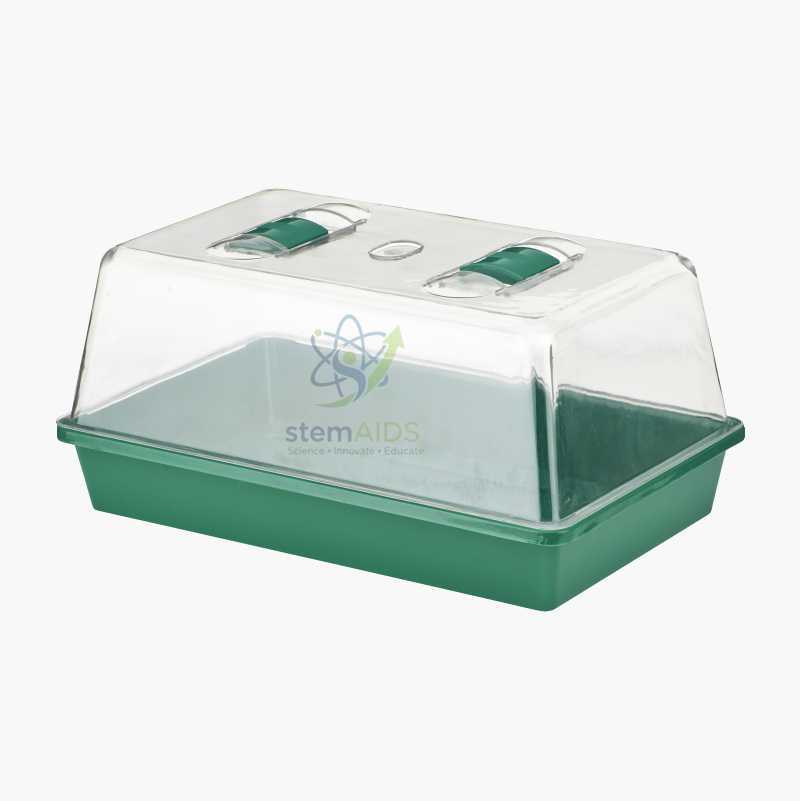
In the product photo, each mini greenhouse is a plastic base tray under a clear, domed cover with vents in the top, which is the classic propagator design. The cover lets light in and holds moist air around the seeds, so the compost surface stays damp and seedlings do not dry out. The vents let excess moisture escape once the seedlings are up, and that is the difference between a healthy propagator and a mouldy one.
A covered tray also warms up. Sunlight passes through the clear cover and heats the compost and air inside, and the cover slows the escape of that warm air. This is a small-scale version of how a real greenhouse works. It is also a convenient way into the atmospheric greenhouse effect, although there gases absorb and re-emit heat rather than a solid roof holding warm air in, so the analogy has limits worth pointing out.
Mini greenhouses pair naturally with coco coir pellets or small pots for sowing, and a seed germination chart helps pupils name the stages they see.
Specifications
| Type | Seed-raising propagator (base tray with clear cover) |
| Design shown in the product photo | Plastic base tray, clear domed cover with vents |
| Purpose | Germinating seeds and rooting cuttings in humid conditions |
| Placement | Bright, warm position out of hot midday sun |
Care & Handling
- Open the vents, or lift the cover for part of each day, once seedlings have emerged, so mould and damping off do not take hold.
- Keep the mini greenhouse out of strong midday sun, which can overheat the air under the cover and scorch seedlings.
- Wash the tray and cover with warm soapy water between uses and let them dry fully before storing.
Investigations and Uses
- Raising vegetable and flower seedlings for the school garden in early spring
- Comparing germination in covered and uncovered trays
- Recording temperature inside and outside the cover to model the greenhouse effect
- Rooting cuttings of houseplants and herbs
Why Choose LabEquip
Schools often buy mini greenhouses in sets so each class or group can run its own sowing, and LabEquip lists them in its biology lab products. Let us know how many you need through the contact page.
Related Products
- Indoor Greenhouse BoQube: A compact indoor greenhouse with a transparent cover for raising seedlings on a classroom windowsill.
- Plastic-Backed Thermometer: A liquid-in-glass thermometer on a plastic backing for recording the temperature under the cover each day.
- Pea Seed Germination Model: A board model of pea seed germination in successive stages, for comparing with the seedlings that come up.
- Compost 3 Stages of Decomposition: Organic matter at three stages of decomposition, linking seed raising to how compost is made.
Frequently Asked Questions
What is a mini greenhouse used for in a school lab or garden?
A mini greenhouse is a propagator: a plastic base tray under a clear domed cover with vents. It keeps moist, warm air around seeds and cuttings so they do not dry out, which speeds germination and rooting. Schools use it on a bench or windowsill for seed raising and to show how a covered space traps heat.
When should the vents on a propagator lid be opened?
Keep them closed while seeds germinate, then open them once the first seedlings appear or when heavy droplets run down the inside of the cover. Open them a little more each day and finally remove the lid, so the seedlings adjust to drier air instead of wilting when it comes off.
Why are my seeds slow to come up in a mini greenhouse?
The usual causes are cold compost, compost kept too wet, seeds sown too deep, or old seed. Some seeds also need light to germinate and should be pressed onto the surface rather than covered. Moving the propagator to a warmer bright spot and checking the sowing depth on the packet usually solves it.
How can mould be prevented in a mini greenhouse?
Use fresh seed compost in a clean tray, water from below rather than soaking the surface, and open the vents as soon as condensation builds up. Remove any seedlings that collapse straight away. Good air movement is the main defence, because mould thrives in still, saturated air.
Can cuttings be rooted in a mini greenhouse?
Yes. Soft stem cuttings of plants such as coleus or geranium root well in a gritty compost under a closed cover, because the humid air stops the leaves losing water while the stem has no roots. Open the vents gradually once new growth shows that roots have formed.
How can students use mini greenhouses for a fair-test experiment?
Sow the same number of the same seeds in two trays, cover one and leave the other uncovered, and keep both in the same place. Students record air and compost temperature and count seedlings each day. Changing only the cover means any difference in germination can be linked to it.
Last Updated: November 2026





Reviews
There are no reviews yet.