
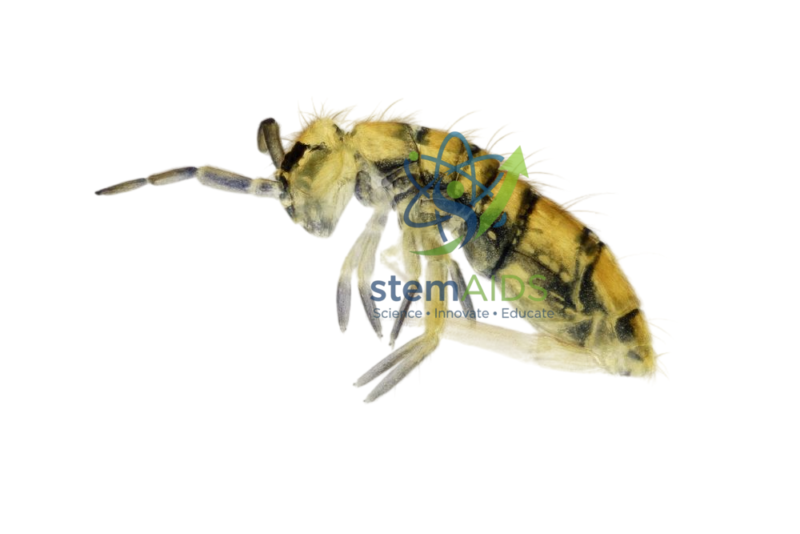
Quick Answer: Microfauna Mesofauna Biodiversity of a Soil in Microtubes is a collection of soil mesofauna specimens and smaller microfauna held in individual microtubes, for studying soil biodiversity under a stereo microscope. Students use it to recognise groups commonly found in soil, such as mites and springtails, and to learn what these animals do.
Soil Life Too Small to Notice
A handful of healthy soil holds a hidden community. Ecologists group soil animals by body size: microfauna, under about 0.1 mm, include nematodes, rotifers and protozoa, while mesofauna, roughly 0.1 to 2 mm, are dominated by mites and springtails, alongside pseudoscorpions, small insect larvae and others. These animals shred leaf litter, graze on fungi and bacteria and so speed up the recycling of nutrients.
Catching and sorting them from fresh soil takes time, usually a Berlese-Tullgren funnel left to run for several days. A reference set in microtubes gives students specimens they can examine straight away, one group per tube, so they learn to recognise features such as the forked jumping organ, or furcula, under the abdomen of a springtail, or the eight legs of an adult mite, before they sort a live sample.
The listing does not state which species or groups are included, how many tubes there are, or what preserving liquid is used, so confirm those details. For a live extraction to compare with the set, see fresh moss for extracting microfauna.
Using the Microtube Collection
- Practising identification of soil animal groups before a field survey
- Biodiversity lessons comparing the variety of soil life in different habitats
- Teaching food webs and decomposition in soil ecology
- Microscope practicals on arthropod features such as legs, antennae and body segments
Care & Handling
- Keep the microtubes closed, and if the specimens are stored in alcohol, keep them away from flames and heat.
- View specimens through the tube wall, or move them briefly to a watch glass with a little of their own liquid and return them straight after.
- Store the collection upright, in the dark and at room temperature, to limit evaporation and fading.
Specifications
| Contents type | Small soil animals held in microtubes |
| Size groups | Microfauna and mesofauna, as named in the title |
| Groups commonly found in soil | Mites, springtails, pseudoscorpions, small insect larvae |
| Viewing | Stereo microscope or strong hand lens |
| Species list, number of tubes and preservative | Confirm at enquiry |
Why Choose LabEquip
Ecology teachers, field centres and university soil-biology courses use reference specimens so students can recognise animals quickly in live samples. The collection is in LabEquip’s biology lab products, and the groups included can be confirmed through the contact page.
Frequently Asked Questions
What is the difference between soil microfauna and mesofauna?
The split is by body width. Microfauna are below about 0.1 mm and include nematodes, rotifers and protozoa. Mesofauna are roughly 0.1 to 2 mm and are mainly mites and springtails. Earthworms and larger beetles count as macrofauna.
How can students tell a mite from a springtail?
Adult mites have eight legs and a rounded body that looks like one unit, because they are arachnids. Springtails have six legs, antennae and, in many species, a forked jumping organ folded under the abdomen.
Why are these small animals important in soil?
They break leaf litter into smaller pieces, feed on fungi and bacteria and release nutrients that plants can take up. Their activity also mixes organic matter into the soil and helps build its crumb structure.
What equipment is needed to view the specimens?
A stereo microscope at low to medium magnification is ideal, because it gives a three-dimensional view of whole animals. A strong hand lens shows the larger mesofauna, but nematodes and rotifers need a compound microscope.
How are soil animals extracted from a live sample?
A Berlese-Tullgren funnel is the usual method: soil sits on a mesh under a lamp, and as it dries from the top the animals move down and drop into a collecting tube. Nematodes are extracted from wet samples with a Baermann funnel.
Can the specimens be used to calculate a biodiversity index?
They are a reference set for identification, not a sample from one site. Students first learn the groups with the collection, then count animals from their own soil samples to calculate a diversity index.
Last Updated: September 2026




Reviews
There are no reviews yet.