
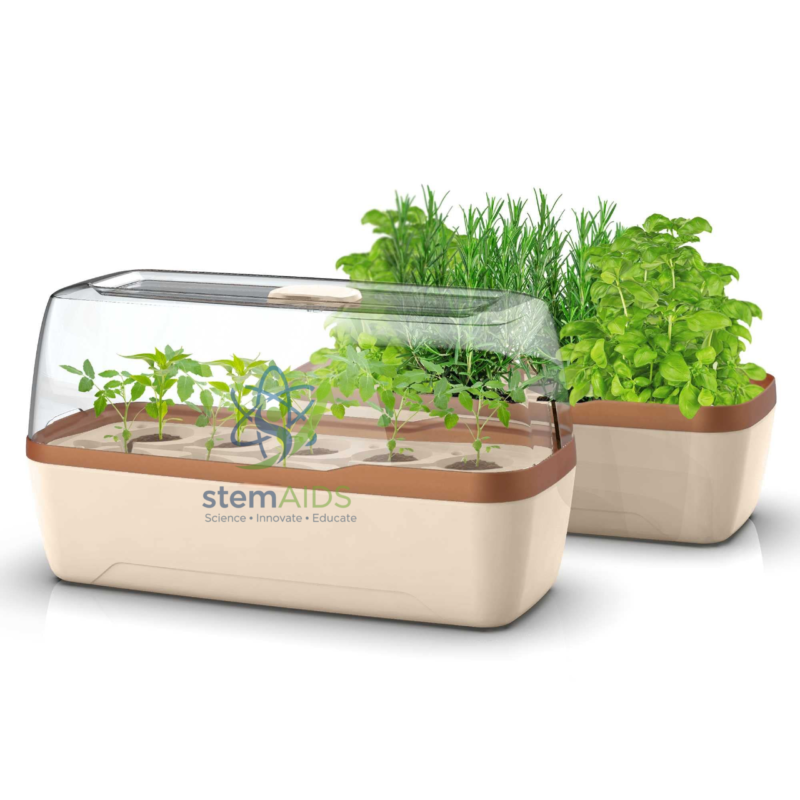
Quick Answer: The Indoor Greenhouse BoQube is a compact indoor greenhouse: a planting base under a transparent cover, in which seeds germinate and seedlings grow in warm, humid air. Classrooms use it to watch germination and early plant growth up close through the year.
Growing Plants Indoors with the BoQube
BoQube is the product’s own name, and in the product photo it is a compact unit: a pale planting base with a transparent cover, beside a second unit full of grown herbs. The cover traps moisture and a little warmth, so the air around the seeds stays humid while roots and first leaves form. Once seedlings are established, the cover is lifted for longer spells so the plants adapt to drier room air.
Indoors, light is usually the limiting factor. A bright windowsill that does not get hot midday sun, or a plant grow light, keeps seedlings short and sturdy. Without enough light they stretch towards the window, turn pale and flop over, a response called etiolation that is worth showing a class in its own right. Turning the unit a quarter-turn each day evens out the growth.
For comparison, a mini greenhouse is a simpler seed tray with a vented lid.
Specifications
| Product name | BoQube indoor greenhouse |
| Design shown in the product photo | Planting base with a transparent cover |
| Use | Germinating seeds and raising seedlings indoors |
| Placement | Bright windowsill out of hot sun, or under a grow light |
Classroom Investigations
- Recording germination day by day and measuring seedling height
- Showing phototropism by lighting seedlings from one side
- Comparing growth in light and dark to demonstrate etiolation
- Growing herbs or salad leaves for lessons on food and plant nutrition
Care & Handling
- Wipe condensation from the inside of the cover every day or two, and ventilate if mould appears on the surface.
- Water gently so the medium stays moist but never waterlogged, since standing water rots seeds.
- Wash the base and cover with warm soapy water between sowings and rinse well, so disease does not carry over to the next crop.
Why Choose LabEquip
Primary classes, science clubs and biology departments without a school greenhouse use an indoor unit like the BoQube to keep plants in view all term. It is listed in LabEquip’s biology lab products; ask about sizes and quantities through the contact page.
Related Products
- Mini Greenhouses: A seed-raising propagator with a clear domed cover and vents, for running more trays alongside the BoQube.
- Biodegradable Pot: Biodegradable pots for moving seedlings on from the greenhouse and planting them out without disturbing the roots.
- Trigger Sprayer 1L: A 1-litre trigger sprayer for misting seeds and compost gently without washing them out of place.
- Thermometer, Digital, Indoor-Outdoor: A digital indoor-outdoor thermometer to log the temperature under the cover against the room air.
- Hortiswitch Programmable Thermostat for Growing Greenhouse: A programmable thermostat that controls heaters, heat mats or fans for keeping growing areas at a set temperature.
Frequently Asked Questions
What is the BoQube indoor greenhouse used for?
The BoQube is a compact indoor greenhouse: a planting base under a transparent cover that keeps the air around seeds warm and humid. It is used to germinate seeds and raise seedlings indoors, and in a classroom it lets students watch roots and first leaves appear through the cover over the following days.
When should the cover come off an indoor greenhouse?
Keep the cover on until most seeds have germinated, then start lifting or venting it for longer each day once the first true leaves appear. This hardens the seedlings to drier room air. Leaving the cover closed for too long keeps the air saturated and encourages mould and damping off.
Where should an indoor greenhouse be placed in a classroom?
A bright windowsill out of hot midday sun is ideal, because a closed cover traps heat and can overheat seedlings in direct sun. Under a grow light also works well. Keep it away from radiators and cold draughts, and turn it daily if the light comes from one side so the seedlings grow straight.
Why are my seedlings tall, thin and leaning towards the window?
Seedlings that get too little light stretch upwards quickly, making long, weak stems with pale leaves. Leaning is phototropism: the stem grows towards the strongest light. Moving the greenhouse to brighter light, adding a grow light or turning it daily gives shorter, sturdier seedlings.
Which seeds germinate quickly enough for a classroom demonstration?
Cress, mustard and radish usually show roots and shoots within a few days, and mung beans, peas and broad beans are large enough for students to watch the seed coat split. Choosing fast seeds means a class can record germination within a week or two and compare conditions such as light and water.
What makes seedlings collapse at soil level and how can it be prevented?
This is damping off, caused by soil fungi and fungus-like organisms that thrive in wet, still and crowded conditions. Use clean containers and fresh compost, sow thinly, water moderately from below and open the cover regularly for air. Once a seedling has collapsed it cannot be saved.
Last Updated: November 2026





Reviews
There are no reviews yet.