
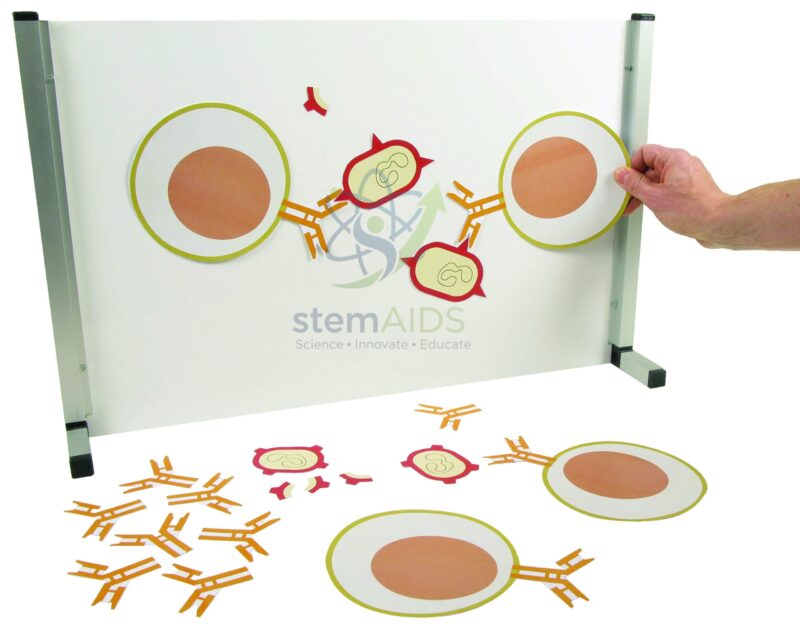
Quick Answer: The Immunology Demonstration Group is an immunology demonstration set: a group of display pieces representing immune cells, antibodies and antigens that a teacher arranges on a board to show how the body recognises and fights infection. It is used in biology lessons on immunity, antibodies and vaccination.
Building an Immune Response on the Board
Immunology is full of interactions that are hard to show in a textbook diagram, and movable pieces let the teacher build each step in front of the class. The product photo shows round cells with nuclei, Y-shaped antibodies and smaller antigen-bearing particles arranged on a white board; group in the title most likely means a set of pieces for demonstrating to a group.
A typical sequence starts with a pathogen carrying antigens entering the body. Phagocytes engulf and digest it and display its antigens, helper T cells recognise them, and the B cell whose receptors match the antigen is activated. That B cell divides into many plasma cells releasing antibodies, a process called clonal selection, while some of its offspring become memory cells. Each antibody is a Y-shaped protein with two identical binding sites at the tips of its arms, so antibodies can clump pathogens together for phagocytes to remove.
The same pieces explain vaccination. A vaccine presents harmless antigens so memory cells form without illness; on a later infection the secondary response is faster and larger, and the pathogen is cleared before symptoms develop. Many of these cells gather in lymph nodes, shown in detail on the human lymph node model.
Lessons It Supports
- Antigen and antibody specificity: why each antibody fits one antigen
- Primary and secondary immune responses and the role of memory cells
- How vaccines work and why booster doses are given
- Agglutination, and how antibody-antigen reactions are used in blood grouping and rapid tests
Care & Handling
- Store the pieces flat in labelled envelopes or trays by type, so cells, antibodies and antigens can be laid out quickly.
- Clean with a dry or slightly damp cloth, and keep the pieces away from heat and direct sunlight, which can warp or fade them.
- Make sure the board surface is clean before a demonstration so the pieces sit flat and stay in place.
Specifications
| Type | Demonstration pieces for teaching the immune response |
| Pieces shown in the product photo | Cells with nuclei, Y-shaped antibodies, antigen-bearing particles |
| Topics | Antigens, antibodies, phagocytosis, B and T cells, memory, vaccination |
| Use | Teacher-led board demonstration for a whole class |
Why Choose LabEquip
Biology teachers use a board set like this when immunity is on the syllabus and the class needs to see the sequence built step by step. It is listed in LabEquip’s biology lab products; to check the piece count and mounting, use the contact page.
Related Products
- Immune System Education Kit: A boxed immune system kit for student activities on barriers, phagocytosis, antibodies, lymphocytes and vaccination.
- Double Immunology Poster: A double immunology poster that keeps the stages of the immune response on the wall after the board demonstration.
- Synthetic blood: Synthetic blood for blood-typing simulations, where students see the agglutination reaction described in this lesson.
- Human Lymph Node: A lymph node model showing where lymphocytes meet antigens in the cortex and follicles.
- Lymphatic System: A lymphatic system model to show where lymph nodes and lymphoid organs sit in the body.
Frequently Asked Questions
How is an immunology demonstration set used on the board?
The teacher builds an immune response step by step with the pieces: a pathogen carrying antigens arrives, a phagocyte engulfs it, a lymphocyte with a matching receptor is activated and Y-shaped antibodies attach to the antigens. Because the class sees each step added in order, the sequence is easier to follow than in a single diagram.
What is an antigen and where is it found on a pathogen?
An antigen is a molecule, usually a protein or carbohydrate, that the immune system recognises as foreign. Antigens sit on the surface of bacteria, viruses and other cells, and toxins can act as antigens too. Each has a particular shape, and antibodies are made to fit that shape.
Why are antibodies shown as Y-shaped pieces?
An antibody molecule really is roughly Y-shaped: four protein chains held together, with an antigen-binding site at the tip of each arm. Having two binding sites lets one antibody link two antigens, and the stem of the Y can attach to phagocytes, helping them recognise and engulf the target.
What is the difference between B cells and T cells?
Both are lymphocytes made in the bone marrow. B cells make antibodies that circulate in the blood and lymph. T cells mature in the thymus: helper T cells release signals that activate B cells and phagocytes, and cytotoxic T cells destroy body cells that are already infected with a virus.
What is agglutination in an immune response?
Agglutination is the clumping of cells or particles when antibodies bind to antigens on several of them at once, linking them together. Clumped pathogens cannot spread as easily and are easier for phagocytes to engulf. The same reaction is used in blood-group testing, where red cells clump in the matching antiserum.
Why is the second immune response to the same pathogen faster?
During the first infection, some activated lymphocytes become long-lived memory cells. On a second exposure they recognise the antigen at once, so antibody production starts sooner, rises higher and lasts longer. The pathogen is usually destroyed before symptoms appear, which is the principle behind vaccination.
Last Updated: November 2026




Reviews
There are no reviews yet.