
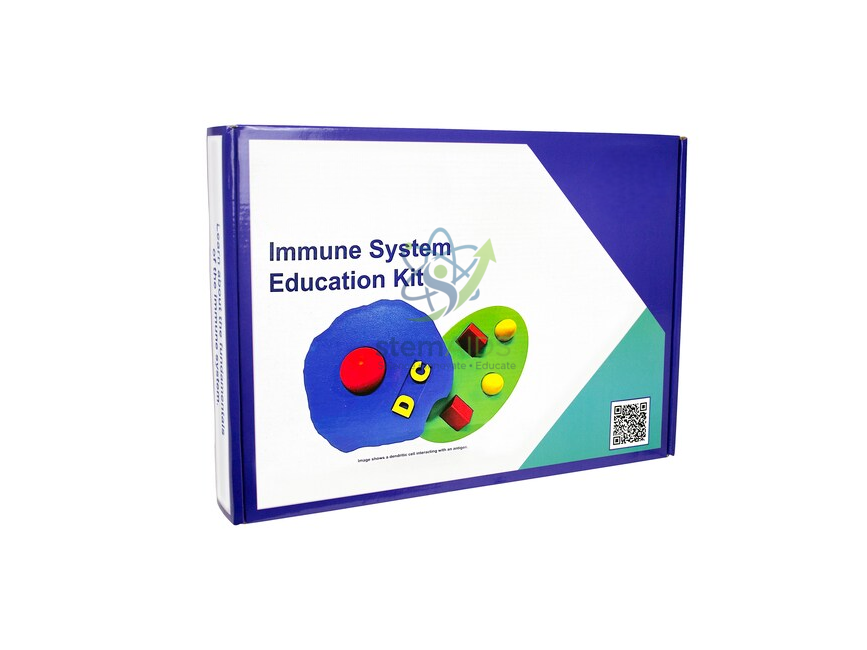
Quick Answer: The Immune System Education Kit is a boxed biology teaching kit for lessons on how the body defends itself against infection.
What the Kit Helps Students Understand
The immune system is taught in layers. The first line of defence is physical and chemical: skin, mucus, cilia, stomach acid and enzymes in tears keep most microbes out. The second is the innate response: white blood cells called phagocytes engulf and digest invaders, and inflammation brings more of them to an infected site. The third is the adaptive response, carried out by lymphocytes. B cells release antibodies that fit the shape of one particular antigen, and T cells help coordinate the response or destroy infected cells directly.
Hands-on kits are especially useful for the idea of specificity, which students often find abstract. Matching antibody shapes to antigen shapes shows why an antibody against one virus does not protect against another, and how antibodies clump pathogens together so that phagocytes can remove them. The same activity leads into immune memory: after a first infection or a vaccine, memory cells remain, so a second encounter produces a faster, larger antibody response.
The human lymph node model gives a structural view of where lymphocytes gather.
Applications
- Introducing the three lines of defence against infection
- Modelling antibody and antigen specificity with shape-matching activities
- Explaining primary and secondary immune responses and vaccination
- Health-education sessions on how infections spread and are controlled
Care & Handling
- Keep the kit’s pieces and any guide together in the box, and check contents at the end of each lesson.
- Wipe reusable pieces with a damp cloth and let them dry before packing them away.
- Store the box flat and dry so printed parts do not warp or fade.
Specifications
| Item | Boxed teaching kit on the human immune system |
| Topics | Barriers, phagocytosis, antibodies and antigens, lymphocytes, vaccination |
| Format | Printed box with illustrated cover (listing photograph) |
| Level | Secondary biology and health science |
Why Choose LabEquip
Biology and health-science teachers use kits like this to make an abstract topic concrete for group work. LabEquip lists the kit in Biology Lab Products alongside anatomy models of the lymphatic system. Ask for a contents list through the LabEquip contact page before ordering class quantities.
Related Products
- Immunology Demonstration Group: A teacher-led board set of cells, Y-shaped antibodies and antigen particles for whole-class demonstration of the same topics.
- Double Immunology Poster: A double poster covering innate defences, phagocytosis, lymphocytes, antibodies and immune memory for wall reference.
- Human Lymph Node: A lymph node model showing the cortex with follicles where lymphocytes meet antigens and multiply.
- Lymphatic System: A lymphatic system model with lymph vessels, node groups and lymphoid organs such as the spleen and thymus.
- Chart On Aids, School Education: A chart on HIV and AIDS for lessons on how an infection that targets the immune system spreads and is prevented.
Frequently Asked Questions
What topics does an immune system education kit cover?
This boxed teaching kit is built around how the body defends itself: physical barriers, phagocytosis, antibodies and antigens, lymphocytes and vaccination. It is aimed at secondary biology and health science, where students need to follow the sequence from keeping microbes out to building long-term immunity.
What are the body’s first-line barriers against infection?
The skin forms a tough outer barrier, and mucus with beating cilia traps and sweeps microbes out of the airways. Stomach acid kills many swallowed microbes, and enzymes such as lysozyme in tears and saliva break down bacterial cell walls. Only microbes that get past these meet the white blood cells.
How do phagocytes destroy bacteria?
A phagocyte recognises a bacterium as foreign, flows around it and engulfs it in a vacuole. Lysosomes then fuse with the vacuole and release enzymes that digest the bacterium. Inflammation at an infected site draws in more phagocytes, and pus is largely made of dead phagocytes and the remains of microbes.
Why does each antibody only attach to one kind of antigen?
The tips of an antibody’s arms have a shape that fits one particular antigen, much like a lock and key. Each B lymphocyte makes antibodies with just one such shape, so only the B cells that match a newly arrived antigen are selected, multiply and produce large amounts of that antibody.
How does a vaccine give long-lasting immunity?
A vaccine presents the immune system with a harmless form of an antigen, such as a killed or weakened microbe or one of its proteins. The body makes a primary response and keeps memory cells. If the real pathogen arrives later, the memory cells trigger a faster and larger response that usually stops illness developing.
How can herd immunity be explained in an immune system lesson?
When a large share of a population is immune, an infected person meets few people the pathogen can infect, so chains of transmission break down. This also protects people who cannot be vaccinated, such as young babies. Class simulations in which students pass on cards or tokens show how vaccination slows the spread.
Last Updated: November 2026




Reviews
There are no reviews yet.