






















In Stock
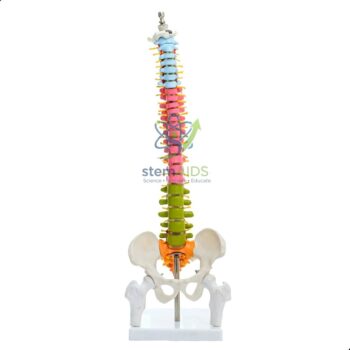
Human Skeleton Model, Mini
Advanced Articulation Dynamics: Features a removable calvarium for internal cranial study and a spring-loaded, mobile mandible to demonstrate basic temporomandibular joint (TMJ) movement.
Morphological Scaling Precision: Engineered with a 1:4 scale ratio using high-density, non-toxic PVC that maintains the forensic integrity of all 206 bones, including detailed spinal nerve exits.
$19.74
Quick Answer: The Human Skeleton Model, Mini is a mini skeleton model: a scaled-down whole-body skeleton small enough to stand on a desk or be passed around a class, used to introduce the main bones and the overall layout of the skeletal system.
A Small Skeleton for Large Classes
A full-size skeleton usually stays at the front of the room, and pupils at the back see little. A mini skeleton model can move around: a group can hold it, turn it and point to bones at arm’s length, and several can be spread across desks at once. That makes it well suited to younger classes and to introductory lessons where the aim is the overall plan of the body rather than fine detail.
At small scale the main bones remain recognisable: skull, spine with its curves, rib cage, shoulder and pelvic girdles, and the long bones of the arms and legs. Teachers use it for labelling tasks, for showing how the skeleton supports, protects and allows movement, and for comparing body proportions, such as how the fingertips reach to mid-thigh or how the rib cage encloses the chest. The small bones of the hands, feet and ear cannot be shown in detail at this size.
The listing does not state the height, the material or whether any parts can be removed, so confirm these before ordering. For more detailed study, the economy human skeleton model is a whole-body option in the same range.
Applications
- Primary and middle-school lessons introducing the skeleton
- Labelling and quiz activities with small groups at their desks
- Revising bone names before handling a full-size or disarticulated skeleton
- Health and physical-education talks on posture and bone health
Looking After the Mini Skeleton
- Pick up the mini skeleton model by its base or pelvis; thin limbs and ribs snap if it is lifted by an arm.
- Keep it away from desk edges during group work and set a rule that it is passed from hand to hand.
- Store it in its box or a cupboard between lessons, since small skeletons are easily knocked over and lost parts are hard to replace.
Specifications
| Model of | Whole human skeleton, reduced size |
| Scale | Reduced (mini) size for desk use |
| Detail level | Main bones and body plan; fine detail limited by scale |
| Typical users | School classes, small groups, individual desks |
| Height, material and removable parts | Confirm at enquiry |
Why Choose LabEquip
Schools often buy mini skeletons in several copies so every group can work with one, alongside a single full-size skeleton for the whole class. LabEquip lists this model in biology lab products; use the contact page to confirm size and quantities.
Frequently Asked Questions
What is a mini skeleton model used for?
Introductory lessons on the skeleton, labelling exercises and small-group work where a full-size model would be impractical to pass around. It shows the overall plan of the body rather than fine bone detail.
Is a mini skeleton accurate enough for anatomy courses?
It is suitable for learning the main bones and their positions. Medical, nursing and physiotherapy courses need life-size or disarticulated bones to study landmarks, joint surfaces and muscle attachments.
What are the main functions of the skeleton?
Support, protection of organs, movement through joints and muscle attachments, blood cell formation in the red marrow, and storage of minerals such as calcium and phosphate.
Which bones should pupils learn first?
A common starting list is the skull, spine, ribs, sternum, clavicle, scapula, humerus, radius, ulna, pelvis, femur, patella, tibia and fibula. These are large enough to find on a mini model.
How can a mini skeleton be used in a lesson?
Groups can label bones with sticky tags, find joints that move in different ways, or compare the model with their own bodies, feeling the collarbone, kneecap and spine while locating the same bones on the model.
How is the mini model different from the economy skeleton?
The mini model is a reduced-size skeleton for desks and small groups. The economy model is a whole-body skeleton for classroom display and more detailed teaching of individual bones and joints.
Last Updated: September 2026
You must be logged in to post a review.
Bestsellers




Reviews
There are no reviews yet.