


In Stock
Glass Coverslips
₹569.00
Quick Answer: Glass coverslips are very thin squares or circles of glass placed on top of a mounted specimen. They flatten the mount, keep liquid off the objective lens and give the even glass thickness that microscope objectives are designed to look through.
Why Coverslip Thickness Matters
A coverslip is part of the optical path, not only a lid. The high-power objectives on most biological microscopes are designed for a cover glass about 0.17 mm thick, and many are engraved with that figure. Coverslips of the right thickness give the sharpest image at 40x and above; noticeably thicker ones can blur fine detail, and very thick glass may stop a short-working-distance objective from focusing at all.
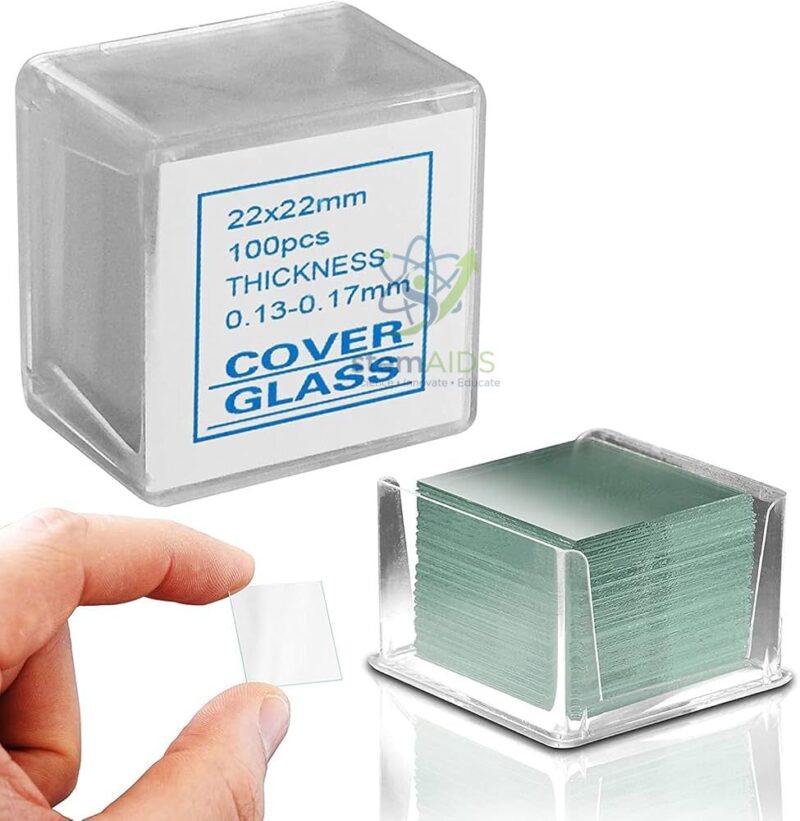
For that reason coverslips are sold in thickness grades. The common No. 1 grade is slightly thinner and suits general class work, while No. 1.5, centred close to 0.17 mm, is preferred for high-magnification and photographic work. The product photo shows square coverslips packed in a clear plastic box, but the listing title does not give the size, shape or thickness grade.
In routine practicals the coverslip does three practical jobs: it spreads the liquid of a wet mount into a uniform film, so the entire field of view focuses at once; it slows evaporation; and it stops stain and water reaching the front lens of the objective. For buyers who need a particular format, LabEquip also lists micro cover glasses in square, circular and rectangular shapes.
Specifications
| Item | Glass cover glasses (coverslips) for microscope slides |
| Packing (from product photo) | Square coverslips in a clear plastic box |
| Function | Flattens mounts, prevents drying, protects the objective lens |
| Optical note | High-power objectives are commonly corrected for about 0.17 mm cover glass |
| Size, shape and thickness grade | Confirm at enquiry |
Where Coverslips Are Used
- Covering wet mounts of onion peel, cheek cells, pond water and algae
- Permanent slides mounted in Canada balsam or DPX
- Hanging-drop preparations on concavity slides
- Squash preparations of root tips for mitosis
Handling Thin Glass
- Pick up glass coverslips by the edges with fine forceps or a moistened fingertip; they crack if bent.
- Keep the box closed so coverslips stay dust-free and do not stick together in humid air.
- Clean before use, if needed, by dipping in alcohol and drying on lint-free tissue.
- Dispose of broken coverslips in a glass or sharps container; the fragments are hard to see and cut easily.
Why Choose LabEquip
Coverslips are ordered alongside slides by every school, college and pathology lab that mounts specimens, often in large quantities per term. LabEquip supplies them through its biology lab products range; send the size and thickness you need through the contact page.
Frequently Asked Questions
Which coverslip thickness grade should I choose?
For general class work, No. 1 coverslips are widely used. For high-power, oil-immersion or photographic work, No. 1.5 coverslips, close to 0.17 mm, match the correction of most objectives and give sharper images. The thickness grade of this listing should be confirmed at enquiry.
How do I lower a coverslip without trapping air bubbles?
Touch one edge of the coverslip to the drop at an angle of about 45 degrees and let the liquid spread along that edge. Then lower the other side slowly with a mounted needle so the liquid pushes the air out ahead of it.
Why do I need a coverslip at all?
Without one, the liquid mount has an uneven, curved surface that distorts the image, it evaporates quickly and it can touch and contaminate the objective lens. The coverslip flattens the specimen and gives the objective a flat glass surface to look through.
Can glass coverslips be reused?
They can be cleaned and reused for simple wet mounts, but they are fragile and easily scratched, so most teaching labs treat them as consumables. Coverslips used with microbes or body fluids should be disinfected and discarded.
When are round coverslips used instead of square ones?
Round coverslips fit into the wells of culture plates, where cells are grown directly on the glass and later mounted on a slide. Square and rectangular coverslips are the usual choice for routine slides and sections.
Why do coverslips stick together in the box?
Moisture and static make thin glass sheets cling. Keep the box closed and dry, and separate coverslips by sliding the top one off sideways rather than prising them apart.
Last Updated: September 2026
You must be logged in to post a review.
Bestsellers




Reviews
There are no reviews yet.