












In Stock
Fermentation Tubes
$1.35
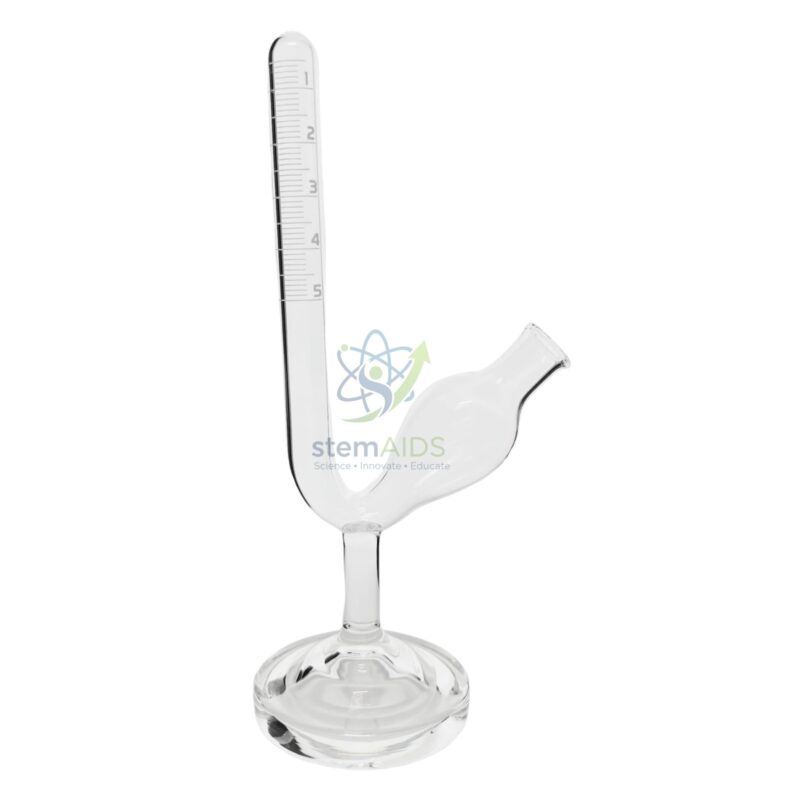
Quick Answer: Fermentation tubes are upright vessels with a closed, graduated vertical arm joined at the base to an open bulb, used to collect and measure the gas given off when yeast or bacteria ferment a sugar solution. The listing photograph shows this closed-arm and bulb design standing on a round foot.
Measuring Fermentation by the Gas It Makes
When yeast ferments sugar without oxygen, it produces ethanol and carbon dioxide. Fermentation tubes turn that gas into a number. The closed arm is filled completely with the yeast and sugar mixture, with no air bubble at the top. As fermentation starts, carbon dioxide rises and collects at the top of the closed arm, pushing liquid down and back into the open bulb. The graduations on the arm show how much gas has formed, so students can take readings at intervals and plot gas volume against time.
That makes the tubes ideal for comparing conditions. Setting up several side by side, students can test different sugars, sugar concentrations, temperatures or amounts of yeast, and include controls with no yeast and no sugar. Glucose, fructose and sucrose ferment readily with baker’s yeast; lactose generally does not, and starch has to be broken down first, which makes a neat demonstration of enzyme specificity.
In microbiology the same idea is used to test whether bacteria produce gas from a particular sugar. Laboratories often use a small inverted Durham tube inside a broth tube for this; fermentation tubes of this design give a larger, measurable volume for class work. The material, capacity and graduation interval are not stated in the title.
Applications
- Comparing how quickly yeast ferments different sugars
- Studying the effect of temperature on the rate of fermentation
- Testing bacterial cultures for gas production from sugars
- Controlled experiments with no-yeast and no-sugar tubes
Care & Handling
- Wash the tubes soon after use with a bottle brush and warm detergent before yeast residue dries on the walls.
- Rinse several times with clean water, since traces of detergent slow the next fermentation.
- Stand the tubes on their feet in a tray while filling and reading, and store them upright.
Specifications
| Item | Tube for collecting and measuring fermentation gas |
| Design | Closed graduated arm joined to an open bulb, on a foot (listing photograph) |
| Organisms | Yeast; bacteria in microbiology practicals |
| Measurement | Gas volume read on the closed arm over time |
| Material, capacity and graduations | Confirm at enquiry |
Why Choose LabEquip
Biology departments buy fermentation tubes in sets so several conditions can run side by side in one lesson. LabEquip lists them in Biology Lab Products; for microbiology versions of the practical, metal inoculating loops transfer the bacteria. Tell us how many sets you need through the LabEquip contact page.
Frequently Asked Questions
How does a fermentation tube measure gas?
The closed arm starts completely full of liquid. Gas made by the yeast or bacteria rises and collects at the top of the arm, pushing liquid into the open bulb. The volume of gas is read from the graduations on the arm.
How do I fill the tube without trapping air?
Pour the mixture into the bulb, then tilt the tube so liquid runs into the closed arm and air escapes. Stand it upright again and top up the bulb until the arm is completely full.
Which sugars does yeast ferment?
Glucose, fructose, sucrose and maltose ferment readily with baker’s yeast. Lactose usually does not, and starch must first be broken down to sugars.
What temperature should the experiment run at?
Yeast ferments well in warm conditions, roughly body temperature or slightly below. Very high temperatures kill yeast, and cold slows it, so a temperature series makes a useful investigation.
How is a fermentation tube different from a Durham tube?
A Durham tube is a tiny inverted tube placed inside a broth tube to show whether gas forms. A fermentation tube collects a larger, measurable volume, which suits classroom rate experiments.
How can students show that the gas is carbon dioxide?
Draw some gas off with a syringe and bubble it through limewater, which turns milky. Alternatively, the teacher can add a little dilute sodium hydroxide solution to the bulb, stopper it and tip the tube gently; the carbon dioxide is absorbed and the liquid rises back up the arm.
Last Updated: September 2026
You must be logged in to post a review.
Bestsellers




Reviews
There are no reviews yet.